
Why Paithani saris are big in Bollywood and beyond
Bollywood actresses love their Paithani saris from this little-known town
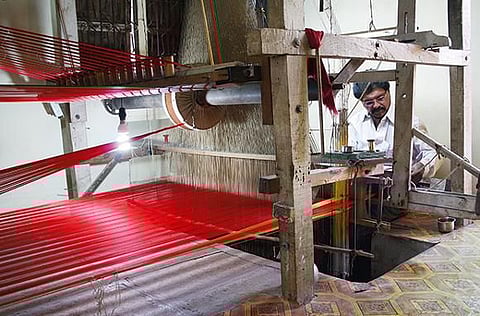
Shashikant Dhalkari leans back and looks at his work. On a large sheet of paper is a fantastic sketch of a spectacularly coloured dancing peacock in the midst of richly hued leaves and flowers. Shashikant cocks his head and looks at the design, then goes back to fine-tuning the image. Once he is satisfied, he picks it up and walks over to the loom in his home in Paithan, in the Indian state of Maharashtra.
Creating the design for a Paithani sari – which took him around three days – is just the tip of the iceberg. And relatively easy. The more intricate job is yet to begin. Fishing out skeins of brocade and coloured threads from a cupboard, he begins to painstakingly recreate the design into a sari on his manual loom, one thread at a time.
“The task of preparing the loom can take anywhere between 10 days to three weeks depending on how intricate the sari’s pattern is,” he says. Once the loom is prepared with the silk threads, work begins on weaving, and some two months later, a spectacular Paithani sari that will go on to be an heirloom, is ready.
Ranging in price from anywhere between Rs7,000 (Dh416) to Rs700,000 (Dh41,600), the saris made in this little town in Maharashtra are much in demand, not just in India but across the world, and has the crème de la crème of Bollywood celebrities including Shilpa Shetty, Kirron Kher and Malaika Arora-Khan queuing up to place an order for one.
In fact, when Bollywood star Genelia D’Souza decided to marry Riteish Deshmukh, she had no doubts about the sari she would be wearing on her big day. It had to be a red Paithani one, designed by Neeta Lulla. Stars such as Dimple Khanna and Kajol too have worn Paithani saris for their marriage ceremonies. And they’re not the only ones.
The dazzling, richly woven, multi-hued Paithani saris have traditionally been a part of the wedding trousseau of every Maharashtrian bride, including the elite, industrialists and political families. Each Paithani sari is about six metres long and includes a piece of material for a blouse.
The main feature of the sari is its border and the pallu (the loose end of the sari), which is richly decorated with motifs woven with gold and silver threads. Apart from the extensive use of silk threads, what makes a Paithani sari so unique are the motifs used and the combinations that are created by interweaving yarns of different colours, an art that is mastered after much practise. The body of the sari is most often plain or has tiny motifs of lotus flowers, a dancing peacock or small parrots.
Weaving Paithani saris has been a tradition in the Dhalkari family for over a century. Shashikant, the fourth generation continuing with the art, is not alone. More than 20 of his family members, including his wife and three children, are involved in making these saris in the small town.
“The more than 2,000-year-old art remains the pride of our town Paithan, and the saris we weave are considered some of the most expensive in the world,” he says.
Paithan village has a cultural history of over 2,500 years. Several arts originated and thrived in the region, but over time most were forgotten. Paithani was one of the few that survived, mostly because of royal patronage. From the Peshwas – the rulers of the region – to the Nizams of Hyderabad and the Mughals, Paithani saris were everybody’s favourite. According to local historians, in the olden days Paithani saris were worn only by the royal and aristocratic families. It is said to have originated 2,200 years ago in Pratishthan, a village whose name over the years got corrupted to Paithan.
Shashikant, who is in his forties, says, “The art survived only because it was passed down from one generation to the next.” The Dhalkari family has 22 members working in this field. “Several of the youngsters have completed their graduation and post-graduation but are also learning the art of weaving these saris.”
In ancient times, a Paithani was only woven out of the finest silk, gold and silver threads. While gold and silver are rarely used these days and are made to order, the technology employed in the making of the sari has remained largely unchanged. “Natural dyes like coal soot, the sap of certain plants and trees, juices of leaves and certain kinds of mud are used to colour the threads,” says Shashikant.
The manufacturers procure silk from Bengaluru, in Karnataka, considered the home of the best silks in India, and silver threads from Surat, in Gujarat. The raw silk is cleansed and dyed in the chosen shades and the thread prepared for the loom. The women of the house generally handle the preparation of the threads while the men work on the looms.
“The cost of a sari is high, because apart from the expensive threads, it takes an excruciatingly long period to weave just a few square inches of the sari. There have been occasions when it has taken up to a year to make one sari,” says Shashikant.
The efforts reflect in the longevity of the Paithani. A sari, that weighs just around a kilo, often lasts decades and is handed down from one generation to another.
“I was only 11 years old when I began working and after completing class 8, joined the business full-time,” says Shashikant. “My father, who is 90, still occasionally helps me at the loom.
“We get recognition and respect as artists and hence feel it’s better to join the family business, rather than take up jobs.”
Shashikant and his extended family work on six looms and produce around eight saris a month. Apart from regular buyers from Mumbai, Delhi and Hyderabad, they have a long celebrity list including politicians and corporate heads.
So highly respected are the saris that the Dhalkari family was presented with the Indian President’s Award for Paithani weaving in 1993 for helping preserve a dying craft.
One of the younger members of his family, Neha Dhalkari, who was initiated into the art of weaving after her marriage to Sudesh, says, “I’m passionate about learning the weaving techniques and rush through my household chores so I can spend more time at the loom.”
She and her husband, who works in a nearby factory, labour at the loom every day. “When two people work we are able to finish a sari in a shorter time,” she says. Another weaver, Shashikala, says, “The light-and shade effect on a Paithani is not easy to achieve and can be done only by a trained weaver. This is a secret art that is known only to a few weavers in this town.” She has passed on her skills to her two sons, who are keen to continue the legacy.
She remembers creating a Paithani in silver some eight years ago. “It was for a celebrity who I cannot name. It took us almost two-and-a-half years to complete and cost around Rs300,000,” she says.
Of late, some top Indian designers have begun to offer customised Paithani saris for the discerning buyers. This has added to the revival of the ancient craft, which was considered in danger of dying out a few decades ago.
Eknath Bhonsale, now in his mid-30s, has been involved in the art of making Paithani saris for the last two decades. Accompanying his mother to a centre, he learnt the art of weaving at an early age. He says: “The saris that I create takes over two months to complete and we sell them for around Rs20,000 each, a tidy sum for us.” The most expensive sari that the mother-son duo have made till date was worth Rs80,000.
“But the middleman sold it for Rs100,000 making a huge profit.”
Encouraged by the dedication of the local weavers, the Maharashtra government set up the only Paithani training centre in the country. Presently providing training to more than 200 destitute and underprivileged women, the art helps them earn a livelihood. The women are paid a stipend and also provided incentives for setting up a loom in their homes and weaving saris.
The centre, which started with six looms in 1973, has over the years increased its capacity to 200 looms, with a showroom on its campus. It produces about 400 saris in the range of Rs20,000 to Rs200,000.
“There are times when some top celebrities come to place the order, but seeing the vast variety of exquisite saris available at the store, instantly buy two or three,” a salesman at the showroom says.
Although modern dresses are increasingly worn by women during festive occasions, saris continue to attract the attention of the culture connoisseur. And it is here that the Paithani rules the roost.


