
Simon Majumdar, the Iron critic
Friday meets the TV food star who turned his life from nervous breakdown to fine dining
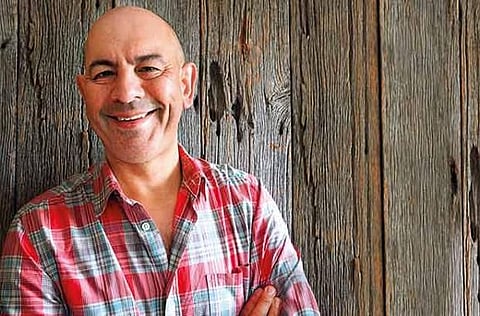
Can food be a peacemaker in these contentious times? It’s a lofty ideal, but Simon Majumdar believes in it.
‘You can’t say to someone, “I hate you and I hate your religion and I hate your politics but could you pass the potatoes,”’ he tells me as we sit in a small ballroom in Abu Dhabi, where a buffet of dishes sits, slightly picked over by conference guests, behind us.
‘You have to be civil, and it promotes civility and it enables discussion.’
Food – Lebanese and Indian cookery, to be exact – has been life-changing for the TV pundit and author, so it might be worth hearing him out.
Simon found his calling to the world of food commentary relatively late. Running a failing business in London, he found himself on the verge of a nervous breakdown, steps away from a balcony edge.
Ten years later, he’s crisscrossed the world, eaten at the best (and worst) restaurants to be found, written books, gotten married, appears on TV shows that are broadcast around the world – and has the liberty of turning down said TV shows if he and his wife want to continue to travel the globe instead.
Four words changed it all for him: Go everywhere, eat everything.
‘I was in a very dark place. Ten years ago I was on the verge of suicide, I had a nervous breakdown, my mother had died, the company I was running was failing – for lots of reasons, many of which were my own. And I really was about to jump off my balcony. The Lebanese people in the apartment below had started cooking. I always say I got more hungry than suicidal, so I went to cook. I cooked a red lentil dhal.’
As he cooked, the story goes, he found a notebook with his when-I-hit-40 bucket list.
‘I’d done them all – I’d run a marathon, had my teeth straightened, I’d had a suit made on Savile Row. On the bottom were the words “go everywhere, eat everything”.’
The next day he quit his job. Four weeks later he was on Bondi Beach, and in the next year he visited and wrote about 31 countries, met his Filipino-American wife Sybil in Brazil and moved to LA.
You’ve got to love what his life looks like now. ‘My wife and I made a life choice a few years ago when we got married – we are coming up to our seventh anniversary – that we wouldn’t own things.
‘So we live in a tiny apartment, we drive a battered old car, my clothes are probably old things I’ve had forever. But what we do is experience. It drives my manager nuts because I turn down work all the time because I go, “that’s fine, but I’m not going to give up three weeks of travelling around this beautiful region for the sake of going on one TV show”.’
Of course there’s got to be a lot more to it than that – we can’t all just pack it all in and find blazing success in a year. He’s clearly talented, and well-read. After publishing his first book, Simon got his break on the hit cooking competition Iron Chef, appearing on over 100 episodes of the high-stakes show as one of the more intimidating judges. In person, the man under the jaunty hat is as fiercely opinionated as expected – thankfully so – but his persona is gentler. Then again, I’m not a top chef trying to impress him with five dishes cooked in an hour.
‘I am a bit mean because I don’t like bad meals, so I get terribly cross and I express it – heartily,’ he tells me, with a cackle worthy of a Bond villain.
This was Simon’s first trip to the Gulf (amazingly, in a decade of world travel, he’s somehow missed the UAE and Oman off his list, something that he rectified with a three-week stay in region), here as a guest of the inaugural Culture Summit 2017, an event bringing together artists and philanthropists to discuss the state of culture in the world today. Simon hints that he was, at first, unsure as to why he was chosen to ‘curate’ a gala dinner invoking the flavours of the Spice Route. ‘Curate is an odd word for a meal, because I always think of museum terms – does that mean I get to show 10 per cent of the food and 90 per cent is in a warehouse in Brooklyn?’.
Then it hit him – the intersection of food, culture, art, history and society, which physically sits somewhere in the region we’re in now. ‘Each of the dishes [at the dinner] can tell you something; there are Moroccan dishes, from the Emirates, Greek, from the whole of the Levant, then we go into India. But they all came through here. There are stories of Alexander The Great selling olive oil in this area. All food is informed by trade war, immigration – I could bore you with stories of how Manhattan came about because of nutmeg or Genghis Khan created the hamburger.’
IT’S HARD TO HAVE AN ARGUMENT WHEN YOU HAVE A MOUTHFUL OF RIBS
Which brings us back to Simon’s theories about the power of food to create empathy and enable dialogue. When he’s not dishing out diatribes over dud dinners on TV, he’s touring his new homeland (he became a US citizen in 2014) and cooking for whoever will have him, hoping to build connections. ‘I do a thing called “give us a bed I’ll cook you dinner”. People invite us into their homes, their workplaces – we’ve been on military bases. By sitting down and breaking bread with people, it’s very sacramental, I treat it as almost a religious act. By sharing food you get to know them in a way you might never get to know them in any other way.’
That’s an incredibly relevant thing to do considering the current atmosphere. A British-Indian immigrant going to the nooks and crannies of America to break bread?
‘For me, food has that ability that precious little else does,’ says Simon. ‘I have a saying: “It’s hard to have an argument when you have a mouthful of ribs.”
‘I was down in Alabama,’ he continues. ‘I am a very liberal man and Alabama is very different from me. I did an event with a group of chefs down there and you know what? We had a ball. It allowed me to connect with them as human beings. One of the problems we have right now is we are so polarised. Everyone is fearful of the other side.’
50 BEST PRESS TRIPS?
‘Polarised’ is a word that could just as easily be used for opinions in the food world, too, of course. In the week that Friday spoke to Simon, the 2017 list of the world’s 50 best restaurants was announced, topped this year by Eleven Madison Park for the first time. The list has always been contentious but also celebrated – it’s the one that Copenhagen restaurant Noma topped for several years, bringing its chef, Rene Redzepi, global fame and putting Denmark on the foodie map. Chefs, diners and the public follow its recommendations, but this year saw more questions raised about how exactly the list is compiled, and why there are so few female and minority chefs on there.
Simon calls it ‘one of the most specious things on the face of the planet’, and he should know – he was once on the panel of judges (‘I think I was only on once, probably I caused too much trouble – I was asking where to send my receipts to prove that I’ve been [to the restaurants he nominated] and I basically just had to fill in a form with what restaurants I like. That was it’)
‘I think it should be called 50 best press trips. That isn’t to say that some of the restaurants are not terrific – some of them are, some of them are awful. Mugaritz [this year’s number 9] is one of the worst meals I’ve had in my entire life, it was ghastly. [Asador] Etxebarri [this year’s number 6] was one of the best meals. There are some truly magnificent restaurants on there, but the notion of grading them is just a marketing exercise – and it’s a very silly one.’
It’s not all high-end dining, he hastens to add – ‘I have my $10 place that I go to and I have my $1,000 place that I go to, far less often. I can go to French Laundry and have a wonderful time and go to a $10 taco place and have a wonderful meal. And equally I can have a bad meal in both places. So it’s finding the genuine, with real integrity in how they serve the food, but for me it’s about remembering the customer is first.’
50 SHADES OF “MEH”
He may not have been everywhere, eaten everything – yet – but globetrotting writer Simon Majumdar has plenty to say when it comes to food and travel. Such as: Don’t bother with online reviews of restaurants when you’re looking for somewhere to eat.
He dismisses the usefulness of the citizen critic that writes on the likes of Tripadvisor or Yelp, for instance.
‘They are entitled to say whether something is good or bad, but the art of criticism is a very particular thing,’ he says.
‘You have to put food in context, you need to know the background. It’s not about “is this tasty?”. That’s irrelevant.’
Instead, ‘I use God’s best tool – I ask people.’
The right people, that is. ‘A lot of that depends on the people. You recognise that they have the viewpoint that would most connect with how you look at food. Then you trust them.’
Then, simply, just try places. ‘Here’s the thing: what’s the worst that can happen? You can have a bad meal. Although I am very serious about food, I don’t get angry about it. I do get cross when I pay a fortune and it’s lousy.’
So what are his top places in the world to eat in? Right now, let’s say it’s not his hometown of Los Angeles. ‘There’s a lot of mediocrity. The LA food scene I call 50 shades of “meh”. And it is. It’s a bit of nothingness. It has a wonderful ethnic food scene, but I find the mid to high end restaurants disappointing. I think because a lot is based on hype.’
Which country or city could you say, right now, I know I could get a great meal, then?
‘In the US, New Orleans, which I think is the greatest eating city in the US by far. It’s almost impossible to find a bad meal in New Orleans. You have to try quite hard. In the world, I adore Madrid, I think Madrid is one of if not the greatest eating city in the world. And Mumbai. But Mumbai is one of those cities, it’s an explosion of everything. I love going but you have to make the effort. I love the food of the Philippines, I think it’s one of the most underrated cuisines.'


