Toni Collette brings life to ‘Miss You Already’
Actress, who plays a woman dying of cancer, says the movie defies all categorization
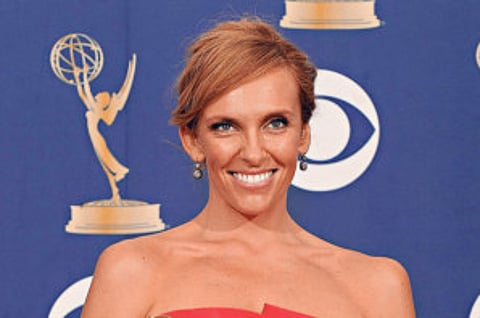
Toni Collette plays a woman dying of cancer in the film Miss You Already, a role that requires her character to show her mastectomy scars. The 43-year-old Australian actress’s bold, chameleon-like career also has seen her put on 18kg (Muriel’s Wedding), play a woman with dissociative identity disorder (United States of Tara) and, here, shave her head.
We spoke recently with Collette about how the new movie — and the performer — stubbornly resists pigeonholing.
I want to talk about Miss You Already. But before we do, let’s get one thing out of the way first. Is your upcoming Christmas movie Krampus a comedy or a horror film? From the trailer, I can’t tell.
You know, it’s both. Initially, it feels like a very family oriented thing. There’s kind of a John Hughes warp to it. There’s a wit to it. But when it takes a turn, it really becomes something else. When it’s scary, it’s kind of winking at you. Honestly, I haven’t seen the film, so I don’t know how dire it does get at the end.
Miss You Already was written and directed by women (Catherine Hardwicke and Morwenna Banks). It’s the story of the friendship between two women, one of whom is dying of breast cancer. This may sound like an archaic notion, but is there such a thing as a women’s film? Not a film made by or about women, but made expressly for women?
I also think it’s an archaic idea. It happens to be a story about a couple of women, but there are all kinds of humans within that story. One of its subjects is a particular kind of cancer which affects — predominantly — women. But initially, the director, when I attached myself to the film, was male (Paul Andrew Williams, of London to Brighton). I don’t think gender has anything to do with talent or creativity. I guess that the story might lure one sex over the other into the cinema, but I have to say that what I love about Miss You Already is that it defies all kinds of categorization. It was made for humans.
Is it fair to call it a tear-jerker, as some have?
Admittedly, it does make everybody cry who sees it. Other than that... there are certain assumptions that come with that label. Most people assume it’s going to be wet, saccharine-sweet, limp, a vapid experience. This is a robust, very vital, very alive journey that we’re taken on. It’s birth, life, death. This film is so grounded and so real. We don’t have the nice pretty satin bow that gets tied up by most movies.
Your character, Milly, is kind of hard to love. She’s a “cancer bully,” as her best friend, played by Drew Barrymore, calls her in the film.
She’s horrible! So selfish. But that’s what makes it even more believable. If suddenly she becomes a bit of a saint, then it’s just another movie that no one will ever give a [expletive] about. She kind of doesn’t change. That, to me, is heaven. She’s still rude and selfish. Yet as horrible as she is, she’s still charismatic. That’s why I love it. Working with Catherine Hardwicke, it was like driving off-road. You had a basic landscape, but you never knew where you were going to go.
Weren’t you worried about the deathbed scene tipping over the edge into pathos?
There’s a tradition between these two women, Milly and Jess, and there’s this thing that they do, where they give each other the finger — the bird, whatever you want to call it. My character is dying, and they’re sitting there doing this to each other. When you read that in the script, you kind of know it’s not going to turn into something that you don’t want to see.
Are you familiar with the Bechdel Test? Originally created by cartoonist Alison Bechdel, it’s a way of evaluating movies based on whether 1) there are two women in it who 2) talk to each other about 3) something other than a man. That’s a pretty low bar.
Isn’t that frightening? This film blows it out of the water. How great! Ever since the financial collapse, there’s been no middle ground in movies. Everything is either very, very high budget or very, very low budget. I just wonder who’s making the decisions. I think that’s where the problems might start: There are so many great scripts that just lie there. No one will ever see them, and they’re brilliant. I think, in my small pea brain, that the issue is the person giving the nod, and the person who has the money bag. Most of those people, I’m afraid to say, are men.
Then there are women like Drew Barrymore who have taken matters into their own hands and started their own production companies.
She’s been doing it for so bloody long. She’s a pioneer. She’s such a go-getter, and she really will revel in something and explore it to the nth degree. She’s so passionate and so smart.
Have you thought about producing?
A: I have. It’s something I’ve wanted to do for a long time, and I just didn’t have the right connections for it to come to fruition. But now I have. I have a production company. I also want to direct, but I also have young children (Sage, 7, and Arlo, 4). I know how absorbing it is, so I’m going to wait a little bit to do that. Although I really, really know, deep down in my gut, that that’s what I want to do.
I interviewed you before, in 2006. At the time, you spoke about taking on fewer film roles so that you could start a family. It looks like you’re about to become pretty visible again.
My kids are in school now. But also I love acting. I love doing what I do. It makes me feel very alive. If there’s material that I connect to on a visceral level, I find it very hard to walk away from it.
What did you say earlier? That you like to defy expectations?
I think I said defy categorization. I love it when you can’t label something. We’re all fluid.


