The new age of chivalry
Should modern day chivalry be gender specific? Should woman be chivalrous too?
A flat tyre in the middle of a highway and the great struggle to replace it - alone. Huffing and puffing, I desperately hoped for a gallant man to drive by and stop to offer help. Don't get me wrong, I am no damsel in distress but what's wrong with wanting a little assistance?
At a party later that week, I happened to rue the loss of chivalry to a woman friend and lo and behold, at least half a dozen men materialised from thin air to pounce on my sentence with industrial-strength ferocity. It's you women, they all seemed to bellow, who have killed chivalry in us thanks to your constant desire to prove you are smarter than us.
I shrunk back a mile, said I needed to get myself a nibble and left for a quiet corner to mull over the issue. Was what they said true? Do women who chair board meetings, fly planes, lead armies and call the shots at home, truly turn up their nose when a man opens open a door or pulls a chair for them? Has an obit been officially written for chivalry as we have known it all along? The clones of Sir Galahad, the fascimilies of Arthurian knights, are they mere tales of the past and not legendary heroes?
Personally, I am always impressed by a man who shows consideration, sensitivity and a whole lot of courtesy. I am not exactly in awe of a man who lunges first towards the elevator when it opens. But that's me. What about other men and women? What's their take on chivalry?
I did a quick informal survey among friends. It turned out no woman expected, or even wanted, her man to throw his coat over a puddle to help her daintily cross over (she bought that coat for him last Valentine's and it cost her half her monthly salary) but all the women said they would be deeply charmed by a well-mannered man who would put her needs before his. So does that still qualify as a nod in the direction of chivalry?
Beneath all the layers of etymology, does chivalry still rest comfortably on the matrix spun from decency, generosity, good manners and responsibility?
Do we need a new code of chivalry?
Richard Wilcox, business development manager for Microsoft UAE, feels that in today's world of fierce contests for spoils of equality, chivalry has an even more important role to play. "It is the cornerstone to one's ethics and beliefs. Traditionally, chivalry is a ‘male only' value that has been fostered from medieval times where knights defended the honour of ladies and were just, loyal, brave, and noble to show courage at all times. The fact is that it is now a dying quality that needs saving from extinction."
Having said that, Wilcox also believes that in these times chivalry is no longer gender-specific and that both men and women are expected to be chivalrous to each other.
"Some believe that in the battle of the sexes chivalry is an attempt to solidify the place of the ‘weaker sex'. In my opinion, chivalry should be shown at all times and men should not hide behind excuses such as women's push for equality or their view of it. Truth is, a woman wants to be treated like a lady, she wants us guys to be gallant and such actions are worthy and go to show that we should seek this kind of respect in our relationships."
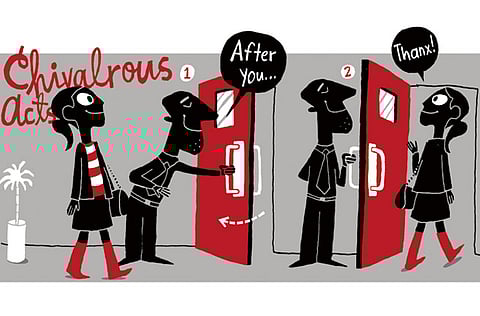
Wilcox's five acts of everyday chivalry, which according to him apply even in today's times are: 1) Open the door for a lady. 2) Walk on the outside of the pavement, nearest to the road. 3) Stand up when a lady sits at a table. 4) Pay for the date when you have asked her out. 5) Give up your seat on public transport to a lady.
The issue of chivalry is actually about two real concerns: firstly the majority of "modern" men are afraid to be chivalrous for fear of being mocked. Secondly, a lot of men are unclear about the correct beliefs; as a consequence, chivalry is undergoing a identity crisis. The chasm between chivalry and male dominance, perceived or real, is at the best of times not easy to bridge.
Coming to the rescue in times of crisis
The very concept of chivalry sprung from Europe during the medieval times when knights on steeds had to wage wars, show their prowess at fencing and shooting to be able to defend the honour of their women.
Poonam Singh, a sociologist at the American College of Dubai, feels chivalry is embedded in cultures and spontaneously demonstrated during times of crises. "When the Titanic was sinking on April 14, 1912, why was it decided by all that first women and children ought to be put on the life-boats?" she asks. "This question has drawn the attention of a number of sociologists. Even moments before a terrible tragedy such as this one, people never fail to be chivalrous.
"Historically, chivalry was rooted in warrior traditions and symbolised knighthood qualities of bravery, courtesy, honour and gallantry towards women. Knights who were strong and powerful and enjoyed a privileged status expressed this act of kindness towards the less powerful or the weaker. Along similar lines, society has developed/defined a socially acceptable code of conduct which requires for men to wear the mask of chivalry."
Clearly "chivalry" is a relative term and is likely to change with time and space. In current times, chivalrous acts may include paying for a meal, opening doors, giving up a seat or assisting a stranded motorist.
As for those who think there is no place for chivalry in our times, their public image may be quite different from the private one. When on stage, they play the socially acceptable role of chivalrous beings but behind the scenes, the reality may be rather different.
"Men display gestures that portray them as chivalrous," says Singh. "This is especially emphasised in cultures that are strongly patriarchal or male-dominated. In addition to being male-dominated, cultures that are highly vertical (having a high power-distance between individuals especially in relationships such a husband and wife or an older and a younger person, for example, Asian cultures) are likely to exhibit higher degree of chivalrous behaviour. On the other hand, horizontal cultures, mainly the Western cultures, tend to be more egalitarian with a lower power distance. In these cultures, chivalry may lend itself to a slightly altered meaning - a noble act that applies equally to both women and men. Here it might mean taking responsibility to help fellow human beings irrespective of gender. It symbolises an act of politeness, kindness or courtesy to all, not just to women.
"In parts of the world where women and men believe in equality of both where the two complement each other, chivalry should come from both and be expressed towards both depending on but not limited to age group, social status, or even circumstances."
On the multicultural campus of ACD, Dubai, Singh finds chivalry being not gender specific but being accepted as a common code of conduct for boys and girls from all cultures.
Code of conduct that guides a gentleman
Katie Foster, who has been in the business of public relations for 25 years, met her husband Roger after being single for 20 years. What bowled her over was Roger's perfect manners and chivalrous behaviour. Nothing has changed in the five-and-half-years they have been married, says Foster, who is all for chivalry among men. "I think chivalry is a code of conduct that guides and supports a gentleman's dealings at all levels - personal relationships, business deals and social situations.
"Chivalry is just simply good manners. Some men have it ingrained - it is part of their DNA - they don't even think about what to do, they just do it because they have a true respect for others. Historically, a chivalrous knight's code included courtesy, generosity, valour, dexterity in arms (today that would be a successful career) and service to others. They were also faithful, loyal, merciless, and modest and always embraced cordial and gentle treatment of woman. I will buy that any day!
"When I first met Roger, we were both well past the age when people think it is proper to fall in love. In fact, both of us, having been single for 20 years, were well ‘over' looking for a mate. But nonetheless, when he pulled out my chair at the dinner party we were attending, and when on subsequent dates exhibited the most profound chivalrous behaviour, I started taking more notice. Roger possesses an ingrained chivalrous nature that means he always puts my safety and comfort first - he makes me feel like the queen!"
Foster cannot understand why people today even dare to question the original code of chivalry. "What was wrong with it? Besides, how would you feel about a guy who just saved your new $300 shoes from a mud bath?"
She is clear that, "Women who believe that equality between sexes means they have to be in total control are sadly missing some of life's greatest experiences. I do not expect a man to hold out a chair for me but boy does his stock go up when he does."
A chivalrous gesture from a man, she believes, is a simple demonstration of the degree of respect he holds for a woman. "It doesn't matter if chivalry is in a social setting or a business setting. Good manners will always win out."
A sign of integrity and a courageous heart
Stella Maria, a spiritual person and therapy practitioner, is clear that the onus of chivalry does lie on men. It runs far deeper than a display of good manners and has to be something of a code of ethics that is internalised by every man.
"Opening doors and pulling out chairs and other small gestures of showing courtesy and appreciation is simply the icing on the cake. Chivalry is when a man can speak and live fully in his truth with trust and integrity, on all levels. When he risks the pain of suffering an ego death in order to live by his soul's deepest purpose and yearning. When he has the courage to stand and face whatever opposition with an open heart and compassion knowing that a decision made from his heart and in his truth, is truly the right decision… thus allowing all those around him to be unafraid to fully express their deepest yearning with open hearts and compassion.
"A man who can see when he has made a mistake and not be afraid to say he's sorry. A man who can learn from his mistakes and forgive his past, in order to move forward and embrace a happier future.
"A man who is not afraid to stand strong and at the same time be able to feel the feminine's energy shifts (mood swings) and know that it's not personal, but just that we are highly energetic emotional beings who need to express! This shows us we can trust you. A man who has faith and believes that there is a God and that we are all sparks of this Divine's light, thus we are all the same."
Stella Maria feels in our times chivalry is not gender specific and women too ought to display some chivalrous traits in their interaction with men. In the Middle Ages, men were the upholders of chivalry, but in today's society of equality in the workforce and on the home front, gender is irrelevant. It's the characteristics and qualities in a person that determines whether they are chivalrous or not.
"I feel I'm a woman living her life with these quality ingredients. Simply open your minds and hearts and allow your natural healthy curiosity to lead you to your truth."
Making a difference in the workplace
This form of chivalry has acquired wider connotations today as we spend most of our waking hours in a corporate ethos thrashing out new behavioural codes each day. Both men and women have to stand up for themselves and their teams and display exemplary team dynamics and that becomes the new form of chivalry expected by people who have a work-related bond with each other.
Ben Dattner, workplace psychologist from New York University and the author of The Blame Game, feels a lot of office intrigue would never take place if people had the ‘chivalrous guts' to stand by their wrongs and not grab credit for someone else's work.
"In the workplace, chivalry, or the lack thereof, can be seen in the realm of blame and credit," he says. "Chivalrous colleagues and bosses accept blame when things go wrong, taking responsibility and admitting their own mistakes. In dysfunctional organisations where chivalry is absent, people are quick to blame one another and to deny their own role in poor outcomes or results. A chivalrous boss will shield his or her staff from threats inside and outside of the organisation, protecting them from politics so they can focus on their jobs. A chivalrous boss takes the blame even when a member of his or her team makes a mistake, while bosses who lack chivalry are quick to blame and make scapegoats out of the members of their team." Chivalrous bosses, according to Dattner, inspire commitment and loyalty.
The benefit of a chivalrous workplace is that people take responsibility, and step up to solve problems rather than pointing fingers at others. Blaming oneself for one's role, whether direct or indirect, in errors or mistakes is the honourable, gallant, and courageous thing to do. "Unfortunately, in too many organisations, people do not act in either an honourable, gallant, or courageous manner, instead covering up their own mistakes, pinning the blame on others, and acting out of fear."
More than just a gesture
Would it be safe to conclude that chivalry is more than pulling out a chair for a woman? Surely. It is a concept that turned into a term that became a succession of gestures. But for those who look at the bigger picture of human behaviour and the great heights it can ascend, chivalry, it seems, is just another way to fully participate in the grand role play of being human.
"Opening doors and pulling out chairs and other small gestures of showing courtesy and appreciation is simply the icing on a fully baked chivalrous masculine cake"... Stella Maria
"I do not expect a man to hold out a chair for me but boy does his stock go up when he does!"... Katie Foster
Inside info
If you believe chivalry should be kept alive in these times, log on to www.chivalrynow.net, a worldwide fellowship of like-minded people. They raise issues, conduct online surveys and ask you to support the idea of chivalry.
Fact
Chivalry was first coined as a term in 12th-century England when knights had to wage wars to defend the honour of their clan. The word comes from the French term ‘chevalier' meaning knighthood. Even cavalry, which means ‘horsemen' is a derived from this French word. So knights who rode horses and went about protecting and providing for their clan were the first men to accept this code of behaviour point out social etymologists
-information courtesy www.answers.com
Facts:
‘Chivalry' is from the French ‘chevalier' meaning knighthood. Knights who protected their clan were the first men to accept this code of behaviour
-information courtesy www.answers.com


