How to make your first film
A film boot camp is a great way to get a grip on the business
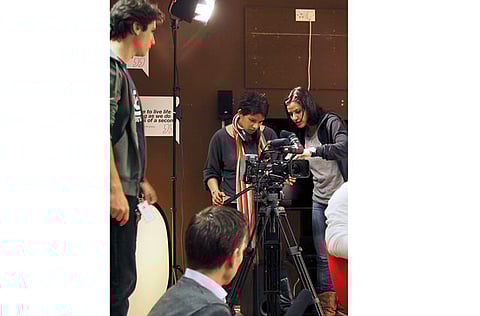
She stood behind me and held my waist - first gently, then more tightly. Her grip led me backwards, out of the green screen studio and into the hallway as I filmed the protagonist of my first film.
It wasn't easy capturing James Dunvall, storming off from the set of his first music video. The antagonist, producer Mike Craig with whom he had signed a record deal, barked out, "I am paying money for every shot you miss…"
I clenched the leather strap of the hand-held JVC 100 camcorder tighter. I quickened my pace to match James' fast-approaching angry frame, closing the space between the exit door and me. The grip on my waist dug in and my body wrenched off centre. That was the moment of the camera shake.
"Cut," said the director.
Immediately, the grip released my sides and I released the camera strap. I turned to my fellow film boot camp student, and said, "Thanks Huda." She was learning to be an assistant to a camera person. On set that was me.
James, played by Hassan Aslan, cracked up at his limited acting skills. He romped around coiled wires and erect lights. The rest of the crew, who had enrolled for the two-day film boot camp at the SAE Institute, Knowledge Village, Dubai, convulsed in laughter. It was Aslan's fault. He wasn't supposed to laugh as he stormed out, supposedly in a livid, agonistic temperament. Still, we were glad he did. Comedy always helps loosen a tight situation.
The course - as the name boot camp suggests - was a concentrated one aimed at those interested in producing a short film under the supervision of industry professionals. The institute, which also has academic degree programmes in interactive animation, applied multimedia and audio and film production, provided the script, cameras, lighting, grip and audio equipment.
A unanimous choice for leading man
Aslan, a student pursuing his bachelor's in film production at the SAE Institute and a filmmaker, was deemed the unanimous choice for an actor because, well, he seemed willing to put up with a group of amateurs whose main expertise was in diverse fields such as marketing, interior design, construction, PR, and in my case, journalism.
We had started out on the first day listening to film lecturer Stephane Randjelovic talk us through an introduction to video production, which included a lot on the making of a film. He is a director and director of photography (DOP) with a strong background in animation, photography and motion graphics. He told us that we would have access to equipment, including two cameras - JVC 100 and JVC 700. We would be shown how to use these, how to make a shot list (for filming various scenes), and learn composition and direction. We were scheduled to shoot a video on the very first day, and end the course in the editing room.
"The introduction will help familiarise you with the basics to be able to shoot a short script and film your own documentaries. It will give you a hands-on feeling of working in a professional setting," he said.
The theory was divided into the three sections - pre-production, production and post-production. Almost like three parts to a story - beginning, middle and end. In the pre-production phase, you organise and finalise details for production. The details include the script, visual storyboard, shot list, crew, budget, contracts, location, equipment, lighting, casting and timetable of shoots. In the second phase, you film. And lastly, you edit for sound and visual effects, and colour correction in the post-production phase.
"This [post-production] will be taught to you by another film lecturer," said Randjelovic, who has worked on commercial projects with clients such as Pedigree, Ferrari World, Nivea and Twix.
He touched upon the technical aspects of filming, including camera movement, camera angles, shutter speed, aperture, framing heights, rule of thirds when framing a scene, etc. "You need to tell the camera what is happening because it does not operate like our vision. Technology has made it a lot easier of course, but you need mental focus and creativity to film," he said.
He showed us a three-minute film commissioned by Dubai Police on the subject of substance abuse. It was filmed over five days by students from the institute. The film portrayed the plight of a college student, caught and imprisoned. "You have to think about story structure. On a film set, time costs money [The average length for a film production is six months.]," he said.
The most important part was understanding that a film - in effect - is done three times: scripting, shooting and editing.
"Create memorable entrances," he said. "If you have an actor coming through a door that means nothing. If you have him climbing through a window, you have a situation. As a rule, start strong. Think about your scene based on the script and follow the action."
When we filmed the aforementioned scene on the second day, we had decided on the shots and who does what.
The consensus: let's get the protagonist to storm out in anger. We prepared our shot list. We divided the roles. "Christian, you operate the boom microphone," said one student.
I offered to operate the camera. You should have seen us as we bandied about film terms like old-timers in showbiz. The camera assistant went, "Scene 15, Take 1." The assistant director, "Final touches please. Roll sound." And so on.
Learning the lingo
Film terminology, we were told during our theory, is paramount. Randjelovic had emphasised this with a personal story.
He said, "When I was training, I was once asked to handover a C47. I looked at all the technical equipment and couldn't figure out what it could be. It turned out to be a wooden clothes peg [used to attach diffusers to a light, which is too hot to touch].
"You have to learn the conventions and communicate correctly on the sets. You can't just ask for a big camera. You have to know what that big camera is."
Over the course of the two-day weekend workshop, we used the institute - lobby, conference room and green screen studio - as our location.
On the afternoon of the last day, we met Areeba Hanif, the lecturer Randjelovic had spoken about. A Dubai-based filmmaker, she has directed and co-directed several short films and documentaries. She is one of Apple's youngest certified trainers in Final Cut Studio 3 and covers a wide a range of post production subjects at SAE. She also owns and runs a small boutique production company.
"Every cut should move the story forward," said Hanif as we stared at our 30" Mac monitors to learn the basics of post-production, using specialised software Final Cut Pro. "Later, I'll give you'll links to online tutorials," she said.
We had to edit more than 10 scenes from the script, roughly equivalent to six hours of filming. The script introduced the character James meeting Craig, the producer who offered to sign him, and then showed James at the set of his music video and Craig pressurising him. It ended with James walking off the set to a quiet lounge area and reflecting.
We had access to all the footage, and could edit as we pleased. We dabbled with music selection and learnt to cut scenes. Collectively we took more than two hours to edit a clip down to a measly minute of screen time, and still longer to add the title, applying fonts and colours.
Was it easy? Film editing was hard work. I returned with renewed respect for film editors.
The point of the workshop was not only to make my own film (the most enjoyable part), but to gain insight into the filmmaking industry. Perhaps also to explore the possibilities of visual storytelling, training my mind to translate our 3D visualisation to a 2D screen. And perhaps even to remove the alchemical filter that hides the harsh realities of what goes into filmmaking.
Will I ever make my own film? If I do, I'll hire someone else to do the editing.
By the way…
- There are no academic requirements to take part in the film boot camp, except that the participant has to be 16 and above.
- Lecturer Hanif's documentaries Ashes to Dust and Moksha have toured multiple festivals in Europe and India.
- Manhattan Film Academy in Dubai holds regular film production workshops.
Inside info
- You can edit a HD movie using the app iMovie on an iPhone 4.
- Shot by Shot by Steve Katz is recommended reading for aspiring filmmakers.
- The SAE Boot Camp Certificate has advanced standing towards the institute's academic programmes.
For more on this
- www.sae-dubai.com
- Hanif's production company: www.MyBigDayFilms.com


