Growing up on Road Rash, Mortal Kombat and Tekken 3: Fatalities, brutality and when button-mashing actually worked
Life was fun too, when you could slip in the card slot or a disc
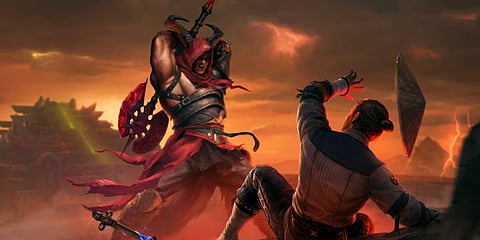
My gaming philosophy has always been straightforward: Press every button available and hope something spectacular happens.
Strangely enough, that strategy has carried me through nearly three decades of gaming.
Before playstations filled my life, in 1998, my father bought a Windows 98 computer: The one with the UPS and that informed you ‘You can now safely turn off your computer’, something most of us never followed. He was stern about the premise: It was for his work. But, as the three of us peered around the desktop as if it was a magic lamp, we saw that it had three games: Road Rash, Diablo and something called Firefly.
There were fixed timings for gaming of course, and my mother, sister and I developed a fondness for Road Rash, because none of us knew what to do in Diablo and kept getting butchered. Road Rash was the first game that I ever played, where we raced through the city (that was the only setting available to us), through the country, while escaping policemen, and avoiding crashing into pedestrians. On the way, we had to also avoid getting hit and kicked by opponents. My mother was faster than us in learning, and beat my sister and I to come first in the races, while we lagged miserably behind.
That was the first bite of gaming, and as it was such a fixed, constrained time, the desire to play more freely, was building up. A year later, we went to Kerala and my cousin introduced me to Mortal Kombat, a game that my mother agreed was too violent for an eight-year-old, but I was ready for all the fighting. I didn’t know any moves; I just knew that if I pressed a few buttons I might knock down my enemy with some surprise powers. I barely remembered names back then, except for ‘Freezer’ (Poor Sub-Zero). II don’t even quite remember the machine itself—only that its card slot gave up within three days, ending its short life in our hands.
And then along came the PS-2 for our summer vacations, two years later. A brand-new shiny one, and all cousins stared at it in awe. Compared to everything else, we had seen before, it was lifelike. The possibilities suddenly seemed endless; all the books and films about losing yourself in a game and 'becoming a character' felt true.
Rules had to be in place, of course: Holiday homework in the morning, and games by afternoon. But I had already gotten entranced by Tekkan 3 (that I kept calling Terrikan), and that’s when the button-mashing developed, much to the annoyance of my cousins. There was actually a round of games where I won consistently, using Jin sometimes, or the powerful Gun Jack, or even Anna, whom I distinctly remember wore a blue gown during combat. There was Nina, a lizard, and there was a panda too, who could give a bear hug and squish their opponent to death. “She’s just hitting all buttons, she doesn’t even know what she’s doing,” complained my cousin.
I didn’t really care; this was too much fun. I lost of course innumerable times, but not without pressing all buttons to deliver ‘fatality’. The graphics felt other-worldly to a 12-year-old, and the console shook with each attack. I didn’t pay much attention to the storytelling, I just wanted to play the combat games more than anything else, including the racing ones. I was terrible at racing in games such as Need for Speed 2 and another fancy car game---but that’s where I picked up a few names: Mitsubishi Lancer, for one.
And then, no button-mashing for years: Just NFS on the desktop and some pokemon simulation, enjoyable, thrilling, but nothing quite like gritting your teeth and delivering punches of a lifetime.
In 2021, UAE, we installed Mortal Kombat again on a PS-4 now. Everything was a lot more sharper, focused and there were more gaming modes than just a 2-minute showdown. But I needed those 2-minute battles; it was a stress-buster. This time, I was 30 and I could now remember all the characters: Kitana, with her fan move that I mastered after losing over 40 games. And there was Kano, who had powerful punches. I squinted through all the power moves and tried to employ Quan Chi, or even the insect-like D'Vorah who could just keep spitting venom at you, even from a distance.
There was also some strong family dynamics occurring too: Johnny, his ex-wife Sonia Blade, and their daughter Cassie. Of course, there was my eternal favourite: Freezer, aka Sub Zero.
I knew none of their powers and yet I knew all of them.
I lost most of the games, and I still do. Button-mashing doesn’t work the way it did when I was 8 or 12. But I played, because while it was de-stressing of course, Mortal Kombat had been too much of a formative experience in my life. I was old enough to enjoy all the tension and the ‘trash talk’ before each game, sometimes between Kitana and her evil ‘sister’ Milena.
Or, Johnny and his ex-wife. I learned the bits of storytelling along the way and moves. I still committed the ‘brutality’ moves---and they were far more violent than they had ever been in my childhood. Brutal and graphic, but it still revived the very casual gamer in me.
Modern games are achingly beautiful. They're cinematic, expansive and emotionally rich in ways my childhood self could never have imagined. I have been hypnotised by the flower fields of Ancient Japan in Ghost of Yotei.
But something else has changed too. The discs have started disappearing and soon will be gone for good. Even the physical act of inserting a game, holding it, borrowing it, passing it between cousins, is slowly fading. The PlayStation world is moving further into downloads, updates, and invisible libraries.
And maybe that’s why I still return, every now and then, to the girl who thought Sub-Zero was called “Freezer”still return to the girl who thought Sub-Zero was called "Freezer", watched her mother dominate Road Rash, and believed pressing every button at once was a winning strategy.
Perhaps, somewhere in all the gaming, I like to forget about winning, and maybe just find versions of yourself never quite log off.


