Digger first reviews: Tom Cruise’s apocalyptic satire is brilliant or a mess, depending on who you ask
Tom Cruise’s risky apocalypse comedy splits critics down the middle
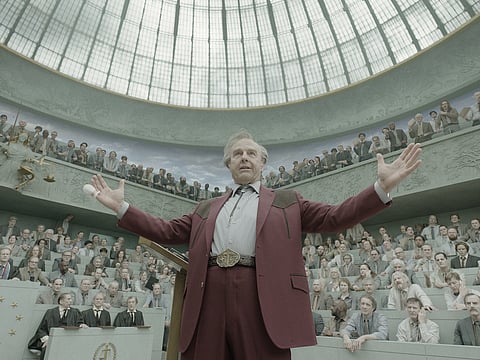
Tom Cruise has hung off the side of a moving Airbus, scaled the tallest building on Earth and flown his own fighter jets. For his latest stunt he is trying something with even less margin for error: making the apocalypse funny.
Judging by the first wave of reactions to Digger, Alejandro González Iñárritu's pitch-black satire, nobody can agree whether he stuck the landing. The film screened for press in New York and Los Angeles over the past few days, and its London premiere is now underway.
The critical community has since fractured along a very visible fault line. On one side, critics are calling it one of the boldest studio films ever made. On the other, they are calling it a mess. The middle ground is sparsely populated.
Variety's Clayton Davis summed up the mood before anyone else could: "the divide on this one is going to be wide."
First, the premise
Cruise plays Digger Rockwell, a flamboyant oil tycoon who seems to live in a hermetically sealed bubble of his own importance. The bubble bursts when he learns that his company's drilling in Greenland has done two very bad things at once. It has released a dangerous plume of methane, and it has knocked an ice shelf loose from a glacier. The ice shelf is now drifting toward Europe, where it could set off a tsunami and a catastrophe on a continental scale.
Think "Dr. Strangelove," but the doomsday device runs on crude.
The orbit of lunatics around Digger is stacked:
Riz Ahmed as Ganesh, the scientist who delivers the bad news
Sandra Hüller as Digger's prickly half-sister and business partner
John Goodman as an authoritarian U.S. president with cancer
Michael Stuhlbarg as his spineless vice president
Jesse Plemons as an enigma whose purpose only becomes clear late in the film
Iñárritu co-wrote the script with his Birdman collaborators Alexander Dinelaris and Nicolás Giacobone, along with Sabina Berman. There is also a twist fairly early on that flips the whole premise upside down, and it seems certain to become the most argued-over plot point of the fall.
The good things
For some critics, Digger is exactly the kind of risk Hollywood claims it no longer takes.
IndieWire's Jim Hemphill led the cheering section. He argued that the film gives Cruise his best role since Magnolia and that it ranks among the most visually inventive, conceptually daring and unpredictable studio pictures ever made. He was even more pointed about its ambition. By his account, the film swings so wildly that it makes Iñárritu's famously sprawling Bardo look like "an episode of The Golden Girls.
His colleague Anne Thompson, also of IndieWire, called it 'a brave and gorgeous art film.' She added a sharp note of realism: in her view, the movie is unlikely to connect with mainstream moviegoers but should play best with the Academy, especially among its craft and acting branches. For a Warner Bros. awards contender, that is arguably the only review that matters.
To like or not to like?
A second camp admired the attempt more than the result.
Matt Neglia, founder of Next Best Picture, called it "Tom Cruise's most dynamic and interesting role in years." He then gave the compliment a twist of the knife. He said the part lets Cruise play big to the cheap seats, but it never gives him room to go deeper. He argued that the performance could have carried far more power and nuance if the film's ambitious story hadn't tilted so heavily toward zany spectacle that, in his words, felt empty.
Clayton Davis landed in similar territory. He praised the size of the swing and singled out stellar work from Cruise and John Goodman, as well as impressive production design and cinematography. His conclusion was that the pieces don't fully fit together, and that the film should have committed harder to the absurdist satire it keeps reaching for.
Then there were critics who left the theater looking for the nearest lifeboat.
Awards Radar's Joey Magidson didn't hedge. He called the film a "mess," wrote that "not a whole lot works here," and admitted plainly that "this wasn't enjoyable."
Critic Edward Douglas said he understood what Iñárritu and Cruise were aiming for but could not call the result very good. He also made a bold prediction about how opening-night audiences will score it: "HORRENDOUS" CinemaScore, in all caps.
The Cruise factor
Critics can't agree on the film. They mostly agree on its star.
Even the doubters point to Cruise, and to Riz Ahmed, as the strongest reasons to buy a ticket. That matters, because Cruise's awards story is unfinished. He is 64 and a four-time Oscar nominee who has never won a competitive Academy Award. He did receive an Honorary Oscar last year, which is a lovely gesture, but it's a little like being handed the keys to the city when what you really wanted was the election.
He is also barely recognisable in the role. Cruise sits under extensive prosthetics. He has said the process originally took six hours in the makeup chair and that he eventually got it down to about one. (Of course Tom Cruise optimised his makeup time. Of course he did.)
Whatever the film's failings, it looks the part. Iñárritu reunites with his longtime cinematographer Emmanuel Lubezki, and Oscar-winning production designer Dennis Gassner (Bugsy) has built a deliberately bleak, obsessively detailed vision of the end of days. Even the harshest reactions don't argue with how the film looks. The argument is over what it's saying.


