Outspoken opposition
Lyudmila Ulitskaya does not mince words about her disapproval of Vladimir Putin and the road on which he is steering Russia
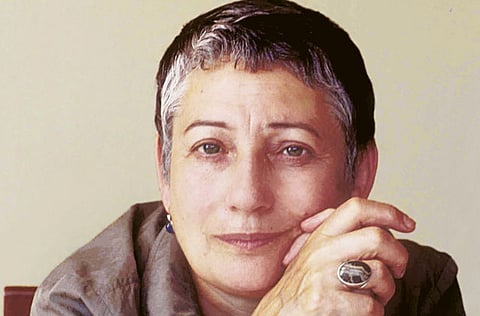
Lyudmila Ulitskaya does not like to draw attention to herself. She is unassuming and soft-spoken, a 68-year-old grandmother with grey cropped hair and small, elegant hands. But this modest, self-effacing individual is one of Russia's foremost contemporary novelists and a leading advocate for freedom of expression. She started writing almost by accident after she was sacked from her job as a geneticist in the 1960s and accused of dissident activity by the former Soviet authorities. "I thought, quite wrongly, that scientists were freer [than artists]," she has written in the past. "Of course, all these illusions were shattered over time."
Her books and short stories have been translated into several languages — she is now promoting the English-language version of her novel Daniel Stein, Interpreter. She was the first woman to win the Russian equivalent of the Booker prize and, more recently, has attracted both controversy and acclaim for publishing her correspondence with the jailed billionaire Mikhail Khodorkovsky. She recently spoke at the Foreign Policy Centre in London about personal and political freedom in Russia, examining what it is to be an artist in a state run by Vladimir Putin, a man not known for his tolerance of free speech or respect for human rights.
"I'm not afraid," Ulitskaya insists, speaking through a translator. "Compared to the Stalinist era, our government now is a pussycat with soft paws. Having said that, I believe that Khodorkovsky is in jail because the whole society was so scared that no one stood up for his defence. That loss of dignity frustrates me, because our society had only just started overcoming its fear after so many years of oppressive rule. The Russian people have once again started to be gripped by fear."
Khodorkovsky, the former head of oil giant Yukos and once Russia's richest man, was jailed for eight years in 2005 along with his business partner after being found guilty of embezzling more than £16.3 billion (Dh59.8 billion) worth of oil from his own company and laundering the proceeds. Khodorkovsky's lawyers maintain that the charges are absurd and based on a failure to understand normal business practices. Their client, they argue, is a political prisoner and a symbol of a corrupt Russian judicial system — a view supported by Ulitskaya. "I'm convinced the allegations were absurd," she says. "It started from tax evasion, then got blown out of proportion. The next allegation was theft, which is completely absurd because you can't steal from yourself."
In December, the former businessman was convicted on new fraud charges, a move widely condemned in the West as politically motivated revenge for Khodorkovsky's defiance of the Kremlin in the past, the oligarch made no secret of his support for Putin's liberal opponents. He now faces imprisonment until 2014.
Ulitskaya began writing to the imprisoned oligarch in 2008, addressing her letters to him in the Soviet-era labour camp in eastern Siberia where he was incarcerated. The correspondence lasted for a little under a year and their letters covered everything from personal backgrounds to political motivations.
"I was travelling around Russia a lot and I would constantly come across different traces of his charitable work," Ulitskaya says. "He spent a lot of money on education, setting up children's homes, giving schools the latest computer equipment. My support for Khodorkovsky primarily lies in how much money he spent on charitable enterprises."
When the letters were published as a book two years ago, Mikhail Khodorkovsky: Articles, Dialogues, Interviews became part of Russia's literature of exile.
"My perception of Putin as an individual is that he is quite juvenile, not very mature, and all the pictures we have of him from state television are of Putin climbing Everest or fighting a tiger or extinguishing a fire. It's just a kind of joke, these machogames. But if I want to judge Vladimir Putin as a politician, these are my criticisms: Our country is in an atrocious condition. Schools and hospitals are underfunded, our pensioners are on the brink of poverty and the condition of our army is shocking. Our soldiers are underfed and live in unsanitary conditions."
Ulitskaya is still in touch with Khodorkovsky, although she has never met him. She was at his trial in December, where he appeared in court in a cage made of bulletproof glass. "It was a very depressing sight," she said. "When I imagine how much the trial has cost the Russian government, it frustrates me that the money has not been spent in a better, more constructive way."


