Nelson Mandela is more than an icon
Glimpses from Nelson Mandela's private archive introduce us to the man behind the legend
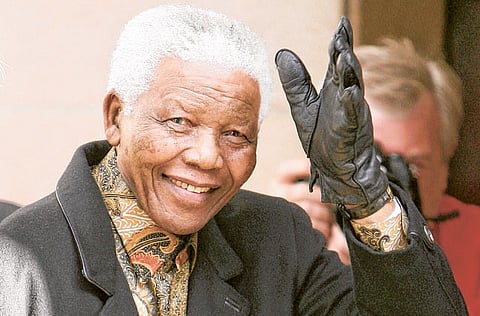
When Nelson Mandela checked into a hospital in late January this year for what was described as a routine health check-up, a global media frenzy followed. Television news channels began broadcasting updates on his health every now and then, online news providers flashed breaking news whenever the hospital had an update. High-profile visitors gathered outside the hospital, others organised prayers and candle-lit vigils for his recovery.
After his discharge from hospital following treatment for what turned out to be an acute respiratory infection, the flurry of visitors continued at his home, even though information about Mandela's state of health remained tightly controlled by his military medical team.
From South African President Jacob Zuma to Deputy President Kgalema Motlanthe to fellow anti-apartheid activist and Robben Island prisoner Andrew Mlangeni, the number and profile of visitors streaming in to catch a glimpse of the 92-year-old anti-apartheid hero is a testimony to what Mandela means to the world. It is also proof of the enormous public appetite to know more about Mandela the man rather than Mandela the legend.
It is in this context that Conversations with Myself — a great collection of vignettes made up of letters written by Mandela during his prison years, glimpses from his diaries, notebooks and calendars, transcripts of conversations he had had with rare visitors at Robben Island and snatches from his unpublished autobiographical manuscript written in prison — works brilliantly to fill a great void of public knowledge about Mandela.
Frank perspective
United States President Barack Obama, in his foreword to the book, writes: "Conversations with Myself aims to give readers access to the Nelson Mandela behind the public figure, through his private archive. This archive represents Mandela writing and speaking privately, addressing either himself or his closest confidantes … Here he is not the icon or the saint elevated far beyond the reach of ordinary mortals. Here he is like you and me." And Mandela himself creates a frank perspective into what this collection of personal memories, anecdotes and conversations is all about: "In real life we deal, not with gods, but with ordinary humans like ourselves: men and women who are full of contradictions, who are stable and fickle, strong and weak, famous and infamous, people in whose bloodstream the muckworm battles daily with potent pesticides."
While Mandela's historic achievements in nation building and changing the ethos of democracy and race in South Africa have been well documented and have made him an enduring voice of freedom and hope throughout the world, Conversations captures the other side of history — how his personal life evolved with his very public persona, his stoic endurance while jailed as a political prisoner on Robben Island, his concerns over the right strategy for the anti-apartheid movement and the thought process behind some of his key political decisions, and his tender words of love and comfort to Winnie Mandela and his children on life without a husband and a father (knowing well that most such correspondence would be confiscated by prison authorities and never reach his loved ones).
The experiences it unfolds for the reader are myriad. Mandela's conversations with Richard Stengel, with whom he collaborates on his autobiography, reveal his evolving political ideology and knowledge of classical literature, the experience of his underground years and why he prefers Nehru to Gandhi. His correspondences with Ahmad Kathrada, fellow anti-apartheid activist and his key political adviser during presidency, turn stark on the prospect of a death sentence: "Of course, when you are alone in your cell you also thought in terms of yourself and the fact that you are not likely to live and that is … only but human. But collectively we took this decision and it also made us happy … that this was the last service we can give to your people."
During an unusually open conversation on sexuality, Stengel probes Mandela on his wife Winnie living her life without him for decades: "[Winnie] has a life outside, she meets other men … it must be very difficult to think about that." To this Mandela replies: "That is a question which one has to wipe out of his mind … It is sufficient that this is a woman who is loyal to me, who supports me and who comes to visit me, who writes to me. That's sufficient."
Heart-wrenching memory
Mandela's experience with prison authorities after the death of his son Thembe in a car crash is heart-wrenching. He pleads with them to allow him to attend Thembe's funeral: "I wish to attend, at my own cost, the funeral proceedings and to pay my last respects to [Thembe's] memory. I have no information as to where he will be buried but I assume this [will] take place either in Cape Town, Johannesburg or Umtata. In this connection I should be pleased if you would give me permission to proceed immediately, with or without escort, to the place where he will be laid to rest." That application was rejected.
In bringing out these and many more collective experiences of Mandela, Conversations goes beyond the confines of a private memoir. It comes across as a cherished album you browse through at leisure, where each vignette triggers a range of emotions. What lingers at the end is Mandela's courage of conviction, his generosity in the face of adversity and suffering, and his ability to hold up a clear mirror to himself and accept the man he is, warts and all. While respect for Mandela as the first black president of South Africa, the anti-apartheid icon, the Nobel laureate and the voice of freedom and reconciliation has been enormous, Conversations works effectively to raise the bar on our appreciation and admiration for Mandela the man.
Conversations with MyselfBy Nelson Mandela and Barack Obama (foreword), Pan Macmillan, 344 pages, £25


