Memories of feminism
A novel set in the 1970s delves into women's role in society in that era
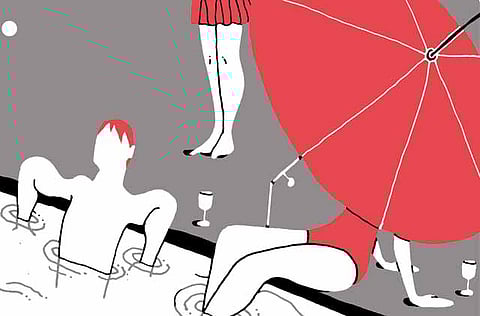
At first glance, Martin Amis's forthcoming novel, The Pregnant Widow, is about sexual relationships among a group of young people during a heady summer in an Italian castle. If you choose, that is as far as the story goes.
However, delve a little deeper and Amis's portrayal of relationships, women's role in society and Islam in that era form an emulsion. A long-known, accurate wordsmith, Amis has a style of writing that combines the base crassness of adolescence with dictionary definitions throughout — a technique employed to highlight an adoration of all things literary.
The book opens with Keith Nearing, 56, looking back on his days of glory: "At his time of life, you resigned yourself to a simple truth: Each successive visit to the mirror will, by definition, confront you with something unprecedentedly awful."
Cue later references to Ovid's Echo and Narcissus (Metamorphoses) — used to warn people of loving someone who can't love them back. Narcissus wasted away after falling in love with his own reflection, while Echo wasted away in the present-day sense of the word.
Amis's pregnant widow plays reference to pro-Western Russian writer Alexander Herzen, whose quote on the matter opens the novel: "The death of the contemporary forms of social order ought to gladden rather than trouble the soul. Yet what is frightening is that the departing world leaves behind it not an heir but a pregnant widow. Between the death of the one and the birth of the other, much water will flow by, a long night of chaos and desolation will pass."
In a 2006 profile in the British newspaper The Independent, (Martin Amis: 30 Things I've Learned About Terror) Amis states that "... the pregnant widow in this novel is feminism. Which is still in its second trimester. The child is nowhere in sight yet. And I think it has several more convulsions to undergo before we'll see the child."
And so the youth spend the balmy Italian summer debating the will-I, won't-I of sex with others, the dilemma of religion is raised (and so Keith doesn't enact his plan of seduction after shouting off his mouth about the folly of religion to a very attractive — but very pious — Scheherazade) and previous relationships break down.
In a highly comical but sinister sequence of events, Keith decides to drug his girlfriend Lily with her own medication, to have her out of the way for his soiree with Scheherazade (whose boyfriend Timmy is yet to appear at the castle). The plan goes wrong for two reasons: Firstly Keith puts his foot in it over religion and Lily then realises her Prosecco has been drugged, as the medication prompts oddly-tasting burps. And so Keith is alone after the holidays, with brief meetings and catch-ups with old friends years later.
If one thing is a theme throughout, it is sex and relationships. The 1970s saw a change in the status of women in the United Kingdom, which Amis has replicated in The Pregnant Widow. However, this change in social and sexual independence for women is told through the eyes of the male characters, with plenty of references to getting "them out". Whether this is a true representation of feminism is up to the reader to interpret — it is in there somewhere, cloaked under the façade of sex-loving males.
Nevertheless, The Pregnant Widow is a good read, with Amis's boundless literary knowledge blending with the carefree sexual exploration of the 1970s.


