How the plot was lost in Afghanistan
A sobering account of how the US and its allies failed miserably in their mission to herald peace and democracy in the country
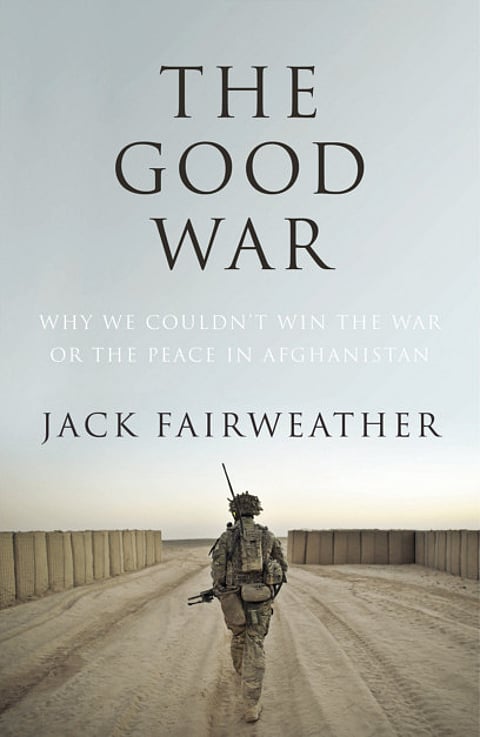
The Good War: Why We Couldn’t Win the War or the Peace in Afghanistan
By Jack Fairweather, Jonathan Cape, 512 pages, $29.99
For Nato and the West, Afghanistan was supposed to be the “good war”, a label that suggested a clear and noble purpose and distinguished it from the futile chaos of Iraq. Thanks to reporters such as Jack Fairweather, who wrote about the British in Iraq in his previous book “A War of Choice” (2011), we now know that this Afghan war has been — and still is — anything but good.
As the United States and its allies quietly withdraw their troops from Afghanistan (though more than 10,000 of a Nato force that peaked at 140,000 will remain next year to support the Afghan government), they must face the fact that the last decade of the war has been a military and political failure.
It started well, which is why it was indeed seen in the early years as “The Good War” of Fairweather’s now-ironic title. The conflict that eventually killed and maimed thousands of Afghans and foreigners, cost $1 trillion (Dh3.67 trillion) and became the longest war in US history began with a successful operation to oust the Taliban regime and chase their Al Qaida guests into hiding.
First prosecuted by George W. Bush in late 2001, with US bombers and special forces supporting a Northern Alliance offensive against the Taliban, the war achieved its immediate purpose of avenging the 9/11 terror attacks on New York and Washington and punishing the Taliban for failing to hand over Osama Bin Laden.
Kabulis, who had long resented the killjoy Taliban mullahs from the Pashtun south of Afghanistan, happily returned to music, sport, kite-flying and pigeon-fancying and did lucrative business with the incoming armies of western aid workers and troops.
Thirteen years on, the achievements that followed the initial military triumph — the beginnings of a modern economy, the education of a largely illiterate population and the establishment of democracy — look very fragile indeed, despite the assassination of Bin Laden himself in Pakistan by US forces in 2011.
Gunmen loyal to the Taliban hold sway in much of rural Afghanistan and have again launched attacks in the very heart of Kabul. In Paktika province in the southeast, more than 40 people were killed recently when a suicide bomber blew himself up at a volleyball tournament. International Sunni Muslim extremists of the same ideological hue as Al Qaida are shedding blood from the Mediterranean to the Hindu Kush, while Pakistan and Afghanistan — where south and central Asia meet — seem as unstable as they have ever been.
Readers of Fairweather’s narrative, which combines first-hand war reporting with shrewd analysis of the western conduct of the war, will quickly come to understand what went wrong: after the first few months, no one on the Nato side knew what the war was for.
Take the south, where so many of the more than 450 British war dead lost their lives in a region described as “the bloody fulcrum of the war”. After years struggling to hold obscure towns and villages in Helmand — which only served to attract Taliban fighters eager to take on the foreign invaders — the US military concluded in 2013 that the province “wasn’t that important after all”.
Ashraf Ghani — the acerbic former World Bank official whose recent inauguration as president has aroused tentative hopes that Afghanistan has finally found a competent leader — remarked in 2005 that there would be a bloodbath if the British raised the Union Jack in Helmand.
“If there’s one country that should not be involved in southern Afghanistan, it is the United Kingdom,” he said, recalling the kind of disastrous colonial adventures described in William Dalrymple’s Return of a King (2013).
But far from forging a purposeful strategy either to defeat the Taliban or to negotiate with them, there was confusion, friction and hesitation among the allies. The Americans soon came to distrust Hamid Karzai, the mercurial Pashtun leader they had installed as president at the start of the war. UN officials argued with the US, while US, British and Canadian military commanders in the south argued with each other.
President Bush said at the start that he was “not into nation-building” — but nation-building is what Nato tried to foster. Aid efforts were marred by waste and corruption, there was disagreement on whether to stamp out the growing of opium poppies (the attempt was an abject failure) and even within successive US administrations there was no clarity on military strategy, with Barack Obama reluctantly backing a halfhearted “surge” of troops in late 2009.
Even in mid-2010, intelligence adviser Derek Harvey — who ran a team of 89 analysts at US Central Command’s Afghanistan-Pakistan Center of Excellence — told incoming US commander David Petraeus: “Our political and diplomatic strategies are not connected to our military strategy ... It’s not going to work.” That’s quite an admission after nearly a decade of war.
The Taliban leadership had already regrouped in Quetta, Pakistan, in 2003, just as the US was distracted by the new war in Iraq. The Afghan war, in fact, had begun like George HW Bush’s 1991 “good war” to liberate Kuwait, with a clear, achievable goal and robust international support. But in its closing stages the Afghan adventure looks more like Bush Jr’s 2003 Iraq folly - harder to justify and without a defensible aim.
For obvious reasons (they kill westerners), the views of the Taliban themselves are largely missing from Fairweather’s tale. But he looks at some tantalising missed opportunities for ending the war and rebuilding Afghanistan through diplomacy rather than guns. They include the efforts by UN representative Tom Gregg to negotiate with the powerful Haqqani family in the mountainous Loya Paktia area of the southeast, and the drive by education minister Mohammad Hanif Atmar and US diplomat John Kael Weston to focus on building schools.
Weston was one of the Britons and Americans who came to the conclusion that a successful Afghan war would take 30 years. In western capitals, however, patience has run out before the halfway mark. It was Robert Gates, then US defence secretary, who said any person in his position who advised a US president to send a big land army into Asia or the Middle East or Africa should “have his head examined”. Not many of those involved with Afghanistan over the past 13 years would disagree.
The Good War: Why We Couldn’t Win the War or the Peace in Afghanistan, by Jack Fairweather, Jonathan Cape, 512 pages, $29.99


