How David Astor coped with being so rich
The Observer’s celebrated owner-editor steered the newspaper he inherited to many achievements and great success
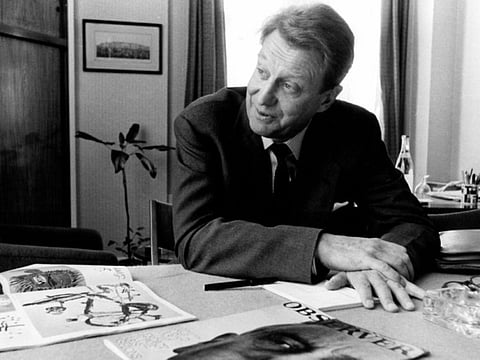
David Astor
By Jeremy Lewis, Jonathan Cape, 432 pages, £25
With compound interest accumulating on the rental income from their Manhattan property empire, the Astors, wishing to better themselves, very reasonably decided that “America is not a fit place for a gentleman to live”. In 1890, the latest in the line, one William Waldorf, having trumped up a coat of arms ( “a silver goshawk perched on a gloved hand”), thus built an Italianate mansion on the Thames at Cliveden, a house so large and ostentatious, meals were despatched from the kitchen to the dining table by miniature railway. There were dozens of maids and gardeners. The Astors took their own cow on holiday to ensure a private supply of fresh milk.
Realising that a good way for a pushy individual to “interfere in public affairs” was to become a newspaper proprietor, William purchased the “Observer” from Lord Northcliffe in 1911 for £5,000. He sacked the editor for spiking his contributions, and died on the lavatory in Brighton, though at least by then he had become a viscount.
It was his son, Waldorf Astor, presumably named after a hotel, who was David Astor’s father. In 1906, Waldorf married southern belle Nancy Langhorne, and what a complete pain she sounds. Nancy “conveyed a sense of perpetual restlessness”, Jeremy Lewis says in this nevertheless highly sympathetic biography. “She enjoyed reducing children to tears as much as driving them to a frenzy of excitement.”
Nancy Astor became a member of parliament, campaigning for women’s pensions and prison reform, though her sole achievement was to raise the drinking age in pubs (it was 14); she engaged in a feud with Winston Churchill, whom she thought a disgusting alcoholic.
Nancy’s party piece at Cliveden was to impersonate the facial contortions of a person having a stroke. After dinner she would don a silly hat and put in a pair of comical false teeth. Perhaps she was simply trying to emulate her niece, Joyce Grenfell?
In any event, she was, seemingly, a nightmare mother. David was born in the family townhouse in St James’s Square in 1912. If Nancy visited him at school she would take over from the teachers and bark out orders.
Lewis says that David grew up “a queer mixture of extreme softness and extreme hardness” — a human meringue? Patrick Leigh Fermor thought he resembled Disney’s Pluto, and though “modest, self-effacing, generous, complicated and single-minded”, he infuriated the family care activist Erin Pizzey so much she installed an answering machine to avoid his calls.
“David became increasingly controlling,” she said — ironic, as he was helping her set up a women’s refuge from abusive men.
“I wish you’d been born an ugly girl,” his mother told David, “then you couldn’t leave me.” It can’t be any surprise that he became an enthusiastic devotee of Sigmund Freud, as well as having to be prescribed Prozac and lithium. Astor used some of his money to endow a psychiatric unit at Guy’s and he startled Katharine Whitehorn, women’s editor at the “Observer”, by telling her with authority that she was “suffering from penis envy”.
At Eton, he was “very average academically”. He proceeded to Balliol College, Oxford, and kept two horses and a groom outside the city. “I don’t think David does any work,” said his tutor. “He has a lot of social engagements.” His mother was such a domineering and possessive snob that when he befriended “the son of a Welsh miner”, she expected the professors to put a stop to it.
During the war, Astor joined the Royal Marines and guarded Deal. He met a Resistance leader in France, but “a mild attack of dysentery” put paid to any heroics. While in a field hospital he met a “bibulous” Terence Kilmartin, so later made him literary editor of the “Observer”, a replacement for J.C. Trewin, who had mystifyingly refused to use the telephone on any pretext.
At least Astor could see, Lewis argues, that he was leading “a shallow, vapid, cotton-wool life”. As an antidote he thought perhaps he would become a plumber or garage mechanic. In order to feel “a refugee from my family”, he visited the Rhondda and helped unload a lorry. Unfortunately, a vast inheritance materialised from his grandfather, which made him financially independent for the rest of his days.
Though his chauffeur was luckily always there to keep him “informed of what the man in the street was thinking”, Astor never quite knew what a mortgage was, and he was ignorant of overdrafts or the realities of everyday expenditure — he assumed that everyone on the staff of the “Observer” enjoyed a private income. His office manager, attempting to economise, turned out the lights while people were still working.
Lewis is light on the private life. We are told that Astor had an affair with Elisabeth Welch, the cabaret artiste, and that later he married the daughter of a Torquay solicitor. Because he had “no innate taste for luxury”, he was determined to lead “a more middle-class life”, and I salute him for managing to cope with just “a driver, a housekeeper and a Czechoslovakian cook” in a succession of big stucco villas. Any dwelling with fewer than 16 bedrooms was a “cottage” to the Astors — and the question now arises: would Astor have been appointed editor of an important national broadsheet on his own merits, without the powerful family connections?
Though “not so mad on journalism as all that”, he was put in charge in 1948, when it was still decreed by the Astor trustees that no Catholic or Jew could be allowed on the staff, only people “with the correct ethical point of view”, preferably Christian Scientists. Cyril Connolly thought Astor “a clumsy wielder of accidental power”, but still, with the news that the “Independent” is to cease its print editions this month, it is easy to relish the rollicking chapters here about the golden age of a long-vanished Fleet Street, before Pilates and San Pellegrino came in, when any semi-educated reporter was capable of writing crisp and concise English; when Dickens, Meredith and Goethe could be discussed knowledgeably by typesetters; when everyone smoked and drank themselves comatose and a newspaper had brilliance and bounce.
When Astor took over the “Observer”, its circulation was 360,000. He doubled it in a decade. Vita Sackville-West did the gardening column. Kenneth Tynan went to the theatre. Kim Philby was employed to cover the Middle East because “he seems an extremely reliable chap and he has created a good impression”, Astor said.
Though Anthony Burgess was sacked when he started reviewing his own novels favourably in the “Yorkshire Post”, Kilmartin sensibly got him back. The foreign editor was appointed “on the basis of an essay he’d written on one of the Bronte sisters”. The Washington correspondent filed his report on Bobby Kennedy’s funeral before it had taken place.
As it was David’s habit to fill the paper with “various friends and acquaintances”, he didn’t mind if they defenestrated typewriters or seized pneumatic drills from labourers and began to dig up Tudor Street. The porter-cum-receptionist had been a butler at Cliveden, “sacked after being found asleep in Lord Astor’s bed”.
If the sense of dynastic poshness and entitlement on display here is an outrage, what counts in the end is that Lewis has turned Astor, featherbedded by his loot as he was, into a character from Wodehouse or Surtees. He died in 2001, ending his days campaigning for the welfare of Myra Hindley, who had begged him to get Lord Longford to stop visiting her, as she had suffered enough.
–Guardian News & Media Ltd


