‘First lady’ in two angles
Jacqueline Kennedy’s life seen through the prisms of a grieving wife and an editor who embraced publishing and commerce
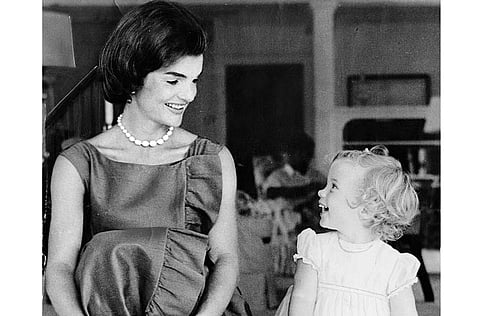
The honorific "first lady of the United States" was first accorded to Dolly Madison, the erudite, charming and popular wife of America's fourth president, though she earlier had acted as official White House hostess for his great friend, the widower Thomas Jefferson.
Other first ladies since are recalled as embodying various permutations of their position, which is not an official office: Edith Wilson is remembered for her dubious overreaching during her husband's last, debilitating illness; Eleanor Roosevelt for her outspokenness and vigorous embrace of progressive causes; Nancy Reagan for her loyalty and fashion; Laura Bush for her intelligence and dignity. Michelle Obama seems sure to leave her mark as well.
Jacqueline Lee Bouvier Kennedy — later Jacqueline Kennedy Onassis — remains, however, the iconic first lady. No president's wife before or since has so dominated the public imagination, set examples for the worlds of taste and style or left such a mark on both high and popular culture. No one has been so popular nor remained such a preoccupation of the press and the common imagination.
So it is interesting to recall that more than a third of her life was spent as a highly productive, well-respected book editor at leading New York publishing houses.
Three new books happen to coincide with a resonant moment in US national life: This is the first time in more than 60 years that no member of the Kennedy family has held federal office in Congress.
Dear Mrs Kennedy: The World Shares Its Grief, Letters November 1963 by Jay Mulvaney and Paul de Angelis mines more than 800,000 condolence notes Jackie received after her husband's assassination, now archived at his presidential library.
They amount to a sentimental period piece of interest mainly to the nostalgically inclined.
William Kuhn's Reading Jackie: Her Autobiography in Books and Greg Lawrence's Jackie as Editor: The Literary Life of Jacqueline Kennedy Onassis are another matter because they shed new — in the latter's case, often entertaining — light on the part of this remarkable woman's life that she most clearly chose for herself. Books, writing and reading always were her private passions. She assembled several notable private libraries over the course of her life and, as Kuhn says in his introduction, her favourite works were Isak Dinesen's Out of Africa, Colette's Cheri and Jean Rhys's Wide Sargasso Sea. Jackie also was, according to Kuhn, a talented writer who, as a college student, won Vogue's Prix de Paris but was forced to decline by her mother because "[i]t was not cool for an American girl to be smart".
Jackie briefly flirted with a reporter's career — she called it a "ticket to a wider world" — before marrying the then-rising young Massachusetts congressman John F. Kennedy. Kuhn and Lawrence take up the story of her life after her full-time return to New York after the death of her second husband, Greek magnate Aristotle Onassis.
A longtime friend, Tom Guinzburg, offered her a consulting editorship at Viking Press. She took up the offer and became a full-time editor, acquiring new manuscripts and participating in their editing and production. A scandal involving a pot-boiling novel by British author-politician Jeffrey Archer, which envisioned an assassination plot against her former brother-in-law, senator Edward M. Kennedy, forced her to resign and she moved to the far more commercial Doubleday house.
Kuhn and Lawrence take a chronological approach to Jackie's career as an editor and agree on its significance to the story of her life. Kuhn is a historian and his rather earnest account of those 19 years is burdened with the conceit that the books she published amount to the only real autobiography she ever left, apart from minor sketches from girlhood. It is a dubious proposition, given her clearly enthusiastic embrace of publishing as commerce.
Lawrence's account is far richer in anecdote and perspective, though the one thing on which he and Kuhn emphatically disagree is Lawrence's relationship with Jackie the editor. Lawrence characterises it as close, warm and supportive — a feeling apparently shared by the majority of her authors — while Kuhn reports it as distant, difficult and problematic. Someone else will have to sort that one out.
What is clear from both accounts is that Jackie was a remarkably perceptive and sensitive editor with a regard for writing and a sense of what makes writing good — far more than just a socialite in an office with a drop-dead Rolodex. Though her long and productive career in publishing may not quite add up to the autobiography she was too tactful and reticent ever to write, it is nonetheless an essential chapter in an altogether remarkable life.


