‘England needs Churchill. We need him too’
The diaries of Stalin’s unlikely ambassador to London make intriguing reading
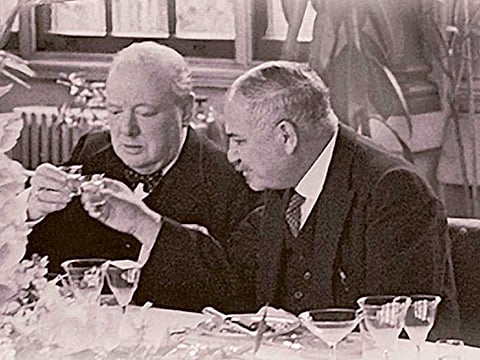
The Maisky Diaries: Red Ambassador to the Court of St James’s, 1932-1943
By Ivan Maisky, edited by Gabriel Gorodetsky, Yale University Press, 632 pages, $40
Almost no Soviet officials kept personal diaries in the 1930s and 1940s. It was too dangerous. Under Joseph Stalin’s dictatorship, the secret police knocked on your door, took you away and rifled through your private papers. Irrespective of its contents, a diary would have indicated a contemptible “bourgeois” mentality. The contents might have led to imprisonment, torture, a labour camp or a bullet in the neck.
In the Soviet diplomatic corps, two ambassadors of that era are known to have risked writing diaries. One was Alexandra Kollontai, a veteran revolutionary and the most prominent woman in Russia’s leadership after the 1917 Bolshevik coup. She drifted into the party’s internal opposition in the early 1920s and was shunted into “exile” as ambassador to Norway, then Mexico and finally Sweden, where she served from 1930 to 1945.
Kollontai’s diaries, scrappily written but sometimes very moving, reveal a humane woman horrified by the blood-soaked excesses of Stalin’s terror. However, they offer limited insights into Soviet foreign policy, for Stockholm was a long way from the action as Europe lurched into the Second World War.
The other diarist was Ivan Maisky, ambassador to London from 1932 to 1943. A political exile under tsarism who had first visited London in 1912, Maisky was a sharp-witted, somewhat stubborn intellectual who entered the Soviet diplomatic service in the 1920s.
Maisky’s independent spirit, which found expression in his professional work, makes it almost incredible that Stalin omitted him from the purges that ravaged the diplomatic corps — like the government and the Communist party more generally — on the eve of the war.
The likeliest explanation is that Maisky’s long experience of London, and his unmatched access to British politicians and policymakers, made him all but indispensable — at least during the years when Britain’s foreign policy, especially towards Nazi Germany, was of vital concern to Moscow.
Now Maisky’s copious diaries are available in full, in English, for the first time. As a first-hand account of British politics and international diplomacy in the prewar and war years, they are an invaluable source.
Maisky published several volumes of memoirs in the 1960s but they were subject to strict Soviet censorship. Moreover, he sometimes put what Gabriel Gorodetsky, editor of the diaries, calls a “misleading and tendentious” slant on his work. By contrast, the diaries have that wonderfully fresh smell of material written by someone with a ringside seat at history and a gift for engaging prose.
Gorodetsky, a fellow of All Souls College, Oxford, and emeritus professor of history at Tel Aviv University, discovered the Maisky diaries in the Soviet archives in 1993. He has done a superb job of checking Maisky’s accounts of events against British and other archival material and providing succinct explanations for readers of when and why Maisky’s versions are different.
For 11 years, Maisky cultivated an extraordinarily wide range of contacts at the top of British politics and public life. Long conversations with Winston Churchill, Anthony Eden, Lord Halifax, Lord Beaverbrook, Joseph Kennedy (US ambassador in London from 1938 to 1940), David Lloyd George, Sidney and Beatrice Webb, H.G. Wells, George Bernard Shaw and others fill the pages of Maisky’s diaries.
If an envoy’s job is to penetrate the inner decision-making circles of his host government and to build up a comprehensive picture of the personalities and factors that shape its foreign policy, then Maisky had few equals as an ambassador in 20th-century Europe.
If the job description extends to trying to mould political and public opinion in a manner favourable to his own government, then Maisky was arguably the most influential ambassador in London since the Count of Gondomar, the Spanish envoy during James I’s 1603-25 reign.
Some of Maisky’s diary entries are startling to read. After meeting Beatrice Webb, the socialist thinker, in October 1939, he writes: “How much snobbery there is even in the best English people! In conversation with the Webbs, I mentioned what Churchill said to me the other day: ‘Better communism than Nazism!’ Beatrice shrugged her shoulders and noted that such a statement was not typical of the British ruling elite ... But then, for some reason, she found it necessary to add: ‘Churchill is not a true Englishman, you know. He has negro blood. You can tell even from his appearance.’”
Maisky’s character sketches are astute, notwithstanding their Soviet perspective. In 1937 he observes of Eden, who was in the first of three stints as foreign secretary: “Eden is not made of iron, but rather of soft clay which yields easily to the fingers of a skilful artisan.” In 1938 he nicknames Lord Halifax, Neville Chamberlain’s ineffectual foreign secretary, “the Bishop”, a man who “retires to pray and comes out a worse hypocrite than before”.
When war breaks out in September 1939, Maisky goes to the House of Commons and is deeply unimpressed with Chamberlain, whom he likens to “an old, leaky, faded umbrella”. Maisky writes: “It was sickening to watch him ... He is not the head of the British Empire, but its gravedigger!”
Maisky admires Churchill, with whom he had carefully established a warm relationship as early as the mid-1930s, when the future prime minister was the nation’s main anti-appeasement voice. These efforts stood Maisky in good stead in the war years, when he had regular meetings with Churchill, who would sometimes summon him late at night to Downing Street. There, clad in a dressing gown and on one occasion looking as if he had had “a drop too much”, Churchill would chew the fat with Maisky.
“Churchill is definitely growing old,” Maisky writes in February 1943. “Yesterday he lost the thread of our conversation several times and, turning to Eden, asked with impatience: ‘Remind me — what were we saying?’ I hope Churchill will last till the end of the war. It’s very important. England needs him. We need him too.”
Ten years later, Maisky was arrested in Moscow and forced to make the ludicrous confession that Churchill had recruited him as a spy in London. Maisky faced a terrible fate, not least because of his Jewish family origins and his early revolutionary career with the Mensheviks, sworn political enemies of the Bolsheviks.
Stalin’s death in March 1953 saved Maisky’s life. But he spent another two years in prison, having been caught up in a web of Kremlin intrigue that resulted in the execution of Lavrenti Beria, the former secret police chief, in December 1953. Rehabilitated in 1960, Maisky died in 1975 at the age of 91.
Yale University Press plans a complete, three-volume edition of Maisky’s diaries, with extensive commentary by Gorodetsky. This selection, containing about a quarter of Maisky’s entries, is a truly delicious first course.
–Financial Times


