Emirates Airline Festival of Literature: Words worth
Heavyweight authors converge on Dubai for a literary fest which began on Wednesday.
Dubai: The sentence, a writer once said, is humanity's greatest invention.
And this week, over 100 of today's top authors (an improvement from 60 last year), including William Dalrymple and Shobhaa Dé, descend upon Dubai during the 2nd Emirates Airline Festival of Literature (EAFL) to celebrate all permutations of this invention.
The four-day event which started yesterday (March 10) at the InterContinental Hotel, Dubai Festival City, will include workshops and seminars, fringe festivals featuring poetry reading, song and drama for school kids, and more serious sessions for adults, and expects to draw in people by the thousands.
Some of the big-ticket draws at the festival include William Dalrymple, writer of White Mughals which won the Wolfson Prize for History 2003, BBC correspondent and non-fiction writer Kate Adie, as well as Shobhaa Dé, the controversial writer of Sultry Days and Second Thoughts.
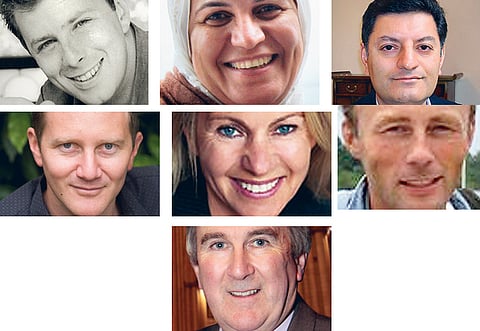
XPRESS caught up with some authors and asked them a set of questions to find out more about their world. Here's what they had to say...
The set of Questions
1. Does the Dubai EAFL give you a suitable platform to address your needs as a writer/author?
2. What is your lifetime mission as a writer? How do you deal with criticism?
3. The same themes or story lines from different writers tend to overlap. How often do you draw on ideas from others?
4. What's the best way to promote book-reading among children? Do you think today's generation is losing the love of reading?
…And the answers
Imran Ahmad
The Pakistani-born author began writing in the aftermath of 9/11. He wrote Unimagined - A Muslim Boy Meets The West.
1. The festival is a wonderful opportunity. One needs to be able to stand up in front of an audience of potential readers and make them think, laugh and, of course, make them want to read my writings.
2. My mission is re-humanisation and an end to tribalism. I am not yet famous enough to have received much criticism.
3. My writing is non-fiction and based entirely on my own experiences. I'm not particularly aware of drawing on ideas from others - but it's possible at a sub-conscious level.
4. The problem is that today, children have so many other options - computer games, the internet and iPods. Nonetheless, we can still reach children with books, by tapping into common experiences and emotions which they recognise and which they can identify with.
Dr Safaa Ahmad Azmy
Egyptian, 49, living in Dubai. She has written 34 books for children and has her own publishing house Wahat Al Hekayat.
1. Dubai EAFL definitely gives me a suitable platform to meet many Arab and international authors as well as people with an interest in children's literature, from all over the world.
2. My lifetime mission is to introduce Arabic to children in a simple, attractive, poetic way. Initially I was sensitive to criticism, but with time I found that some of the critics were right and with more success of my books, people became less critical and I became more confident.
3. Human thinking and ideas overlap. I think of ideas as seeds, give 10 similar seeds to ten writers and they will give you ten different flowers or stories.
4. To promote reading we have to make books available in each corner of the house. Yes, children are reading less because of the attraction of the multimedia world.
Conn Iggulden
The British writer has written the number-one bestselling Emperor series as well as Bones of the Hills and co-wrote Dangerous Books for Boys.
1. I hope so, though it's my first time in Dubai. The chance to get away from research and the computer and actually talk to people is always valuable.
2. As Hilaire Belloc once said: "When I am dead, I hope it may be said: His sins were scarlet, but his books are read." As for criticism, I try to learn from the earnest ones… I digest them and think for a while, kick the dog and then get back to work.
3. I have influences, such as David Gemmell, James Clavell and George McDonald Fraser. I try not to step on toes if I can help it, which in historical fiction means that I won't touch a character if he's been done well.
4. I understand boys better and I know they still like to read stories of courage. I don't think they are losing the love of reading.
Gervase Phinn
British writer with 70 books to his credit, but who is best known for his bestselling autobiographical novels: The Other Side of the Dale, Over Hill and Dale, and Head Over Heels in the Dales.
1. Most certainly. I have spoken widely at various literary events over the years, but this is the most exciting.
2. I don't have a ‘lifetime' mission. I just seek to amuse, entertain, sometimes challenge and maybe provoke.
3. I draw my ideas largely from observing people. Charles Dickens, in David Copperfield, said that "the power of observation in numbers of very young children is quite wonderful for its closeness and accuracy".
4. If you give a child a book, he's going to want to read it. As he reads more books, he'll discover books that make him smile, laugh, cry, angry, curious, frustrated, contented, thoughtful, happy. And then as time passes, he'll become a lifetime reader.
Kate Mosse
The English author wrote two non-fiction books, a play and five novels, including the award-winning multi-million selling international No 1 bestseller, Labyrinth, which was translated into 37 languages and published in 40 countries and chosen as one of Waterstone's top 100 novels of the past 25 years
1. All festivals - Dubai EAFL in particular - are about connecting with as wide a range of readers as possible.
2. I don't know many writers who would say that they had a ‘lifetime mission'. I certainly don't, it's always about the next sentence, the next paragraph, the next chapter...
3. Not at all. A novel has to be inspired from within. So, though you might admire other writers' handling of similar issues, you must always stay faithful only to your own way of seeing the world.
4. If the sales of authors such as Meyer, J.K. Rowling, Pullman or Horowitz are anything to go by, children are reading more than ever. Making books an everyday part of one's day to day life - and accessible to everyone - is the key.
Chris Cleave
Born in London in 1973, his debut novel Incendiary won a 2006 Somerset Maugham Award, was shortlisted for the 2006 Commonwealth Writers Prize, won the US Book-of-the-Month Club's First Fiction award 2005 and the Prix Spécial du Jury at the French Prix des Lecteurs 2007
1. I attend festivals partly to share my work, but mostly to learn from other writers. The Dubai EAFL will be a new world for me.
2. My mission is to create beautiful written artefacts that people will find moving. In fairness, readers and critics have generally been very kind.
3. Never.
4. The best way to get children reading is to write books that children love. If we can produce at least one Roald Dahl or one J.K. Rowling per generation, then children will always be able to experience the joy of escaping entirely into the world of a book.
Tim Butcher
The journalist and author was born in the UK in 1967. His book Blood River - A Journey To Africa's Broken Heart, was the bestselling travel book of 2008 and topped the Sunday Times charts.
1. Literary festivals are fantastic at bringing together authors and readers. The Dubai EAFL will expose me to a cohort of new readers from a different part of the world.
2. To keep curious. If the fire of curiosity goes out then I might as well give up. Honest criticism is always a help. If the criticism is petty and personal then I simply find out where the critic lives and….
3. One would be a liar if one did not admit being influenced by other writers. I hopefully take their influence, but do not steal their ideas.
4. J.K. Rowling taught us that with the right books, children will put away their mobile phones/playstations. She inspired a new generation of writers interested in children's literature.


