Alternative strategies
The challenges democracies around the world face in their attempt to fight terrorism
Although eminently understandable in the aftermath of the 9/11 attacks, few questioned the speed with which counter-terrorism measures were adopted in the United States, ranging from the USA Patriot Act (at 342 pages) to hasty decisions to invade and occupy two sovereign countries. At the time, the mood was to act first and ask questions later, as a besieged Washington bureaucracy mobilised to "defend the homeland" from ninja warriors, ostensibly determined to destroy a particular "way of life".
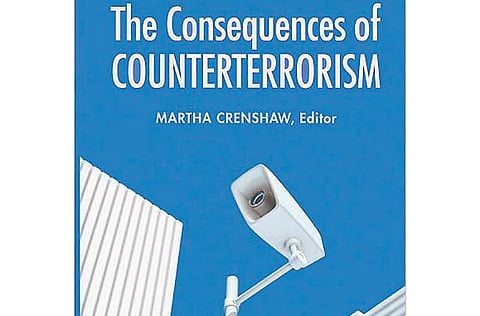
Almost a decade later, responsible analysts have started to pore over the "evidence", raising the kinds of questions that are essential in free societies where the rights of citizens, painstakingly acquired through revolutions and enough bloodshed to paint red all inter-state freeways throughout the world, cannot be absconded without significant challenges. Martha Crenshaw, a renowned professor of political science who is also a senior fellow at the Centre for International Security and Cooperation and the Freeman Spogli Institute for International Studies at Stanford University in California, has edited a fascinating book that answers the call. There will be many more of these investigations but this unique contribution relies on historical and comparative perspectives to document what was learnt elsewhere.
Gently, but effectively, Crenshaw dares to ask how other democracies confronted similar concerns and addressed them without unnecessary panic. She wonders whether citizens living in, and contributing to, democracies are now asked to pay too high a price for what are essentially failed policies. This is courageous to say the least because few have the intellectual courage to write that democratic governments ought to learn from one another, especially in terms of "the ways in which they can better anticipate the political impact of their policy choices and to take that potential impact into account in their decisionmaking" (page 27). In other words, while confronting terrorism is a necessity, one cannot, and perhaps should not, divorce the political costs that presumably are expended to protect citizens from danger.
Legislation against terror
The book is divided into two parts with a total of ten papers, three of which examine governance, civil liberties and securitisation and seven essays that look at specific national counter-terrorism responses. The three thematic chapters are most enlightening, with John Finn offering a comparison of post-9/11 antiterrorism legislation in the US, Europe, Canada and India to demonstrate the effects of hastily drawn policies on civil liberties and constitutional norms.
Needless to say, Finn calls for "robust and public justifications" (page 81) when governments use the law to change constitutional norms. For their part, Chantal de Jonge Oudraat and Jean-Luc Marret brilliantly illustrate how so-called "advanced terrorist designation lists" are. They show their widespread uses, why governments rely on them and how such dependence is ineffective because there are no "safeguards in place that respect fundamental human rights and principles of due process" (page 113). In turn, Gallya Lahav provides a solid examination of immigration policies, which have become inextricably linked to security in Europe, as she compares nascent fears of alleged internal threats (from Muslim minorities) to the American fear of external ones.
The book then focuses on various responses, starting with a magisterial analysis by Dirk Haubrich who explains differences and similarities between the British and American governments after 9/11 and 7/7, both eager to compromise their democratic principles. He correctly focuses on the lack of support among the public for any terrorist objective that speaks volumes and should set to rest any accusations of existing fifth columnists. Rogelio Alonso focuses on Northern Ireland and Spain. He asserts that restricting the rights of those who perpetrate ethno-nationalist violence can become acceptable to protect the rights of citizens who are victims of such violence. Terrorists are weakened, he posits, when they are "denied the right to illegally control and affect the governance of the regions where they operate" (page 245).
Jeremy Shapiro considers how the French response to terrorist threats, which started during the Algerian War, became more coercive during the last 50 years. He depicts in vivid terms how political repercussions gave rise to staunchly Right-wing and racist movements that demanded "action".
Giovanni Cappocia clarifies how Germany, home to millions of foreign workers predominantly from Turkey, strove to protect basic norms and institutions. The most surprising essay is by Ami Pedahzur and Arie Perliger of Israel, whose "war model" of counter-terrorism simply failed. The authors painstakingly document how military influences on state institutions prevented "flexible and conciliatory" (page 356) policies. In contrast, David Leheny stresses the significance of change in Japan's approaches, as Tokyo coordinated its actions with Washington's military presence throughout the Pacific Rim.
This is a sophisticated book that must be read by legislators everywhere. Devoting a few hours of their precious time to it would also enlighten security personnel and prosecutors eager to uphold the supremacy of the law.
Dr Joseph A. Kéchichian is an author, most recently of Faysal: Saudi Arabia's King for All Seasons (2008).


