Images from the fringes of society
Narrating the plight of those caught on the wrong side of history
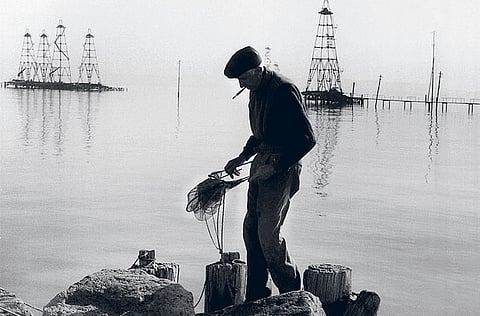
A man approached Rena Effendi one day while she was walking down the street in a neighbourhood mahalla in Baku, Azerbaijan. He had seen the camera hanging around her neck. "My mother is dying. It's the last day of her life," he pleaded. "Can you please come to our home and photograph her for me?"
Effendi was with her photography teacher at the time and they both followed the man into his house. The room was dimly lit and his mother was breathing very heavily. The woman looked almost translucent from the light the window cast on her sharp cheek bones and accentuating the whiteness of the sheets and her pale skin.
Effendi held her breath from fear of getting infected by the "air of death". Her teacher, sensing that Effendi was in no state to remember, whispered "2.8 and 15" — the aperture and shutter speed settings for Effendi's Rolleiflex camera. Effendi stayed in for only a few moments as she took photos of the woman. The next day, when she went back to the house to give the man copies of the photographs, she found a funeral tent. He quietly thanked her and said no more.
This happened in 2003. Fast forward to a different time and place and I am waiting at London's HOST gallery to interview Effendi, now an award-winning photojournalist. I have arrived early and there is a flurry of mild panic in the gallery. Tonight she will be giving a talk about her new book of black-and-white photos — Pipe Dreams: A Chronicle of Lives Along the Pipeline. Sitting in a corner of rows of empty chairs, sometimes flicking the pages of her book, copies of which lie on a nearby table, I can overhear Effendi and the organisers as they plan out how she is to introduce herself and the sequence of the talk. Someone else has been testing to make sure the microphone is working.
Timeout for a tête-à-tête
Clearly a woman in demand, when she gets a moment she hurries over to assure me it won't be long. Effendi only arrived two days ago from Baku and is leaving the next day to go home to her husband and 4-month-old baby. Suddenly there is a knock on the door. Standing outside are some guests who are early and want to come in. I look quizzically for help at a representative from the Buta Festival of Azerbaijani Arts of which this event is a part. Finally Effendi announces it is time for the interview and she leads me upstairs to a quieter room. As we sit down, I ask her about the weather in Baku and am surprised to learn London is colder. Soon we leave aside the small talk as she delves into her journey to become a photojournalist, having started her career as a painter. "I often say that it was my frustration with the brush which led me to photography," she explains. "I felt very restless sitting in that room struggling with the canvas. I was looking for something more dynamic and a friend of mine gave me a camera to play with for one day. It was an old Nikon camera with no electronic function. I held it in my hand and it just felt right."
Then one day she found out there was a Magnum exhibition coming to Baku. The night of November 5, 1999, was also the opening of the first McDonald's in Azerbaijan and she had invitations to both events. So it happened that while all her friends went to McDonald's, Effendi opted instead to attend the opening for the Magnum exhibition and was inspired by what she saw. It was a travelling show of Magnum photographers examining 50 years of the Cold War.
"The pictures were interesting to me as they showed our history from a different perspective— that of a foreign observer," she says. "Rather than someone who had experienced it firsthand, living through the hardship. This was the first time that I looked at our grim reality and found it beautiful." Her father's old work has also been an influence. He had been a butterfly scientist or lepidopterist, which involved travel around the Caucasus and Central Asia to catch butterflies. He kept an album of the black-and-white photos he took of the butterflies and his work holds a special place for Effendi.
Early recognition
"I first came across photography as a very powerful way of expressing what you feel about the world," she says. In 2004 she sent some photographs she took of a disappearing mahalla in Baku to Fifty Crows in San Francisco and was surprised to win an award, which gave her confidence. So she quit her job at the US Agency for International Development and started full-time work as a photographer. The move has certainly paid off. In 2007 she was chosen among 30 emerging photographers to watch for by Photo District News magazine and selected as a finalist for the Magnum Photos Inge Morath Award. In 2008 she won the National Geographic's All Road photography award. She has also been recipient of a grant from Getty Images and a winner of the Giacomelli Memorial Fund.
I turn the conversation to her book, which is about the lives of people living along the Baku-Tblisi-Ceyhan oil pipeline. It stretches over 1,700 kilometres and brings oil from the Caspian Sea to the Mediterranean. Effendi, 32, has spent six years on the book and travelled along the length of the pipeline to capture the lives of that section of society left out from the oil boom.
When she first started, she did not have the pipeline in her mind but soon discovered that every story she came across was somehow related to oil, which has had a profound impact on Azerbaijan.
In fact Azerbaijan's relationship with oil runs so deep that it is also known as the "land of fire". Some say the burning flames of the place were what long ago inspired Zoroaster. But it was the construction of the pipeline in the post-Soviet dawn of the region which helped transform the country and the city of Baku, bringing in much needed capital. "I think it is both a blessing and a curse for Azerbaijan," she says. "It has had positive effects for development. But by stifling out all the other sectors of the economy, it has made the country too dependent on one major sector of the economy. The purpose of this book was to show those faces are hidden by the corporate propaganda."
Ironically it was while working on a commercial assignment for BP to collect images for their corporate calendar that the idea to travel the length of the pipeline came about. "I saw along the way that some of the things I really wanted to photograph weren't fitting in with the calendar," she says.
Undone by a pipeline
So she travelled from Azerbaijan along the pipeline's route in Georgia and into Turkey. In Yumurtalik, off the Mediterranean coast in Turkey, she came across fishermen who had lost their livelihood due to the pipeline and instead become toilet cleaners at a military base in Iraq. This was because the bay where the fishermen used to fish became restricted due to increased pipeline security and tanker traffic, forcing the fishermen to go to deeper waters where they were confronted by a lower supply of fish and increased petrol costs. There was also an environmental chain reaction from the releasing of warm water into the sea which had an impact on the fish's habitat.
The fishermen have received compensation, she says, but it just wasn't enough. The fishermen told Effendi she was the first journalist who came to hear about their plight.
She relates another story about a village in Azerbaijan where the pipeline goes directly underneath because the company did not want to displace the people. "I saw such poor families living there, especially one with a guy who was mentally unstable and was living on his elderly mother's pension of about $50 a month. You see all this wealth passing underneath the home. The pipeline was outside the fence; I saw the yellow stickers. They had one cow and the elderly mother and two mentally unstable brothers and one sister who is not married and it is a very desperate situation."
Effendi uses the words "fading hope" to describe the situation of the people in the region who are linked with the pipeline. Is she pessimistic about the future? "It's not about being pessimistic. The word ‘fading' applies here because the hope is still there but everyday there is less of it. For me it sometimes goes up and down. I think of them, especially when the pipeline was being built. There was a lot of PR action around it and there were a lot of people going back and forth promising them things," she says. "Then in the end when they didn't get what they were promised, there was a big disappointment. So I think they feel very much underwhelmed by the situation to say the least."
One resident in Tetritskaro, Georgia, told Effendi that the compensation they receive was like "throwing a piece of bread to a dog to make it stop barking".
The book is not available in Azerbaijan and 50 of her own copies have been stopped at the border and not let into the country. I ask her about the future prospects of it ever being available and she laughs about her "fading hopes" for that to happen.
Bursting the comfort bubble
Yet outside the country her work has drawn attention to a crucial issue which many people are not even aware of. "I think people in Europe are interested probably because this gas is keeping the continent warm in the winter. So they want to know where it comes from."
What of the Azeri elite or the people who have benefited from the pipeline — what do they make of the despairing situation facing the other half? "There is not much awareness because there is state censorship for all media. Everything that gets published or put on TV has to go through censorship. There are some social programmes but they are very rare. Everybody is preoccupied with showbusiness and fake news and things like that."
There are people who kind of understand or guess when they drive through the country and see what is happening," she says. "They just look outside the car window and see for themselves. But they also try to forget. I feel like they live in this bubble of comfort. I have this bubble of comfort too but it's my photography that takes me out of it."
She is drawn by the dynamism of photography, which is a world away from the constraints she experienced as a painter. "You go out and meet people. You can then lay out a narrative. So it is more sort of between painting and cinema, you know. That kind of perfect point."
The image of the dying mother in the old mahalla is evident of this potent mix of the visual and narrative in her work. Today when Effendi remembers it, the incident feels like a dream to her, with the picture the only proof it happened. "I still question that because it's a very unusual thing for us," she says. "I was in a way privileged to be there in such an intimate moment when you don't really invite a stranger from the street. It was probably a strange accident that he saw I was a woman with a camera and an idea came to his head. Why not take a picture of my mother on the last day of her life? He was probably grieving her, obviously she was dying slowly and he wanted to preserve that memory."
Besides the pipeline project her photographs have taken her to various countries, including Russia, India, Iran and Egypt. She has also been to Osh, in the Ferghana Valley section of Kyrgyzstan, where she took photos of women who are heroin addicts. According to the United Nations, nearly 60 per cent of the opiates from Afghanistan pass through the mountains of Kyrgyzstan and Tajikistan. "What they call the ancient Silk Road is now nicknamed ‘Heroin Highway'," says Effendi. "A lot of really cheap quality of heroin sits in Osh and then there are a lot of addicts, both male and female. But I decided to focus on women because the society there is so traditional.
"They raise women to be mothers and wives and they don't really have any life skills," she says. "If they get divorced they also get stigmatised by society. They can't go back to their family, so a lot of them fall victim to trafficking or abuse. The story is called House of Happiness because it is the name of the institution where their marriages happen. I look at one side where you have a happy facade, the sort of fake cultural curtain. But what is behind the curtain are these women — victims of heroin. Some of them were introduced to it and trafficked by their own husbands. So it's a family story in a way. "
So what is next in the pipeline for Effendi? "I have several ideas for future projects," she says. "One of them is to go up to this village called Xinalik inhabited by a thousand shepherd families that speak a language that nobody else speaks in the world. It is kind of a disappearing culture. More of a travel piece."
I am distinctly aware her talk is soon to begin and ask if she is getting nervous. "No, I am not. I just feel I should go down. What time is it?" I inform Effendi I still need to take her photo and am surprised when she hesitates and wonders if it would be okay if she provided me with her own pictures.
The woman who travelled along a pipeline stretching over 1,700 kilometres, entered the homes of complete strangers and took their photos, is not too keen when it is the turn for someone else to click her picture.
As luck would have it there is a poster of Che Guevara on the door and I somehow persuade her it would be the perfect setting. Effendi voices her disapproval of the photogenic revolutionary Cuban rebel, telling me she is not a fan. Posing a bit reluctantly, she keeps a safe distance from the image of Guevara. I momentarily fumble around with the camera, feeling a bit embarrassed in front of my bemused subject, muttering an apology about the contraption being a new purchase and still having to figure out all the functions.
The camera finally records the image. Downstairs there is a queue that has built up at the door for the night's event. As I step outside the building into the cool London air and make my way down Old Street, I take out the camera and have a closer look at the photo. Guevara is standing in his army fatigues and holding a golf stick in his right hand; he is looking down and laughing in the direction of a smiling Effendi. She, for her part, is staring towards the camera — perhaps longing to be behind the lens again.
Syed Hamad Ali is an independent writer based in Cambridge, UK.


