Geithner push splits G20 nations
Finance ministers struggle to agree on current account targets
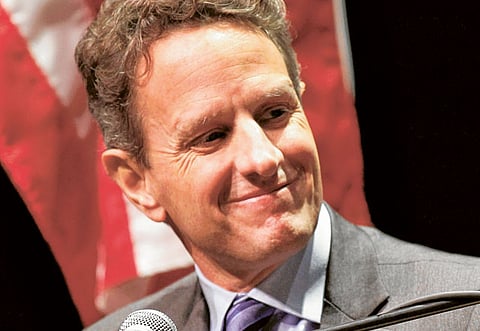
Gyeongju, South Korea : Group of 20 (G20) finance chiefs are struggling to agree whether to set targets for their current account imbalances as a way of defusing tension over currencies before it sparks a trade war.
G20 finance ministers and central bankers began talks in Gyeongju, South Korea, today after weeks of wrangling over whether nations from the US to China are relying on weaker exchange rates to spur growth.
Seeking a solution, US Treasury Secretary Timothy F. Geithner proposed G20 members pursue policies to reduce trade imbalances "below a specified share" of their economies, according to an October 20 letter. That suggestion split the group of emerging and industrial countries.
"I think that setting numerical targets would be unrealistic," Japanese Fin-ance Minister Yoshihiko Noda told reporters. Canadian Finance Minister Jim Flaherty told Bloomberg Television the idea was a "step in the right direction" and a French official said the Group of Seven, which includes Japan, was supportive of it.
Repeating themes he has pushed for the last month, Geithner also told his colleagues not to seek "competitive advantage by either weakening their currency or preventing appreciation of undervalued currency." Geithner also urged countries with persistent current account surpluses to "undertake structural, fiscal, and exchange rate policies to boost" domestic demand and those with "significantly undervalued currencies" to allow them to "adjust fully over time."
IMF role
If current account aims are adopted, the International Monetary Fund should be handed the role of monitoring progress through a semi-annual report, Geithner said.
The greenback weakened versus 14 of its 16 major counterparts. The dollar fell to $1.3955 per euro as of 6:39am in London from $1.3920 in New York yesterday. It fell to 81.14 yen from 81.33 yen.
The G20 officials are meeting in a bid to end what Brazilian Finance Minister Guido Mantega calls a "currency war." China's restraint of the yuan even as it runs a trade surplus and the recent slide of the dollar as the Federal Reserve shifts toward easier monetary policy are in the spotlight.
Nations caught in the middle such as Brazil and South Korea are embracing capital controls or intervening themselves to stay competitive with China and limit inflows of speculative cash from North America and Europe.
Fragile recovery
This has raised concern from policymakers and investors that the friction will spark a round of devaluations and retaliatory protectionism, derailing an already fragile global economic recovery.
"History teaches us that moves toward competitive devaluation and beggar-thy-neighbour policies are negative for the world economy," Noda said. "We should come up with ideas that go beyond our individual circumstances."
Focusing on current account imbalances takes the debate beyond the thorny topic of currencies and allows policymakers to address excess US demand and Chinese savings, according a South Korean official.
Limiting talks to foreign exchange is too inflexible for nations with trade surpluses and would make agreement less likely, the official said.
Looking at the current account allows countries to decide on which tools to adopt to reduce their trade imbalances, including exchange rate appreciation, he said.
"It's fraught with difficulties, but a framework would be an attempt at looking at currency revaluation and cooperation without resorting to a shouting match," said Kit Juckes, head of foreign exchange research at Societe Generale SA in London.
Statement
The G20 finance officials are also debating whether to make their first joint comment on currencies since their leaders began meeting in 2008, having previously resisted remarks for fear of alienating China. A draft statement yesterday included a pledge to avoid "competitive undervaluation" of currencies. The final text is scheduled for release tomorrow and won't be finalized until then.
Leaders said as recently as an April 2009 summit in London that they would "refrain from competitive devaluation" of currencies and at June talks in Toronto said exchange rates should avoid excess volatility and be made more flexible in emerging markets.
Any initiative to set current account targets still leaves Asian economies under pressure to allow their currencies to gain, said Win Thin, global head of emerging markets strategy at Brown Brothers Harriman & Co. in New York.
His estimates on the basis of purchasing power have the yuan, Thai Baht and Philippine Peso undervalued by at least 70 per cent.
It may nevertheless provide a way of persuading such nations to revalue in lock-step rather than be wary of acting only to lose competitiveness as others hold back, said Juckes.
China has limited gains in the yuan to about 2 per cent against the dollar since a June pledge to embrace flexibility, forcing other countries to try and control their exchange rates to keep a trading edge with the world's largest exporter. South Korea is discussing several measures including a bank tax or levy on financial transactions and Brazil this week raised taxes on foreign inflows for the second time this month.
US deficit
In a sign of the challenge that would await the G20, the International Monetary Fund this month estimated the US current account deficit will remain around this year's 3.2 per cent of gross domestic product in 2015 and China's surplus will swell to 7.8 percent from 4.7 per cent.
Geithner's proposal leaves questions to be answered, said Tim Adams, a former US Treasury official. Among them is whether governments will detail how and when they'll meet the goals and what happens if they're missed.
The G20's ability to carry out its own commitments has also proved patchy. A repeated vow to avoid protectionism hasn't stopped its members imposing about 400 measures that hurt trading partners in the past two years, according to Global Trade Alert.
The skirmish over exchange rates tests the G20's ability to strike consensus after it became the main body for shaping international economic policy a year ago.
After uniting to bailout banks and cut interest rates and taxes to fight the credit crisis, members have since clashed on the withdrawal of stimulus and imposing taxes on financial speculation.
"It seems a bit of a stretch to look for some sort of unified currency policy to come out of the G20," said Thin at Brown Brothers Harriman. "It's hard enough to get any sort of consensus in the G7."
Sign up for the Daily Briefing
Get the latest news and updates straight to your inbox


