Rich but in the red: Seven big economies owe over a year of GDP
IMF data: 11 economies make both lists as interest bills grow; Singapore is the outlier
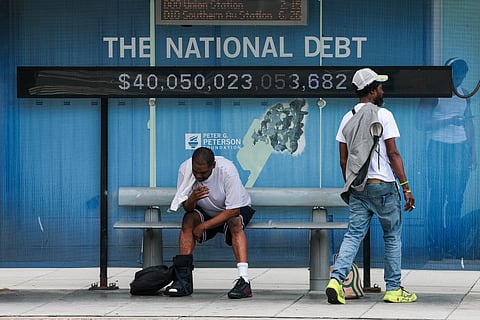
Dubai: Several of the world’s biggest economies owe more than a year of output, according to International Monetary Fund projections for 2026. The United States leads on size at $32.6 trillion and ranks eighth on debt, at 126.8 per cent of GDP. Sudan tops the debt table at 334.4 per cent. The global ratio stands at 94.6 per cent.
The comparison uses 2 data sets from IMF’s October 2026 World Economic Outlook. It looks at the 30 largest economies by nominal GDP against the 30 highest debt-to-GDP ratios. About 11 countries appear on both lists. And the size of those countries offers little protection.
What is driving the numbers
The bigger story sits beneath the ratios, it the ballooning interest payments, these countries need to make. The IMF projects average government financing costs rising from 2.3 per cent in 2021 to 3.7 per cent by 2031. The global primary deficit, which excludes interest, will reach about 3.3 per cent of GDP in 2026. Stabilizing debt needs about 2.6 per cent. Defence spending, ageing populations and energy costs after the Middle East war add to the bill.
United States: Size and the dollar
The US ratio implies debt of roughly $41.4 trillion. Federal debt passed $40 trillion on August 18. The Congressional Budget Office projects a fiscal 2026 deficit of $1.9 trillion. Net interest reached about $1.04 trillion, close to 19 per cent of federal revenue.
Washington copes because lenders keep coming. About 71 per cent of publicly held debt sits with domestic investors. The dollar’s reserve status and the depth of the Treasury market do the rest.
The weak point is yields. The 10-year Treasury peaked at 5.31 per cent on October 5, the highest in over two decades. A weak auction or an inflation surprise could repeat that jump. The IMF estimates that a Treasury supply shock lifts borrowing costs elsewhere by 0.8 to 0.9 basis points for every basis point it adds.
Sudan: A ratio that hides a collapse
Sudan’s debt is projected at more than three times its output. Its economy is worth about $31 billion, ranking 120th. War has damaged productive capacity, trade and farming, leaving a far smaller base.
Most of the burden is old. Sudan has defaulted and piled up arrears since 1984. A 2021 debt-relief plan stalled after the coup. It repaid only $34 million in 2024, all to the World Bank’s concessional arm. China cancelled $50 million (Dh184 million) in June.
The ration needs care. The IMF forecasts 7 per cent growth for 2026, but experts doubt the recovery is real. Either way, Sudan cannot carry its debt without relief, and relief will depend on peace and stable institutions.
Japan: Debt owed to itself
Japan ranks second on debt at 199.4 per cent. It has avoided a crisis for structural reasons. Almost all the debt is in yen, and the country holds substantial net foreign assets. The Bank of Japan owns about 47.9 per cent of government bonds. Average remaining maturity is about 9.5 years, so higher rates reach the budget slowly.
Those buffers are being tested. The 10-year yield touched about 3.12 per cent in October, the highest since 1996. The 30-year hit a record 4.235 per cent. The central bank is trimming its holdings while Prime Minister Sanae Takaichi pursues a looser fiscal stance. Her government has moved away from a primary-surplus target.
The trouble scenario is a bond sell-off that outruns domestic demand. Early signs are mixed. Domestic investors bought $136 billion (Dh499 billion) of Japanese bonds between April and August. If more Japanese money stays home, Treasuries lose a buyer. Japan remains the largest foreign holder, with about $1.07 trillion.
India: Debt below average but interest above comfort
India’s $4.1 trillion economy carries a ratio of 83.1 per cent, below the global figure. The Centre’s own debt stood near 56.1 per cent of GDP in March 2026. The 2026-27 Budget targets 55.6 per cent and a fiscal deficit of 4.3 per cent of GDP. The goal is 50 per cent, give or take one point, by March 2031. The government has made debt, not the deficit, its main anchor.
The cost of carrying that debt is the pressure point. Budgeted interest payments of Rs14.04 lakh crore absorb 39.7 per cent of revenue receipts. They exceed capital spending. The plan works only while nominal growth outpaces borrowing costs. The IMF has urged a broader anchor that includes state government liabilities
Singapore: High debt but no net debt
Singapore ranks third at 166.4 per cent, ahead of Italy and Greece. Yet it is the clearest case of a ratio misleading. Around 99 per cent of its debt is raised for non-spending purposes. Under a 1992 law, money raised from government securities cannot be spent. The proceeds fund Central Provident Fund retirement savings and deepen the bond market. They are invested.
The balance sheet explains the rest. The Ministry of Finance says the government has no net debt, because its financial assets exceed its liabilities. Returns on the reserves fund about 20 per cent of annual spending. All three major agencies rate Singapore AAA. The IMF treats it as a low-scrutiny country for debt sustainability.
It is an example to watch because the model depends on returns. The government has drawn on its reserves twice, most recently for the pandemic. It has also issued bonds for infrastructure since 2021. The IMF expects the CPF’s investment needs to ease as ageing slows employment growth. Its record shows how high debt can be managed. It also shows how much rests on asset performance.
What to watch for
A debt ratio is just a starting point, not a verdict. Interest costs, who holds the debt and the currency it is owed in matter as much. The US and Japan borrow in their own currencies from deep domestic markets, which buys time. Singapore shows that high gross debt can sit beside a strong balance sheet.
Bond yields are the variable to watch, and they can change the picture quickly. G7 benchmark yields rose by more than 110 basis points between February and September. Each rise lifts the interest bill on new and refinanced debt. Shorter debt maturities speed that pass-through.
Economies already spending heavily on interest feel it first. India puts about 40 per cent of Centre revenue receipts into interest payments. A further jump in yields would land on a tight budget. Yields will decide which economies cope and which struggle.


