AIM Congress 2026: Africa looks to Gulf investors to power its next growth phase
From minerals to manufacturing, Africa courts Gulf capital for value-added growth
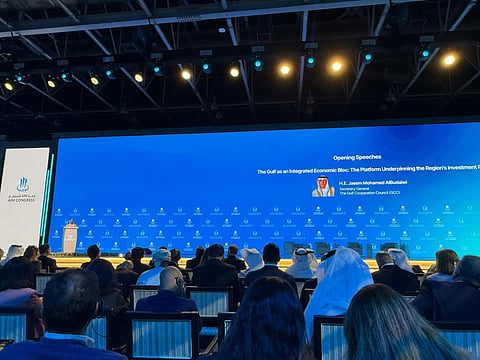
Dubai: Dubai World Trade Centre has become an unlikely capital of African economic diplomacy at the AIM Congress 2026. From Robinah Nabbanja, Honourable Prime minister of Uganda to Naseem Banu Lahri, the Managing Director Lucara Botswana, the Congress witnessed the powerhouse of Africa walking the red carpets of the Congress.
The banner "The Voice of Africa in the Heart of the Middle East," at the Africa Pavilion at AIM Congress 2026 has drawn heads of state, sovereign fund managers, mining executives and entrepreneurs into a single conversation: Is Africa becoming a genuine destination for Gulf investment, and can that investment move past extraction alone?
Get updated faster and for FREE: Download the Gulf News app now - simply click here.
A pavilion built as an ecosystem, not an exhibit
The Africa Pavilion, hosted by the Africa GCC Council, stands not just as a showcase, but as what its backers call a strategic ecosystem, powered by curated deal rooms, ministerial roundtables and direct introductions between African project sponsors and GCC sovereign funds, family offices and institutional investors.
Dr. M'zée Fula Ngenge, Chairperson of the Africa Pavilion and Co-Founder of the Africa GCC Council, has framed this year's edition as a shift from visibility to outcomes. Rather than a static exhibition, he has described the Pavilion as being restructured around three converging forces, the explicit goal of turning dialogue into bankable projects rather than ‘another round of photo opportunities and memoranda that go nowhere’.
“The AFCFTA, the Africa Continental Free Trade Area, is now in implementation mode, said Secretary General Wamkele Mene while speaking at the African Pavilion, noting that 50 countries have ratified the agreement, representing 1.4 billion people and a $3.4 trillion combined GDP.
That ambition will be tested against a market Gulf capital that has already been moving in. The UAE alone invested more than $110 billion in African projects between 2019 and 2023, over $70 billions of it in green energy and renewables, making it Africa's fourth-largest source of foreign investment, behind only the United States, China and the European Union, according to the UAE's Ministry of Economy and Tourism.
Landlocked, but not land-locked in
The central stage panel paired landlocked nations from two very different regions, the Horn and East Africa, and Central Asia, to argue that regional integration, transit diplomacy and cross-border corridors are the key to economic growth. Uganda's prime minister, Robinah Nabbanja was among the speakers, addressing the investment opportunities the country is bringing to the table despite having ‘no direct access to the sea’.
Taye Atske-Selassie, President of Ethiopia also joined the speakers to outline the Strategic Investment priorities for Ethiopia,” We have a total potential of 60,000 megawatts only from renewable sources and our aim is to reach a target of 50,000 megawatts by 2030,” He said, as he aims to scale up energy supply across east Africa and beyond.
The minerals at the centre
If the Pavilion supplies the diplomacy, critical minerals supplied the hardest economic argument of the week. Addressing delegates, Wamkele Mene, Secretary-General of the African Continental Free Trade Area (AfCFTA) Secretariat, laid out the scale of what is now in implementation. 50 African countries ratified the agreement, most recently Somalia, bringing together a market of roughly 1.4 billion people and a combined GDP of $3.4 trillion, He shared on Stage.
Mene argued that Africa's position in critical minerals such as copper, cobalt, lithium and bauxite sits at the centre of the global shift to renewable energy and electric mobility. His argument centered less on extraction than on what comes next: moving beyond raw commodity exports to building the refining and manufacturing capacity within the continent.
While speaking at the Pavillion, He also emphasized his aim to strengthen the intra-African trade, promoting investments and unlocking opportunities of the private sector, particularly for the Small and Medium-sized Enterprise (SMEs) and entrepreneurship across Africa.
Meet the FYWEDO of Africa
The F& F Young Women Entrepreneurship Development Organisation (FYWEDO) takes part in the AIM congress to address the capacity-building gaps of African SMEs, specifically focused on entrepreneurial soft skills like branding and marketing, says Ngwi Njikta, the Director of Entrepreneurship program and Board chair of FYWEDO.
Having established for three years, she said the organization has collaborated with eight companies in the GCC and Middle East region including the AIM congress, “the Federal Economic Exchange Program enables African women entrepreneurs, who are ready to scale international market to be able to facilitate. We facilitate for them to meet companies in their fields, get mentorship, and assess markets, especially in the GCC and Gulf area, Middle East.” She added.
The bigger picture
Taken together, the Pavilion's deal rooms, the landlocked economies debate and the plans for minerals expansion says the underlying story, Africa is not simply asking for capital but pushing Gulf investors past extraction and logistics to industrialisation itself.
AIM Congress 2026 has aimed to set the stage to produce contracts rather than communiqués for the African Pavilion, as they await the investors to return for a cause.


