
Why photochromic sunglasses change with the light
Smarter shades: How photochromic lenses react to changing light
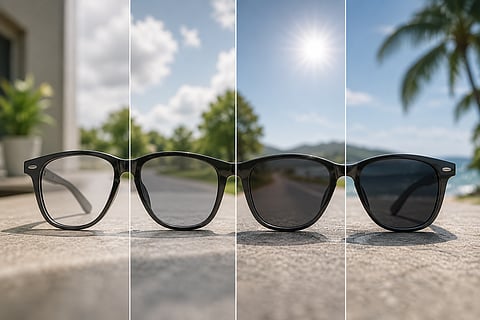
Walk outside on a sunny afternoon and some lenses begin to darken within seconds. Step indoors and they slowly become clear again. It feels almost automatic, but the trigger is not simply brightness. Most photochromic lenses respond primarily to ultraviolet light, which is abundant outdoors but largely absent inside buildings. That explains why a bright room beside a window may not darken your glasses as much as direct sunshine does. Modern lens makers such as Transitions and ZEISS build this behaviour into the lens using light sensitive molecules that repeatedly change structure as UV exposure rises and falls.
What they are and who they're for
Photochromic eyewear combines everyday glasses and sunglasses into one pair. Tiny photochromic compounds embedded in or bonded to the lens change shape when exposed to UV light. In their activated form they absorb more visible light, making the lens appear darker. Once UV levels fall, the molecules gradually return to their original state and the lens clears again.
This makes photochromic glasses useful for people who move regularly between indoor and outdoor spaces, particularly in sunny climates such as the UAE. There is one important limitation, though. Most modern car windshields block much of the UV radiation that activates standard photochromic lenses, so they often remain only lightly tinted while driving. Some specialist lens technologies are designed to respond to both UV and part of the visible light spectrum, but ordinary photochromic lenses generally will not become as dark inside a vehicle as they do outdoors.
What to look for
Choose lenses with certified UV protection first, then consider whether polarisation is also useful. Photochromic technology changes tint according to light conditions, while polarization reduces glare reflected from roads, water and other flat surfaces. They are different features and can sometimes be combined in one product. If driving is your main priority, remember that standard photochromic lenses may stay relatively light behind a windshield, so dedicated driving lenses or clip-ons can still be worthwhile.
ROCKNIGHT Photochromic Sunglasses
These sunglasses are aimed at everyday outdoor use, with photochromic lenses that automatically adapt as UV levels change. Their lightweight design makes them suitable for commuting, walking and casual wear without needing to swap between clear glasses and sunglasses. The UV400 protection helps block harmful UVA and UVB rays for comfortable outdoor wear and the lightweight metal construction helps improve comfort during extended use.The appeal is the convenience of automatic tint adjustment rather than carrying multiple pairs.
grinderPUNCH Polarized Photochromic Driving Sunglasses
This model combines photochromic behaviour with polarised lenses, giving drivers and outdoor users help against reflected glare while still adapting to changing daylight. Polarisation is especially useful on bright roads because it cuts reflected light rather than simply making the scene darker. Keep in mind that the photochromic effect itself may still be limited behind a UV blocking windshield, although the polarisation remains active throughout use.
Costyle Polarized Clip On Sunglasses
Clip-on lenses offer a practical alternative if you already wear prescription glasses. Instead of replacing your everyday eyewear with photochromic lenses, you can attach polarised sunglasses whenever extra shade is needed outdoors or while driving. They are particularly useful for motorists because polarisation works regardless of whether UV reaches the lens. Just make sure the clip on size matches your existing frame before ordering.
Verdict
Photochromic lenses rely on chemistry rather than electronics. Light sensitive molecules respond mainly to ultraviolet light, darkening outdoors and gradually clearing indoors as UV levels fall. Understanding that simple principle also explains why most standard photochromic glasses do not become fully dark inside a car. If you spend most of your day moving between offices and outdoor spaces, a quality photochromic pair is a convenient choice. Drivers who want stronger glare reduction may prefer a polarised option or keep polarized clip-ons ready for the road.
Top recommendation: ROCKNIGHT Photochromic Sunglasses
Gulf News earns a commission on purchases made through links in this article, at no extra cost to you. Our editorial team selects products independently.


