
Why moisturiser works better on damp skin
Why slightly damp skin helps your moisturiser hold on to hydration
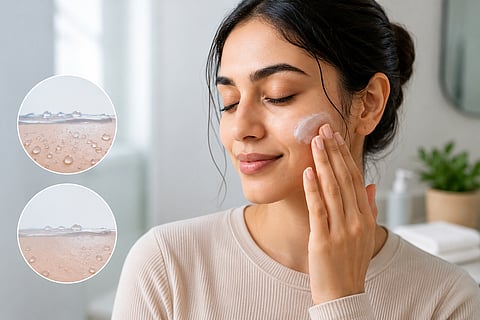
A good moisturiser does not simply pour hydration into skin. Much of its usefulness comes from controlling where water goes next. The outermost layer of skin, the stratum corneum, continually loses water to the surrounding air, a process called transepidermal water loss. Occlusive ingredients create a film that slows that evaporation, and dermatology literature notes that their effect is particularly pronounced on slightly damp skin. The American Academy of Dermatology gives similarly practical advice: after washing, leave some water on the skin and apply moisturiser.
What damp skin moisturising actually does
Moisturisers usually combine three types of ingredients. Humectants such as glycerin and hyaluronic acid attract water. Emollients smooth the spaces between cells at the skin surface. Occlusives, including petrolatum, mineral oil and some silicones, reduce the rate at which water escapes. Many formulas do more than one job because they combine several ingredient types.
Applying them to slightly damp skin gives the formula water to help retain at the surface. Damp means a light film of moisture after cleansing, not a dripping wet face. This can be especially useful when indoor air feels drying, including long periods spent in air conditioning in the UAE.
Layering follows texture and function. After cleansing, apply a water based hydrating serum, follow with moisturiser, then use a facial oil if wanted. In the morning, sunscreen is the final skincare layer. A facial oil is not a substitute for sunscreen.
What to look for
For hydration, focus less on fashionable ingredient counts and more on whether the formula combines water binding ingredients with something that reduces evaporation. Glycerin is a well established humectant, while petrolatum and dimethicone provide occlusive effects.
A serum can add a light humectant layer, but it does not automatically replace moisturiser. Facial oil belongs near the end because an oil rich layer is better suited to slowing water loss than supplying water itself.
Recommended products
Cetaphil Moisturizing Cream
This is the clearest example here of the humectant plus occlusive principle. Cetaphil's current formula lists glycerin high in the ingredients, followed by petrolatum, with dimethicone also present. It also contains panthenol, niacinamide, sunflower seed oil and sweet almond oil. That combination makes it well suited to applying shortly after cleansing, while a little water remains on the skin. The richer cream format also makes sense for readers whose skin tends to feel tight after washing or extended time in air conditioned rooms.
Medicube PDRN Pink Peptide Serum
For the serum step, Medicube's PDRN Pink Peptide Serum uses a water based formula containing glycerin and niacinamide, with sodium hyaluronate among its ingredients. The manufacturer lists Salmon DNA PDRN, peptides and niacinamide as key ingredients for the standard version. For this routine, its most relevant quality is simply its light, hydrating texture: apply it after cleansing, before cream. It illustrates why a serum and moisturiser have different jobs. The serum supplies a water rich layer, while the moisturiser above it is better placed to slow subsequent moisture loss.
Palmer's Cocoa Butter Formula Skin Therapy Face Oil
Palmer's takes the final layer role. The manufacturer lists a blend of 10 oils, including sesame, coconut, sweet almond, macadamia, apricot, argan, grapeseed, rosehip, camelina and sunflower oils, alongside cocoa butter, retinol and vitamin C. From a hydration perspective, the important distinction is that an oil is not adding the same water rich phase as a serum. Use a small amount after moisturiser when an extra lipid rich finishing layer suits your skin. Because this particular formula contains retinol, follow the manufacturer's directions and use appropriate daytime sun protection.
The Face Shop Rice & Ceramide Moisturizing Cream
The Face Shop Rice & Ceramide Moisturizing Cream is the alternative cream in the selection, aimed at readers who prefer a ceramide centred moisturiser. Ceramides are naturally part of the lipid structure of the stratum corneum, and research on ceramide containing moisturisers supports their role in formulations designed around hydration and barrier function. The practical position in the routine remains the same: apply cream after a watery serum and before any facial oil.
Verdict
The useful part of damp skin moisturising is timing, not complexity. Leave a slight trace of water after cleansing, use a hydrating serum first if you want one, then apply moisturiser before that water has evaporated. Facial oil can finish the routine when extra richness is appropriate. For the most direct demonstration of the science, Cetaphil Moisturizing Cream is the top pick because its confirmed formula combines glycerin with petrolatum and dimethicone. Persistent dryness, irritation or another ongoing skin concern is a reason to speak with a doctor or dermatologist rather than relying on skincare alone.
Gulf News earns a commission on purchases made through links in this article, at no extra cost to you. Our editorial team selects products independently.


