Chinese carmaker GAC bets on UAE drivers with EVs, hybrids and SUVs built for Gulf roads
Chinese carmaker says Gulf growth will depend on localisation, service and trust
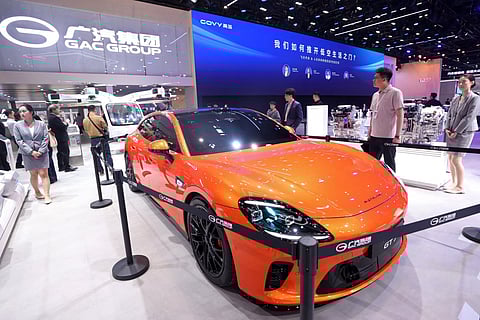
Dubai: GAC is making a deeper push into the UAE and wider GCC, betting that demand for smarter SUVs, electric vehicles, hybrids and premium ownership services will help the Chinese automaker move from brand awareness to long-term trust in one of its fastest-growing overseas regions.
Speaking at the Beijing Auto Show 2026, James Wang, Vice President of GAC International, said the company’s expansion in the Middle East and Africa will be built around products that match local driving habits, climate conditions, infrastructure readiness and after-sales expectations, instead of simply exporting models designed for other markets.
Get updated faster and for FREE: Download the Gulf News app now - simply click here.
“GAC’s goal in going global is not simply to expand sales volume, but to gradually move from ‘entering the market’ to ‘taking root in the market and winning the market,’” Wang said.
The comment points to a wider change in how Chinese automakers are approaching the Gulf. The UAE and Saudi Arabia are now among the key test markets for a broader mix of SUVs, electric vehicles, range-extended models, hybrids, digital services, and fleet solutions, supported by local showrooms, service networks, and parts operations, as opposed to once being treated only as export destinations for petrol cars or early-stage EV launches.
GAC’s latest regional push comes as the brand adds to its UAE retail footprint. Gargash Motors opened GAC Motor’s largest UAE showroom in Deira, Dubai, in January, giving the brand a stronger base in one of the city’s most active automotive districts.
New models designed for mixed driving needs
At Auto China 2026, GAC put the i60 and N60, described by the company as its “Overseas Twin Stars,” at the centre of its global expansion message. The models are designed around a dual-powertrain strategy covering pure electric and range-extended options, with the company presenting them as vehicles suited to both daily commutes and longer journeys.
YUE7, AION i60 and AION N60 were among the key models unveiled on Day 1 of the Beijing Auto Show 2026.
Wang said the Middle East will receive greater focus on SUVs, new energy vehicles, intelligent technologies and premium-quality products. Africa, by contrast, will require more emphasis on practicality, durability and adaptability across different road and service conditions.
“The ‘GAC Overseas Twin Stars,’ i60 and N60, launched globally at this year’s Auto China, are exactly this kind of ‘global vehicle,’” Wang said. “Moving beyond the limitations of a single-technology route, they adopt a strategic pure electric + range-extended dual-powertrain approach, built around real mobility scenarios of global users and offering solutions for everything from daily commuting to long-distance travel.”
That approach matters in the GCC because EV adoption is rising, but range, charging access and residual values still influence buying decisions. Range-extended and hybrid models could give consumers a bridge between petrol familiarity and electric driving, especially for families that do frequent highway travel between Dubai, Abu Dhabi, Sharjah and neighbouring Gulf markets.
Fleets and mobility
GAC is also looking beyond individual buyers. The company sees the GCC as an ecosystem market, with possible opportunities in government fleets, corporate fleets, mobility services and other business-to-business channels.
That is a key part of its longer-term shift from automaker to mobility company. The group has positioned itself as a “value creator for mobile life,” with a strategy built around vehicles, intelligent technologies, energy solutions, service networks and wider mobility platforms.
The company’s view is that future growth will be linked to user experience across the full ownership cycle, from showroom discovery and financing to charging, maintenance, digital interaction and fleet support.
In Africa, GAC is studying opportunities in local production, sales and service partnerships, and industrial cooperation. The company said petrol-powered vehicles will remain important in some African markets for a considerable period, given infrastructure gaps, road conditions and affordability considerations.
The Gulf, however, is being treated as a higher-value market where brand elevation, technology and premium experience carry more weight.
Winning trust is the real battle
GAC’s challenge now is to convert growth momentum into customer trust. Chinese carmakers have gained attention in the Gulf by offering high-spec vehicles at competitive prices, but the next phase will be harder. Buyers will want proof that brands can deliver spare parts, maintenance support, software reliability, warranty execution and resale value over several years.
Wang said GAC will build influence through auto shows, media test drives, brand events, digital communications and local partnerships, with the aim of helping consumers better understand the company’s technology, quality and brand value.
That aspect will matter most in the UAE, where consumers have more choice than ever across petrol SUVs, hybrids, premium EVs and newer Chinese nameplates. GAC’s pitch is that it can compete across all those categories without forcing buyers into one technology path too early. GAC wants to sell more cars in the Gulf, but its larger goal is to become a brand that local consumers trust for the full life of the vehicle.