Yemen on the edge
Sana'a moves cautiously against Al Qaida despite US pressure
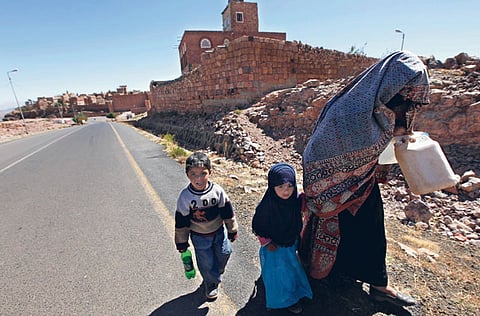
Sana'a: Yemen's president said he is ready to talk to Al Qaida members who renounce violence, suggesting he could show them the same kind of leniency he has granted militants in the past despite US pressure to crack down on the terror group.
Yemen is moving cautiously in the fight against Al Qaida, worried over a potential backlash in a country where anger at the US and extremism are widespread.
Thousands of Yemenis are battle-hardened veterans of past "holy wars" in Afghanistan, Bosnia, Chechnya and Iraq, and though most are not engaged in violence now, they preserve a die-hard Al Qaida ideology.
"Any movement against Al Qaida will lead to the fall of the Yemeni regime," warned Ali Mohammad Omar, a Yemeni who fought in Afghanistan from 1990-1992 and says he met Osama Bin Laden twice during that time.
If the US or its allies become directly involved, "the whole [Yemeni] people will become Al Qaida. Instead of 30 or 40 people, it would become millions," he said in an interview.
Yemeni forces recently launched their heaviest strikes and raids against Al Qaida in years, and Washington has praised Sana'a for showing a new determination against Al Qaida's offshoot in the country.
The United States has increased money and training for Yemen's counterterror forces, calling Al Qaida in Yemen a global threat after it allegedly plotted a failed attempt to bomb a US passenger jetliner on Christmas Day.
President Ali Abdullah Saleh's comments raised the possibility he could continue a policy that has frustrated US officials in the past — releasing Al Qaida militants on promises they will not engage in terrorism again.
Several have since broken those promises and are believed to have returned to Al Qaida's ranks.
"Dialogue is the best way ... even with Al Qaida, if they set aside their weapons and return to reason," Saleh said in an interview with Abu Dhabi TV aired on Saturday.
He said Yemen would pursue those who continued violence, but "we are ready to reach an understanding with anyone who renounces violence and terrorism".
In the past, Yemeni officials have defended the reconciliation policy as a necessity, saying force alone cannot stop Al Qaida.
Multiple wars
Saleh's government has been weakened by multiple wars and crises. It has little authority outside a region around the capital, and tribes dominate large areas of the impoverished mountainous nation — many of them bitter at the central government for failing to develop their regions.
Hundreds of Al Qaida fighters, foreigners and Yemenis, are believed to be sheltered in mountainous areas. Al Qaida Yemenis get help from relatives, sometimes out of tribal loyalty more than ideology — and when the government kills or arrests militants or their relatives, it risks angering the heavily armed tribes. Another factor is the regime's alliances with hardline Islamists, such as Shaikh Abdul Majid Al Zindani, one of Yemen's most prominent clerics.
The US has labelled him a terrorist for alleged links to Al Qaida. But the government relies on his tacit support and denies he is a member of the terror group. In a prayer sermon on Friday, Al Zindani railed against US pressure to fight Al Qaida, accusing Washington and the United Nations of seeking to "impose an international occupation of Yemen".
In Yemen, "it is difficult to draw the line between who is a fundamentalist and who is Al Qaida. It's a spectrum," said Ali Saif Hassan, who runs a Yemeni group that mediates between the government and opposition.
But those with extremist thought "are everywhere, in the government, in the military, among the tribes and the wealthy", he said, and some could oppose cooperation with the US against Al Qaida.
The regime has also used Islamic radicals to fight a war against Shiite rebels in the north and to oppose secessionists in the south — two threats that many feel the government sees as more dangerous than Al Qaida.
Omar, the Afghan veteran, is a case in point. He heads an organisation in the southern city of Aden mobilising against the secession movement.
The 42-year-old Omar recalled meeting Bin Laden twice in the Pakistani city of Peshawar. He said they discussed the situation in Yemen, the Al Qaida chief's ancestral homeland.
Bin Laden told him Al Qaida bought thousands of weapons sold off illicitly by the former independent government in south Yemen when it unified with the north in 1990, arms that remain in Yemen, Omar said.
After returning to Yemen in 1992, Omar — who says he is not in Al Qaida — was imprisoned twice, including a yearlong stint in 2005 on charges he helped send militants to fight American troops in Iraq. He was acquitted and released.
He estimated Yemen has some 20,000 veterans from the Afghan war in the 1980s and 1990s as well as other extremist fronts like Chechnya and Bosnia. A smaller number have returned home from more recent jihads, like the war in Iraq, he said.
Bedrock of sympathy
They and younger generations form a bedrock of sympathy for Al Qaida that could turn to outright support. "If the government draws them into a fight, they will fight the government."
Sana'a points to successes in its reconciliation programmes, saying they have turned some 600 former mujahedeen into "good citizens".
But there have been security lapses.
The leader of Al Qaida in the Arabian Peninsula, Naser Al Wahishi, and other senior figures escaped from a Sana'a prison in 2006 — with help, it is believed, from sympathisers in the security services. Hazem Al Mujali, accused in the 2002 bombing of a French oil tanker off Yemen, was recently released from prison. Last month, he escaped a government raid outside the capital on an Al Qaida cell suspected of plotting attacks.
Another released militant is Fahd Al Quso, wanted by the United States for his role in the 2000 USS Cole bombing, which killed 17 American sailors. He served three years of a 10-year sentence before being freed in 2008.
Now he is on the run with other Al Qaida fighters in the mountains of Shabwa province, said Ali Hassan Al Ahmar, the province's governor.
Al Quso long reassured authorities he was staying peacefully at home in Aden, but it became "clear he was meeting with Al Qaida elements", al-Ahmar said in an interview with the Sharq Al Awsat newspaper.
Will the Yemeni government stand to gain or lose from the fight against Al Qaida? What do you think is the biggest threat to Yemen?

