Dubai Metro zooms to one-year mark
Passenger numbers up 183% as Dubai train wins over every social class
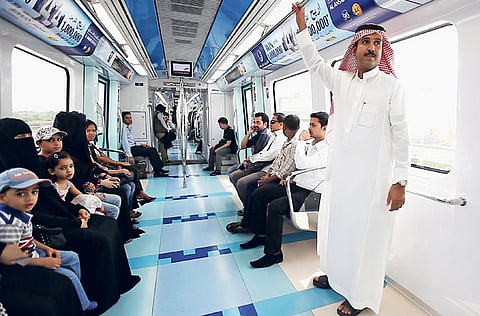
Dubai: The Dubai Metro has managed to win over just about every social class as opposed to some other modes of public transport, a senior official observed.
Thursday marks the first anniversary of Dubai Metro, which was launched on September 9, 2009.
Mattar Al Tayer, Chairman of the Board and Chief Executive of the Roads and Transport Authority (RTA), said some 30 million passengers have used Dubai Metro since it started operations until the first week of September this year.
He said the number of Dubai Metro users has been on the rise since its launch, jumping from 1.8 million passengers in October 2009 to 3.3 million passengers in August 2010; in the process recording a growth rate of 183 per cent.
"In September 2009 the Metro users clocked 2,196,920 passengers and the number soared in October to 1,767,879 passengers. The number of monthly passengers served by the Metro broke the two-million barrier in December 2009 and continued to grow steadily to hit 3,193,087 passengers in May 2010 and the number still showed further growth to clock 3,301,959 passengers last August," he explained.
Al Tayer noted that the massive investments made by the Government of Dubai for developing infrastructure in the mass transit sector had proved to be successful. It had also contributed to conserving the environment, reducing the financial strain of traffic bottlenecks, and diverting the demand from the use of private vehicles to modes of mass transport.
"People have come to feel the benefits and features of using mass transit systems such as the psychological and physical relief in moving around easily and smoothly, and minimising the cost of fuel and vehicle maintenance. It is well established that using public transport modes substantially contributes to reducing accident-related fatalities and carbon emissions from vehicle exhausts as well," he elaborated.
Al Tayer pointed out that the next step will be to disseminate the culture of using mass transit modes and encourage the community members to use them on a daily basis.
Engineer Adnan Al Hammadi, chief executive officer of the RTA's Rail Agency, said RTA's field studies showed that various social groups are using Dubai Metro unlike other means of public transport.
He said this showed the public's acceptance and satisfaction with the Metro. He said the Red Line with its 19 opened stations had contributed to reducing traffic by between 10 to 20 per cent during peak hours in the areas it serves such as Shaikh Zayed Road, Al Riqqa Road and Khaled Bin Al Waleed Road.
"We expect this percentage to increase with the opening of the Green Line at the end of 2011," Al Hammadi said.
He said the number of Metro trains will be increased gradually as new stations become operational and this would help achieve more punctual services.
Al Hammadi said statistics showed that the Union Square Metro station was the most used by passengers, with 14,644 passengers daily, followed by Khaled Bin Al Waleed Station with average of 13,685 passengers daily and then Mall of the Emirates Station with 10,775 passengers.
Gulf News had earlier reported that it takes 400 engineering and technical staff and 200 cleaners to keep the Dubai Metro trains tidy and operational every day.
The maintenance and cleaning staff work at night when the Metro service is stopped and the trains start moving to the depots in Al Rashidiya and Jebel Ali at opposite ends of the Red Line.
As soon as the Metro service stops at night, the trains start moving to the sheds in Jebel Ali and Al Rashidiya depots. Though all the trains are cleaned every day, each train is washed once every three days in automatic washing bays.
It takes five to seven minutes to wash a train.
Fast train: Defining features
- The Dubai Metro comprises two main lines; the Red Line and the Green Line.
- Total length of the Red and Green lines is about 75 km, and the total number of stations is 47 stations.
- The Red and Green lines intersect at Al Ittihad and Khalid Bin Al Waleed Stations.
- The Red Line extends 52 km and comprises 29 stations, including 4 underground stations, and 25 elevated stations.
- The Red Line starts off at Al Rashidiya, passes through the Dubai International Airport, Al Riqqa district, Al Ittihad station and Shaikh Zayed Road up to Jebel Ali area.
- The Green Line extends 23 km and comprises 18 stations, including 6 underground stations and 12 elevated stations.
- The Green Line starts off at Al Ghusais and passes through the Dubai Police General HQ, Al Ittihad Station, Al Ras district and then passes through Al Shindagha area, Dubai Healthcare City up to Al Jaddaf.
- The Metro project is fitted with three park-and-ride facilities with a total capacity to house 9,000 vehicles.


