Pay up or stay out
Service fee defaulters at a building in Jumeirah Lake Towers locked out
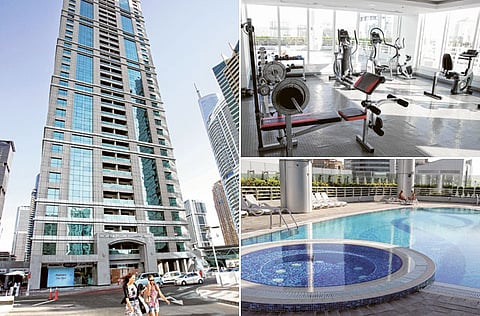
Dubai: No parking, no swimming, no gymming - this is the stark reality for residents defaulting on service charges at Al Shera Towers in Jumeirah Lakes Towers (JLT).
And this is not an isolated case.
Across Dubai, interim owners associations (OAs) are sending out a clear message to property owners - pay up or lose access to facilities. The move follows a sharp spike in defaulting members in many developments, especially in New Dubai.
Al Shera Towers is among the first to implement the policy of denying facilities to defaulting residents. "Our association passed a vote in the recent AGM meet of the building to deny facilities to delinquent owners. If owners do not pay their service charges they do not contribute to the upkeep and maintenance of the tower and must not be allowed access to enjoy these privileges," said Sanjay Thawani of SNS Property Management Solutions and Association Manager of the interim owners association board for the tower.
"Our leisure activity floor with the swimming pool and gym has access control. This will not be available to defaulting owners. Similarly, they won't be given parking access cards when Dubai Multi Commodities Centre Authority (DMCC), [licensing authority for JLT], approves the parking slots to our building residents," he said.
Out of a total 241 residents in the Al Shera Towers building, seven owners have defaulted. It is a well-maintained building with a number of facilities such as a children's playroom, swimming pool, gymnasium, sauna and a games room.
There has been a marked increase in the number of owners defaulting on service charge payments. This has resulted in a significant drop in service fee collections across New Dubai.
Mohammad Metwally, Chairman of Interim Owners Association Board, Al Seef Tower 2 in JLT, said: "I fully support any OA that would deny units in default access to common facilities such as health club facilities, play rooms, or any other common facilities within their communities.
"Since all residents face the risk of collective punishment of discontinued services or utilities supplies as a result of groups of owners in default, we should not allow irresponsible owners to cause communities in this great city to fall in disarray. We have the responsibility of standing up to the non-payers and enjoy living in our communities."
Non-defaulters penalised
"If Dewa [Dubai Electricity and Water Authority] is not paid, it will cut off the electricity supply in our community which means no elevator services, no air conditioning services, no lights in common areas, or pumps to push water and chilled water up to the tower. This would severely penalise the responsible owners who pay their OAs all their dues," said Metwally.
Around 38 owners have defaulted in Al Seef Tower 2 out of a total 239 residents.
Similar is the case with The Lakes Community, an Emaar development situated close to the Emirates Golf Course which has seen a third of its residents defaulting on service charge payments this year. Its interim owners association board stated: "When Emaar released the names of delinquent owners, we were alarmed that almost one-third of the owners had not paid service fees. No one is sure why almost 330 home owners within The Lakes are not paying their obligations. We have asked Emaar to provide us the amounts owed by these people so we can evaluate the magnitude of this issue," said a board member of The Lakes.
Service charge for Lakes residents has been set at Dh2.78 per square foot for this year in addition to a deficit payable amounting to Dh0.95 per square foot.
Emaar said timely payment of service charges is a civic responsibility of the home owners for the long-term welfare of the community.
"We work with the Interim Owners Associations in rolling out various initiatives to promote the payment of community service fees. Home owners are regularly sent reminders about the payment due dates in addition to follow-up calls. There are deterrents in place for non-payment including late fees, as applicable by law, and potentially reporting to the concerned authorities. Timely payment of service fees is a civic responsibility of the home owners for the long-term welfare of the community," said an Emaar spokesperson.
According to sources, almost 60 per cent of residents in Rimal 2 tower at Jumeirah Beach Residence (JBR) in Dubai Marina are delinquent. And this is the story playing out in most towers across JBR with more than 50 per cent of owners reportedly defaulting on payments. "Collections could be as low as 40 per cent. Some owners have not paid right from the time they moved into their apartment. Service fee debts could be substantial, running into a couple of million dirhams in the towers," said an association member at JBR. For 2010, service charges in JBR was set at Dh15 a square foot, but auditors of JBR owners' associations are calling for this to be dropped to Dh9.
Kent A. O'Brien, CEO - Managing Director, Strata Global Group, said the reason for the sharp rise in defaulting residents could be due to lack of trust between owners and developers. He said the level of service fee collections has particularly dropped in developments where there is little transparency between the developer and the investor. Attributing the mounting debts to the absence of a bank account and a trust where funds can be parked, he said: "If real estate authorities can get the independent bank account issue sorted, the registration of the Owners Associations will become more effective."
Ludmila Yamalova, Managing Partner, HPL Yamalova & Plewka, a law firm in Dubai, said: "It's not that people do not want to pay their service fees or they don't have the means, they don't pay because the quality of services in a community or building does not match the service fees they are being asked to shell out."
She added: "There is a lack of transparency regarding the calculation of service charges. Developers have been extremely resistant to providing that kind of disclosure."
So what does the law say in this situation?
According to the Strata Law set up by the Real Estate Regulatory Agency (Rera), if an owner is delinquent, the owner's association has the right to file a case against that owner and put a ‘lien' on his property for the defaulting amount.
"Lien means a charge levied on the delinquent property which includes the delinquent amount, the interest rate on the amount and any legal fees that may have [been] incurred in the process," explained Yamalova.
"The other way to get back the service fees is when the OA files a case against the owner and force-sells his property to settle the debt. This does not mean that the OA keeps all the proceeds of the sale of the property. For example, if the service charge debt is Dh50,000 and the property is sold for Dh5 million, the OA will keep the service charge debt amount plus the interest rate on the debt amount and any legal fees that may have [been] incurred in this process," she said.
However, due to the Strata Law not being fully enforced, the owners associations are not able to legally recover the amounts from the owners.
While the non-payment of service charge is a contentious issue within Dubai, its effects are leading to a vicious cycle that could ultimately affect all investors. "A badly-maintained building or community will ultimately reflect in the value of a property unit falling low," said Metwally.
Reasons for delinquency
- Lack of understanding of what the service charge is for
- Owners are living abroad
- Lack of awareness that the charges are an annual affair
- Lack of understanding by owners that issues concerning individual units have no connection with common area and service maintenance
- Financial constraints on the part of owners
What do you pay the service charge for?
- Common area services and maintenance
- Specialised services such as fire systems, lifts, swimming pool, building maintenance unit
- Management cost (Interim OA manager and/or developer)
- Building Insurance cost
- Contingency costs for spare parts, materials, improvements etc
- Utility bills such as Dewa and Palm District Cooling (capacity and consumption)
- Master community service charge
Did you know?
According to the Real Estate Regulatory Agency (Rera), every delinquent owner will have to pay an interest rate of one per cent per month (12 per cent per annum). This is much higher than current mortgage rates and other loan rates.


