Strict TB check needed to keep disease away
Newcomers to the UAE with an old tuberculosis scar are denied residency visa, official explains
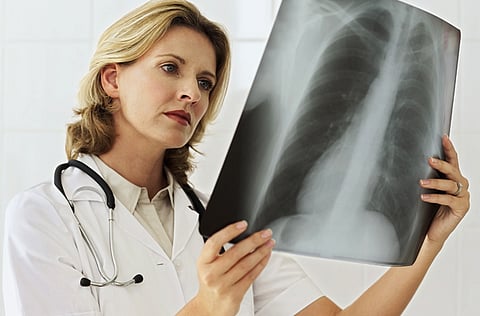
Abu Dhabi: People with old tuberculosis (TB) scar are scientifically symptom free, however the condition can be easily reactivated if the person's immunity system is reduced for any reason, stressed senior health officials. For that reason, newcomers to the UAE with an old TB scar are denied a residency visa, and are no longer allowed to enter the country.
Dr Kalthoom Hassan, director of national TB programme and director of specialised health care at the UAE Ministry of Health (MoH), told Gulf News that the health ministry is currently looking into introducing a TB filtration programme, which ensures that new-comers arriving from countries with high TB prevalence are screened in their home towns before entering UAE ports.
"We realise that it's inhumane to separate families, and sympathise with those found to have scars in the outer layer of their lung; however we are doing this because an old scar TB can be easily activated if a person's immunity system is reduced for any reason.
Stricter rules
"That's why the MoH is implementing even stricter TB rules and is now revising TB regulations, to ensure newcomers arriving from high-risk TB prevalent countries are screened in their hometowns first," clarified Dr Kalthoom.
Scar TB becomes active once a person's immunity system is reduced, and this is commonly found among the elderly and children under the age of five.
"People with old TB scars are carriers, which still poses a threat to society, and this can only be detected through a chest X-ray, which is an inexpensive, accurate and quick method practised globally," said Dr Kalthoom.
Close contacts to an old TB carrier is also considered a threat, and is sent back to their country once treated and become non-infectious.
When asked whether countries such as the US and the UK are as strict with their newcomers regarding old scar TB, Dr Kalthoom said: "There's a global intention to reduce the spread of TB and introduce early diagnosis, treatment and follow up. Both the UK and the US require that immigrants from countries with high TB incidence have a chest X-ray on arrival. However I believe that they are revisiting their current TB regulations in order to implement stricter rules."
The Division of Tuberculosis Elimination, US Centres for Disease Control and Prevention, state that "current British border policies require immigrants from countries with a TB incidence higher than 40 per 100,000 people to have a chest X-ray on arrival to check for active TB."
CDC reports show that in the US, "any applicant for whom the clinical suspicion of tuberculosis is high enough to warrant treatment for tuberculosis disease, regardless of laboratory results is considered Class A, which requires screening follow-up mandated by US immigration law."
Concern
A concern was raised as a response to a previous Gulf News article on TB. Dr Farida Al Hosani, Section Head of Communicable Diseases at the Health Authority Abu Dhabi (HAAD), questioned the articles headline "chest X-ray to check for fitness is outdated" describing it as "misleading"
"X-ray is the first line of screening for TB worldwide and there's no other screening test recommended until today. This is according to HAAD standards, CDC guidelines for screening of immigrants and many other guidelines."
A risk to community
The Health Authority Abu Dhabi, Dubai Health Authority and the MoH are currently discussing and revising the current TB control programme.
In a 2010 HAAD study which summarises the risk of TB among 948,504 residents in Abu Dhabi — 14 per cent out of the 1,558 people who had TB were found to have IGRA positive (which means that there is latent TB that might reactivate any time) — 9 per cent were found to have TST (Tuberculin Skin Test Positive). "These results may cause a risk to the community that we have to consider and plan for," said Dr Farida Al Hosani, Section Head of Communicable Diseases at HAAD.


