The people must always come first
Governments must deliver or face an Arab spring, Mohammad warns
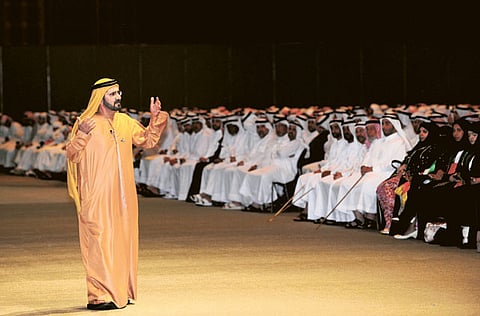
Dubai: While the Arab Spring spread across the region, the UAE was able to firmly hold its ground and surpass the revolutions that gripped a number of Arab countries simply because the country has its own democratic system that cares about people, His Highness Shaikh Mohammad Bin Rashid Al Maktoum, Vice-President and Prime Minister of the UAE and Ruler of Dubai, stressed.
Speaking exclusively to Erin Burnett's OutFront programme on CNN International yesterday, Shaikh Mohammad talked about why the UAE passed through the Arab Spring without a glitch, the importance of listening to the needs of citizens, and how Dubai managed to survive the global economic meltdown.
"I don't call it [a] crisis, it's a challenge, you know, when everybody — all [are] good leaders when things are all right. But you take a leader, a good leader to come, when it's crisis like that," Shaikh Mohammad said.
The following are excerpts of CNN International's Erin Burnett interview:
Erin Burnett (CNN International): What about the real estate market here? Europeans own a lot of real estate in Dubai. When you're here, you see a lot of Europeans on vacation, Europeans buying property. Is the European crisis affecting Dubai?
SHAIKH MOHAMMAD: Of course. I mean, even the American crisis, all the European crises [are] affecting the market. But we are, here, better than anywhere else. We got out of the crisis and now we [are] back to building again. But just to remind you, when the crisis [happened], the total spending, we completed, the Metro was completed, the Meydan [race track] was completed, all was in the crisis. So all the big projects, we did not stop. We only stopped some projects [that were] on paper for a year or two.
I was surprised when I was here in May at the graduation of the American University Dubai, and I made a comment about [how] I was covering Tahrir Square during the revolution. And the students in the audience were cheering, and you were supportive of them. I wasn't sure whether you would be supportive of them, I didn't know exactly how you would react. So what is your view of the Arab spring?
I have said that — in 2004, I said, "Please change or you will be changed."
You were talking about Arab governments?
The Arab governments. The Arab Spring is the people who waited for a long time and some governments are serving themselves, are not really serving the people. And their people want to work.
If you look at Egypt, with the first round of elections. They have democracy, but democracy is going to elect the Muslim Brotherhood and the Salafis.
Yes.
Very conservative Muslim groups. Some people have said they're worried that Egypt could become like Iran. They could democratically choose to be like Iran, with an ayatollah with a totally religious society. Do you have that fear at all?
No. I don't. Because Egypt has a very strong army watching what's happening and giving the lead for this party.
And what about in Syria? What do you think is going to happen in Syria?
I think Syria is more complicated than Egypt or Libya because they have Iraq behind them, they have Lebanon, they have all that. So it is the same as everywhere else. The people want jobs, they want opportunities. And they asking for it. Unless Bashar [Al Assad] changes and starts making things good for the people, they will carry on like that.
Or he'll go? If he doesn't change.
Yeah
So explain how government works here. Because the UAE is different. You have accomplished things that those other countries have not. But it's not a democracy either. So explain how it works.
We are tribes, we must serve our people. We must get the education, the universities, the hospitals, housing. And no tax here, and the government has the wealth to spend on their people.
No tax. A lot of people on the street love that. You ask any one what they like about Dubai they say "no tax, no tax."
Yeah. No tax and the government is working. Like today in the cabinet we made the programme. We have our vision and we [are] going through it. And we are achieving that vision. The dream, we are getting there. Here it's different. Here, everybody can come to the ruler and say, ‘Well, I didn't get that or that. Or this department or this ministry didn't give me my rights.'
They come to you? And they directly ask you "You didn't do this" or "I want that" and then you have to answer to the individual person?
Yes, and he will complain about one ministry, so I'll get hold of the minister and say, "Why didn't you do your job?" So transparency is here more.
There were five activists recently here in the UAE, some of them dissidents, a blogger. They were sentenced to two or three years in jail; they were pardoned on National Day. My understanding is they were — one of them was saying that all of the free things in the UAE, the free health care, the free education, no taxes — he said it was buying off the people. So what's your view of what happened and whether it's okay to say something like that here?
If you are a criminal, you go to court. You know, not everybody is really perfect, and we are not perfect, you know? We [are] doing a lot for our people; we still [have] more to do. So we hope all these five also will become better citizens for their own good, and for their people.
It just leads to the question of one thing over the years, covering the UAE, people will say, "Well, the press isn't totally free. People can't really say everything that they think." Do you think that that's part of how, in this society, you need to govern?
As long as they don't say something wrong about a person or whatever it is, they can say anything they want. As I told you, we are not perfect we are still learning. We're trying to do our job right and trying to help our people. We have our own democracy. You cannot transport your democracy to us. We are different. And for example, our democracy is coming from the Quran. And, you know, as long as you don't step on somebody else, you are free to do what you like.
When people look at you, they say: "Okay, your family has ruled Dubai for 200 years. You, your son, Hamdan, will will rule after you. Father to son. Will that continue forever, do you think?
As long as the people want that. Our tribe are really ruling a bigger tribe because they accepting us to — to do that.
So do you think that there will be more countries where the governments fall in the Arab spring?
I think this period of time, you know, every 100 years this might happen again, you know? Yes, well, you have to be careful. You don't know what is happening, you know, here or there. But I think the Gulf states [are] safe for the time being.
The issue I'm curious about was the welfare system. It's an amazing thing to have free health care and free education and no taxes. It's a good thing. But it also sometimes could be not a good thing because maybe people are a little complacent, or they get a little bit lazy because they know someone's going take care of them. Do you ever worry about that?
Not really because this is only the basic — people want more. [They] want a better life. They want a better job, so they have to work harder.
Dubai's had problems, but you're going ahead. So you're showing people that you can take risks. You can have failures [but] you can stand up and keep going.
Yeah. And don't stop when somebody doubt you. Once you make up your mind, then go full speed. And that's what we think and that's what we believe and that's what [is] going to happen. You know? I'm not looking for the last spring, I'm looking at for the next spring.


