Dwindling shark population causing mayhem in food chain
Marine biologist is studying predator's state in Arabian Gulf
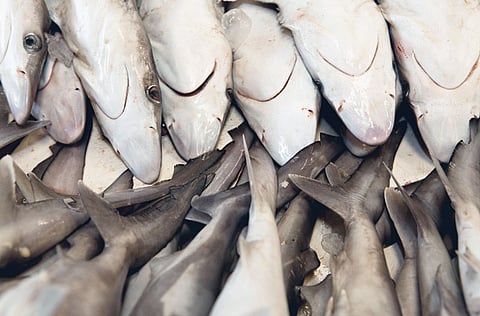
Dubai: The sight of hundreds of bloodied dead sharks, waiting to be sold at fish markets across the UAE does not bode well for the ocean's super-predator.
Sharks play an important role in the ocean's food chain and their decline is already being felt in commercial fisheries worldwide.
While fisheries statistics around the world indicate that 80 per cent of the existing global shark reserves have already been fished out, no research has been carried out on the Arabian Gulf's shark population.
However a new study on sharks in the Gulf has just been launched in collaboration with fishermen and the UAE University in Al Ain.
Ecosystem collapse
"The state of sharks in the Arabian Gulf is a blank," said Rima Jabado, marine biologist and a doctoral degree candidate at UAE University. "Attention should be given to sharks — they're the apex predator and their demise could lead to the collapse of the marine ecosystem."
In Australia, it's been reported that low numbers of sharks have led to an increase in the number of octopuses, who without the predators to keep them at bay, devour the entire lobster population.
And with fewer sharks along the US Atlantic Coast, cownose rays have increased so much that they've wiped out bay scallops by feeding on them.
This summer, Spain's Ministry of the Environment said the decline of natural marine predators was likely the cause of jellyfish blooms that led to the closure of several beaches along the Costa Blanca.
Rima's research will monitor the shark population in the UAE to find out which species are here and exactly where they've come from. The project is part of her doctoral study on shark fishing in the UAE which focuses on species diversity, distribution and abundance, as well as feeding ecology and the fin trade.
Her three-year research has already begun. She has so far interviewed 126 fishermen from landing sites all over the UAE.
"The majority of the fishermen would want to protect sharks and believe in the protection of fish for a sustainable fishery," said Rima. "But if sharks are caught in a fisherman's net, should they be thrown back? Perhaps they should be brought in? [This subject] causes them to debate. Some complain that sharks just make holes in their nets."
Data from the Food and Agriculture Organisation showed that between 1985 and 2000, shark landings in the UAE were relatively stable with between 1,300 and 1,950 tonnes per year.
A decade ago, the UAE was already considered one of the main exporters of shark fins to Hong Kong with 400 to 500 tonnes per year being sent to East Asia to meet demand for shark fin soup, according to the World Wildlife Fund (WWF).


