The widow who educated 600 children in her garage
One woman's drive to give needy children a good education - in her garage
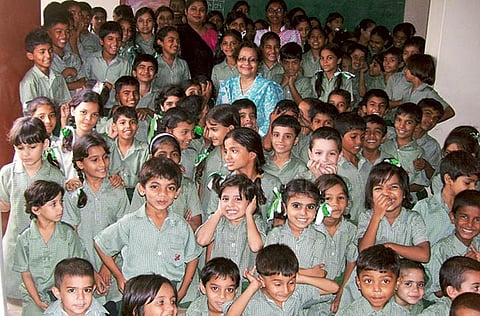
Mohammad Asad is an exemplary student. The son of a domestic servant, the 19-year-old is about to go to one of the top colleges in Pakistan. And while most of his friends dream of becoming sweepers, or mechanics, if they’re lucky, his hopes of a career as an aeronautical engineer are almost certain to come true. Already he has been runner-up in the world Maths championships, Mathematics Olympiad, and in the national Robotics competition. Not bad for a boy who was taught in a garage in the Karachi villa of his mother’s boss.
Over the past 13 years Shabina Mustafa, 62, has educated 600 children from the slums of neighbouring Shah Rasool and Neelam Colony at her Clifton Road home. “The children of my school are my extended family. I share my life with them,” she says.
Mohammad couldn’t be happier. “Joining The Garage School was a turning point in my life,” he grins. “It’s the reason why I am studying in a good college today.”
Turning misfortunes into opportunities
Widowed at 21, Shabina always hoped to turn her personal tragedy into realising her late husband’s dream of starting a school for underprivileged children. It took years but finally in 1999 she opened the doors to her garage school, where she taught basic maths and English, along with health care, grooming and vocational training.
“I could see that education would not only help these children stand on their feet, but the grooming would give them life skills and values they will pass on to the next generation.”
Originally from Kolkata, India, Shabina met her husband Flight Lieutenant Syed Safi Mustafa after she moved to Karachi to attend university. The couple had a son, Zain, but in 1971, two months after he was born, Fl Lt Mustafa was pronounced missing, presumed dead.
“My husband told me once, ‘If something should happen to me, just move on with your life’”, she says. “And these words resonated in my head as I stepped into a new life.”
After graduating, Shabina found work as a teacher at the Pakistan Airforce base Masroor, Mauripur on a meagre salary of Rs 175 (Dh8) per month. “All I owned was two plates, a kerosene stove and endless days of uncertainty,” she says.
But the struggling single mother fought for her husband’s pension, gallantry award, land and then found a job in 1975 with Saudi Airlines in Karachi. She and her son lived in a tiny one-bedroom apartment until she was able to sell the land to move into her current home.
“With the money I built a house and provided the best possible education for my son, Zain, who is now an architect.”
One day in 1999, she was horrified to learn that her maid’s daughter, Sobia, had been denied admission to a sewing school because she was illiterate. Shabina offered to give her lessons, but didn’t know where. Her home was crowded with family memorabilia, and her late mother Bilkees Ahmed, who was 96, was living with her.
Shabina recalls, “Sobia’s mother cleaned up my garage and surprised me by turning it into a school. Soon the word spread in the neighbourhood that I was going to teach children how to read and write. The very next day, I found 14 bright-eyed kids sitting eagerly on the floor, waiting to be taught.
“I had to supply notebooks and pencils and the following week, a friend gave us a plank of wood which was put on blocks of stone for seats and a blackboard was donated by my nephew Mehdi. My older brother Taskeen gave me desks. The school wouldn’t stop growing.”
Shabina held two classes in the garage – she taught one while a volunteer taught the other. A school nearby sent used pencils and exercise books, another gave newspapers, which they sold to buy pencils and erasers.
“My working hours at Saudi Airlines were flexible so that allowed me six hours in the morning to teach the children basic Urdu and English alphabet, numbers and poems,” she says. “I had no idea how long this would last. All I knew was I had to help these kids and help from other quarters just came naturally.”
After the first year, the school had 75 pupils. “I opened an additional two classes just outside my garage as I had more volunteer teachers and we ran a morning and an afternoon teaching shift five days a week,” Shabina says.
They discovered the children were malnourished, so they wrote to companies for food. “Nestle provided us milk and biscuits that were given to children as incentives to study. Most of them were so hungry and that gave them the strength to learn,” she says. “I was able to support the school from my salary, plus help from my colleagues, friends, family and well wishers.”
At the school, Shabina taught the four basic Ts of life. “Taleem (education), Tarbiat (grooming), Taur (manners), Tareeqa (behaviour), which I believe leads to the fifth T, Taraqqi (success). I always tell my students that I can only help them in obtaining the first four tools, but achieving success depends upon their hard work and determination. My formula worked as I saw more and more parents eager to send their children to the school. Eventually with more funds from well-wishers, I had to look for bigger accommodation.”
Given every encouragement to learn
The garage in Shabina’s home always served as an extension for the bigger school. A few classes are held there, while 400 students have moved to a three-storey commercial building nearby that Shabina rents. There the students are taught until grade six and trained in vocational courses for sewing, carpentry, computers, henna painting and other life skills in two shifts.
Shabina uses anything she can to entice the children to learn. “Twice a month they are given chicken at school and twice a month we send a chicken to their homes,” she says. “We are closely linked with each child’s family. I know exactly where a child stands health-wise.
“In Pakistan most parents from underprivileged background do not seem to remember the date of a child’s birth, as they do not consider it important. I make sure that each child has a little cake for his or her birthday and that way the birth certificates are also made once the date is fixed.”
Many children go on to mainstream schools and carve out a career, others go back to the school as volunteers. Some have graduated from university, and one carries on Shabina’s work.
“Tahira Rasheed, the daughter of a domestic worker in my house, joined me as my first teacher,” she says. “A very dedicated girl, she worked day and night with me for eight years to run the school with hardly any funds, even when she had a baby.
“In her spare time, she gives classes to the children in her own impoverished area of Akhtar Colony to help them get some education and grooming. I can proudly say that she is taking my dream beyond in her own little way.”
Shabina, who came to Dubai last month to make an impassioned appeal for funds, says the school is her passion. “This is my life and I have so much energy and love when I am working for my school that nothing else matters to me. It is said, if you’ve touched one life, you have already touched a 1,000 lives. If you teach a woman, you have taught her next generation.
“My basic aim is not just to give them education but to make sure they stand on their feet. I want to groom my students into becoming successful; more importantly, I want them to become good human beings.”
Now she wants to extend the school into another premises nearby. “It’s ideal for all our future plans including a polytechnic institute for the unemployed youth of this area to get them out of street violence and other bad habits. My challenge is to get them off the streets, into skill-development programmes, provide education, groom them and then make them stand on their own two feet.
“Generating funds is difficult but we are trying to promote our school to people who we know will help us on a regular basis. We have had extremely generous individuals helping us out but for bigger dreams we need more funding, especially from the corporate sector.
“There are so many more people who are waiting for someone to pull them out of this destitution. We have limited resources and although the impact that we have had is easy to see, we still have a long way to go.”
Shabina knows the challenges ahead are tough but she’s ready for them. “Over time, I have learnt that nothing comes on a silver platter. But through hard work and honesty, there is no such thing as impossible.”
Tell us the story...Do you know of an individual, a group of people, a company or an organisation that is striving to make this world a better place? Email us at friday@ gulfnews.com or the features editor at araj@gulfnews.com


