Backing a new track
Suchitra Bajpai Chaudhary tells us why a unique satellite tracking and conservation programme for Hawksbill turtle being led by the UAE is such good news.
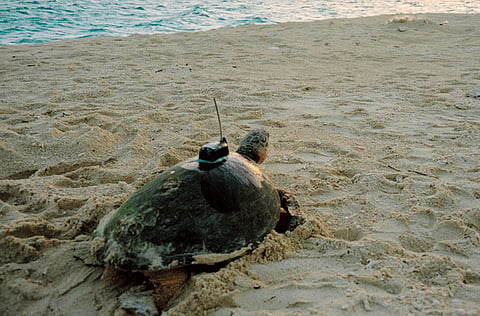
The Hawksbill turtle (Eretmochleys Imbriata) is likely to disappear from our planet as more than 80 per cent of their tribe have been wiped off the earth - about three generations in 100 years.
Why should we care if this rather stodgy creature waddles right off the edge of the planet? Because they are important to the health of our planet. Found in tropical waters all over the world, with a hawk-like bill and with very beautiful shells, these hapless creatures are the world's most hunted species. Human beings hunt them for:
- Their exotic turtle meatn
- Their beautiful shells which have been used for centuries to make ornaments and other decorative items. That's the bad news.
However, the reason they are so important is because they are important to the health of our planet. These small but highly effective marine scavengers play an enormously significant role in keeping the toxic levels in the seas low. They do this using a variety of tactics: - Turtles in general feed on seagrass without which the undersea meadows would wither and die.
- They rejuvenate vast tracts of underwater habitat and allow the development of all kinds of associated species, from shrimps to fish to all kinds of mussels and oysters. (The next time you tuck into a plate of steaming oysters doused in an exotic rock salt, think of the Hawksbill.)
- The Hawksbill feeds on a variety of sponges that are very toxic in content for other species and thus help other marine creatures thrive.
- Clearing out these sponges helps the corals grow better and other marine creatures continue to enjoy living in their safe habitats.
So a Hawksbill turtle is like one of the cards in the middle deck of a house of cards. Pull it out and what you have is a collapsed heap of cards. Even cards neatly stacked in their own set boxes have more value than this heap. Just how are the Hawksbills dying? Lisa Shrake Perry, programme director at Emirates Wildlife Society (EWS-WWF), which spearheads the Marine Turtle Conservation Programme, lists out a few obvious reasons: - They drown and die after being caught unintentionally in fishing nets.
- They are poached for their shells and meat.
- Pollution such as oil spills lead to a decline in their population.
- Indiscriminate destruction of coastlines and encroachment of beaches has led to a loss of their nesting habitats.
Red alert
If you believe that our planet is like patchwork and every patch is linked to the other, then no matter where you live, the well-being of a species that safeguards the health of our planet should matter to you. Our ecological health is inextricably linked to that of the marine world around us and when ecologists say that the Hawksbill turtle has been on the critically endangered list of the International Union for Conservation of Nature (IUCN), it's time to pay attention. The Red List is a comprehensive inventory of critically endangered plants and animals on our globe. And what makes this alarming situation worse is that the Hawksbill, as nature has created it, lives for a very long time (anything between 200-1,000 years) and has a very slow reproductive cycle. So when one adult turtle is killed, what goes away with it is a time span of 200 to 1,000 years. And that is a very long period of time to come around quickly as even a kindergartner will tell you.
So if we have to halt the long-term damage for this species, we need to move fast enough to save these creatures from extinction. But any action is a good start and the UAE is making an effort.The EWS-WWF, in association with a host of other ecological organisations in the region, has launched a new satellite programme in the Gulf that aims to tag these turtles with a tiny radio transmitter that will help scientists and other marine and ecological experts track them around the globe as they swim to various seas to understand their movement, feeding and mating behaviour. All this information will be collated to come up with effective schemes to a) conserve them and b) increase their numbers. The EWS-WWF's project aims to follow up to 100 post-nesting female turtles from the UAE, Qatar, Oman, Iran and Saudi Arabia.
Data collected from the satellite tracking programme will be used to help local and regional agencies identify the critical overseas migration routes and near-shore habitats favoured by the turtles. This will consequently help management and conservation authorities with their decisions and activities.
Dr Nicolas Pilcher, Co-Chair IUCN SSC (Species Survival Commission) Marine Turtle Specialist Group, technical adviser, CMS-UNEP (Conservation Monitoring Systems - United Nations Environment Programme) Dugong MoU (Dugong Memorandum of Understanding - a paper signed for the conservation of dugongs), and technical adviser for the Marine Turtle Conservation Project provides the details. Since the programme was launched in May 2010, it has met with success, he says, as five turtles have been tagged in the UAE and a total of 20 turtles have been tagged in Iran, Qatar, Saudi Arabia, Oman and the UAE thus providing excellent data to chart their progress.
This is groundbreaking work in the field of turtle conservation and once the results of this project are in, and the authorities learn of the findings, decisions can be taken to speed up conservation.
The science of satellite tracking
For marine zoologists, satellite tracking is no longer a rocket science as satellites are routinely used by major agencies such as the World Wildlife Fund to track a variety of animals such as the polar bears, elephants, tigers, whales, dolphins just to name a few. In the Gulf region, conservationists have used satellite tracking to follow several species, for example the Arabian Oryx, sharks, and falcons.
Tracking sea turtles by satellite involves the global Argos System. (The Argos satellite tracking systems were developed through a collaboration between the US and French Space, an environmental agency that engages in worldwide environmental monitoring through sophisticated transmissions of satellite signals.)
Dr Pilcher says: "A small watertight transmitter with sufficient battery reserve is attached to the back of a turtle, usually at the time of nesting." The turtles carry an additional transmitter attached to their shell from which all data about their location, the distance they have swum and at what speed, their feeding and mating grounds are transmitted as digital signals to the satellite that happens to be transiting that geographical area.The signals are received only when the turtle surfaces above water. This information is rapidly relayed to ground processing stations that calculate the earth's location with varying levels of accuracy. The results are then sent to the researcher over the internet on a daily basis for evaluation and mapping."
This technology, says Perry, has enabled them to easily track turtles in open oceans, though these transmitters fall off the back of the turtle in about 8-10 months.
How much does a project of this kind cost? The project is estimated to cost around Dh3 million over four years, says Perry. Each satellite transmitter costs around Dh30,000 which includes the tracking device, permits, etc. "We aim to track as many turtles as possible, up to 100 over the next three years. Moreover, there are operation costs, and very importantly, EWS-WWF is putting in a lot of effort in raising awareness about marine turtle conservation in the communities where we are operating. This includes capacity building, public talks and learning material."
But certain logistical conundrums remain. What about the hours when the satellite is not at the exact site over the ocean where the turtle is moving? As the satellite orbit timeline goes, each satellite circles the earth every 101 minutes. So, at a given spot it is tracking only for about ten minutes. At the equator, the satellite makes about six to eight transitions per day for ten minutes each. For the satellite to determine the location of the turtle transmitter, it takes about three to five minutes. So if a turtle is underwater, it has to surface in those three to five minutes for the satellite to pick up the signal. One reason why every turtle's track record cannot be precisely recorded every day. The best-case scenario is that information on each turtle's passage is available once a month.
The other tricky problem is that the turtle does not upend itself and take a break. It is constantly on the move. By the time a signal is processed the turtle would have moved some miles from its initial location. So satellite trackers, while viewing the information, know that any given plot mark may not be 100 per cent accurate. "[But] this limitation really doesn't detract from the overall value of the research," says Perry. "While a particular location point may actually be miles off a given turtle's actual location, the accumulation of data stills tells us where the turtles are generally moving to and where their primary foraging areas are located. Using this information, we can begin to focus conservation efforts where they are most needed."
The EWS-WWF is working in close collaboration with international experts who have a lot of experience in such projects. In the Gulf region, this project is the first. Dr Pilcher says: "By tracking them with satellite transmitters we can identify the areas where they spend the majority of their lives - this was previously unknown for the Gulf region. We know where they lay eggs, but it is hard to find and follow them at sea (except in a few locations). By knowing where their feeding grounds are located, we can work with the authorities to protect those areas as well as their beaches.
"All of our turtles are providing critical information which means our collection of data is successful so far. We have been able to reach out to authorities, universities and local communities and have received great feedback and support." The real success, he says will be only when those behind the programme know for sure if the tagged turtles were saved. That, he says will take some time to gauge. But once the results prove to be successful, the efforts would have been worth it."
How you can help?
First, drop the notion that turtles are not important to our planet's well-being. Second, go beyond their looks. They are actually lovely creatures. And third, do your bit to save them from extinction. Perry says, "It is important to note that the satellite tracking is but one part of the solution to conservation. Satellite tracking, information gathering and other key elements are one way of using the data to raise awareness and convince decision-makers to protect feeding grounds and support turtle conservation in the form of legislation." Much like what is being actioned in fishing.
"Raising awareness is the key element for conservation. Many people living in this region are not aware that they are sharing the Gulf with turtles. Hence they have no interest in conserving these beautiful, valuable treasures. When you throw a plastic bag into the sea or on the beach, it could kill a turtle that attempts to eat it, as to a turtle a plastic bag resembles a jellyfish."
The other big threat from mankind is the destruction of the turtles' nesting places. "Many beaches are not suitable for turtle nesting any more, because they have been developed with no consideration for turtles or other wildlife. For example, the lighting on and near the beaches can have consequences for the success of the nesting. When the turtles hatch, the hatchlings run towards the light (in nature that's where the ocean is as it shines in the moonlight). With too much artificial city lighting, and the moonlight being blotted out as a result, the hatchling run in the wrong direction and never find the ocean."
Other problems are people driving along the beachline and in the process crushing eggs under the sand. "Information and raising awareness can help tackle these issues," says Dr Pilcher. "There are many layers to the conservation onion, and this project will provide the results through which a number of those layers can be peeled back to find good, strong solutions at the core."
His message for the people of the UAE: "Please look after our turtles. If you find one on the beach, please don't touch it. Enjoy watching it and let it be. Also, please report any sighting to the authorities."
To know more about the life and times of the Hawksbill and other turtles and to follow the journey of the tagged turtles around the oceans log on to www.gulfturtles.com
Turtle tattle
Beyond the nitty-gritty of science and its astonishing ability to intrude into the privacy of every creature on this planet (albeit for a good cause as in this case) what the project has revealed are some uniquely endearing aspects of a creature most of us take for granted as a stodgy, dull and brooding bore. The tagging and tracking programme necessitates giving each turtle a name and guess what? These creatures are smart. Take the case of Ms EMEG.
This pretty Hawksbill was the first to be tagged in the UAE and released off the coast of Palm Jebel Ali earlier this month. Taggers feared that it might get trapped in the underwater maze of offshore construction, but Ms EMEG proved to be smarter. She slowly but surely navigated her way out of that complicated network of concrete and slid her way into the open sea towards Ajman and Sharjah.
Turtle Q, released in the ocean around Qatar, was a tad more ambitious. He ventured through the high waters of the open ocean far enough to make the corner between Saudi Arabia, Qatar and the UAE his home.
More on turtles
- Turtles come to beaches to nest.
- The female turtle lays eggs about five times a year and about 100 eggs at a time.n Once the baby turtles are hatched, they waddle towards the ocean and begin swimming right away.
- These eggs take 60 days to incubate.
- The green turtle (Chelonia Mydas) is the only known herbivorous turtle that largely feeds on sea grass.
- The same satellites that track our weather patterns and tell us of impending storms, cyclones and rain track these tiny shell-backed scavengers of the sea.


