'Taking today's advice,I hope to stay out of prison'
Open house at Indian consulate helps calm nerves of expats in financial mess
Single woman, age 30, monthly salary Dh11,000. Now, guess the total amount of debt she has piled on in the last four years.
"Dh50,000."
"No! Try again."
"Is it Dh200,000?"
"Sorry. You are not quite there."
"Dh300,000"
"Close enough."
"Dh500,000"
"Well, it's Dh400,000."
The figure is not surprising if we go by the recent client survey of International Swiss Debt Management (ISDM) which reveals that the average individual debt owed in the UAE is Dh500,000.
For the bespectacled Indian professional working in a multinational firm in the energy sector in Dubai from the true case mentioned above, the debt is not just a huge financial burden but also hard on her social life.
Only her parents, two sisters who she supports, her fiancé and two of her friends who work in the banking industry know of her dire situation. She however says her banking friends were not much of help as they took the banks' side. Relieved that she still has her job amid the recession that has seen lay-offs, the 30-year old doesn't want to share her predicament with her office colleagues, boss or friends. She didn't want to disclose her name when she was interviewed last Friday at the Indian Consulate in Dubai. She feared that going public could send wrong signals to her company and might jeopardise her job.
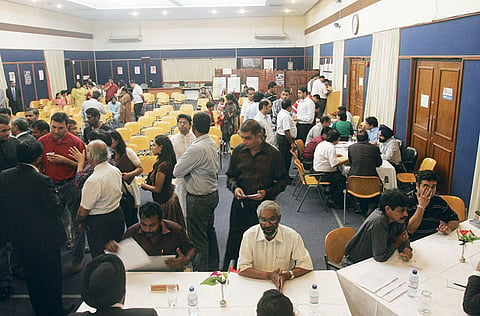
She was among more than 100 people who turned out for an Open House invitation organised to raise financial awareness and to counsel those struggling with debt and related legal and psychological issues. For most of the families and individuals who came in, the overriding issue involved liabilities arising out of multiple credit card usage and taking out personal loans, according to Savera members. Savera is an alumni association of the Indian Institute of Management and also a non-governmental association.
There were a few who had questions about their mortgage loans availed for the properties that have been delayed or stalled. Some others had questions about insurance covers they bought with an investment option tied into it.
The session brought together a group of banking executives, who offer counselling services under the auspices of a Savera. There were also a lawyer and a psychologist to assist the affected.
Criminal offence
After all, bounced cheques and continuous defaults on credit card and personal loans payments are a criminal offence in the UAE, unlike in India, and is likely to land the defaulter in prison. And a financial problem is not agonising just for the individual but also the family.
Sanjay Verma, the Indian Consul General in Dubai, told the gathering that he realised the magnitude of the problem after visits to prisons and emails from Indian expatriates. "We felt there was a need for this [open house]," he said.
A paramedic at a government company in Dubai, Chandan Shive came to the consulate to take advice from the K.S. Abdul Aziz, a commercial and corporate lawyer at Hashim Al Jamal Law office.
Shive, 46, who has been in Dubai since 2006 and earns a monthly salary of Dh6,500 had taken a personal loan of Dh76,000 to book a commercial unit in Ajman in July 2008. As a booking amount he paid two consecutive instalments of Dh23,000 each. Rest of the Dh30,000 was used up for personal expenses.
"This was an investment decision going wrong," said a Savera member, a Dubai-based banking executive, who counselled the people gathered at the consulate. "For the down payment one should always have his or her own personal fund and never take a personal loan for it."
Generally customers, he added, are not aware and neither do many of the banks explain the features of a product and its end use. "A particular debt product is created for an intended use," he said. "You simply cannot use a credit card to pay off your car loan. Or for that matter you should not take a personal loan for booking a house or an apartment. Debt should be used for what it is intended for."
Until today, there are no signs of the proposed development in Ajman, Shive said.
After months of waiting to get answers to their queries, Shive and 32 others have given their power of attorney to a person they consider reliable who would consult a lawyer and who would file a petition at the Ajman Court. They hired him as he would not be charging them upfront. It would save them travel time to Ajman from Dubai at the cost of office work.
Shive came to meet Aziz to know whether there is any hope of getting his Dh46,000 back.
"Have they started the construction of the building?" Azeez asked Shive.
"No sign of it, there's just sand all over the plot," he told the lawyer.
"Then you have a chance to get back your money. File a case in the Ajman court," Azeez advised.
Shive has been repaying his loan "with a lot of difficulties", monthly outgoing being Dh1,872. He has moved to a more crowded bed space and is suffering from stress and diabetes and is taking medication for both.
"Now we have to chase the person to who we have given the power of attorney on our behalf to act fast," Shive said. "He is now in India."
For the Indian professional with Dh400,000 debt, who lives in a two bedroom apartment in Sharjah on an annual rent of Dh55,000, it all started going out of control during the boom years of 2006-2008. Not just her wayward spending, but a large part of the debt — whether on her credit cards or on personal loan — was piled on trying to help her father in his business that eventually went bust. Her parents have returned to India. Her sisters, who do not earn, have stayed back. Her fiancé has several dependents to support.
She acknowledged she was spendthrift and lacked financial awareness and was emotional in trying to help her family members, all of which contributed to her current mess. She did not care to know, she said, that interest rates on credit cards in the UAE was more than 20 per cent per annum, the highest in the world, on balances not paid. She was also not aware that making minimum payments worked more in favour of banks and she did not care to ask banks about credit shields.
Blamed
At the same time she blamed her father, who is a chartered accountant, for not sharing with her or other members of the family on his side business.
Venting her frustration, she said: "It's a men's thing. It's their ego. They refuse to share things with women."
Juggling payments on her nine credit cards with outstanding balance of Dh180,000, a personal loan of Dh180,000 and a car loan of Dh40,000 has been a nightmare that led to psychotic behaviour for a while, which has been under control now.
Sixty per cent of her monthly salary goes into paying part of her debts, but that's not enough to ward off collection agents. She has started defaulting on her credit cards payments and that is adding up her outstanding balance.
After listening to her, the Savera counsellor figured out that after paying her personal loan and car loan instalments and her rents there's hardly anything would be left to meet her personal needs.
Negotiating with banks to ease the monthly payment requirements on credit cards is a way out, the counsellor said, but her situation has made it difficult to even do that.
"Before approaching any bank for settlement she has to better her position to have something to negotiate with," said the counsellor. Instead he suggested the following:
- The first step is to cut down on her expenditures and make a list of her liabilities.
- To do that she should try to increase her income, may be take a second job after her office hours;
- Reduce the annual rent below Dh30,000;
- Send her two sisters back to India and that would allow her to move into a cheaper accommodation;
- Sell the car and free the auto loan or at least talk to the bank to reduce her monthly instalment;
- Talk to the bank to extend the period of her personal loan, which would allow her to reduce the amount of monthly instalment;
- Consider the option of talking to her employer for a salary advance.
Her plans to get married in December still stand, but her parents are insisting on a big wedding, she said.
"Big wedding needs to be avoided at any cost and any money saved in that must be used to clear this mess," the counsellor said.
The energy sector professional fully understands the gravity of her financial mess. "I am willing to just go and do a simple ceremony in a temple in India and come back," she said. "But I am not sure at this stage how my parents would react if I suggest something like this. I will have to convince them. I have to. There's no way out."
Support
Her fiancé, standing by her side, nodded in agreement, saying he is fine with a low key wedding. She says he has been a big moral and psychological support for her all along. In fact, after getting married, she said, she would move into his apartment and save her rent.
If she follows his advice, the counsellor said, she should have surplus funds that would help her to start paying her card dues. But how to approach the payment on the different cards?
After making the lifestyle changes that would allow her to save some cash and assuming that interest rates on her cards are of the same ranging between 25 to 30 per cent, the Savera counsellor advised to start settling from the lowest outstanding card and paying off the total dues and closing that card. "That's one collection agent off your back," he said. "Paying Dh100 or Dh200 to every card has no value. This would reduce the number of banks where she has outstanding and systematically work towards clearing all her dues," the adviser said. Of course if she had a high interest card and another lower interest card, it's always advisable to pay off the former, he said. Looking at her financial track record, he added, no bank would allow her to carry out balance transfers, which does not always come free and even sometimes interest rates may not be competitive. On her personal loan a top up was considered — her original loan value was Dh250,000 which is now down to Dh180,000 — but given her salary and the bank now lending only for Dh20,000 and higher, this option was out.
She plans to provide home tutoring for school children to augment her salary.
"I wish such a counselling session took place earlier," she said coming out of the auditorium, with a sigh of relief. "I believe I was just a couple of months away from being put into prison.
Taking today's advice, I hope to stay out of prison."
What to do when debt is mounting
Talk to your friends and family and see if they are willing to loan you money to pay off some of your immediate payments to avoid a cheque from bouncing or missing a credit card payment; n Approach you bank and try to restructure your personal loan extending the tenure that would allow you to reduce your monthly installment;n Compare your credit card interest rates and get rid of the ones with higher interest rates by balance transfer or taking a personal loan if you are eligible, which is usually of a lower interest rate and pay off your credit cards and close them. However, beware that some balance transfers come with a fee. n If you can neither do a balance transfer or take a personal loan because of your financial situation, you have to force yourself a drastic lifestyle change. That means simply cutting down on your day to day expenditures, including moving to cheaper accommodation, giving up on your car if you have one; sending your family back home if they are here; and if possible, have a second income.
Do you face similar issues? How are you resolving them?


