Passing your time helping others
Time dirham scheme lets you trade an hour of your time for a service
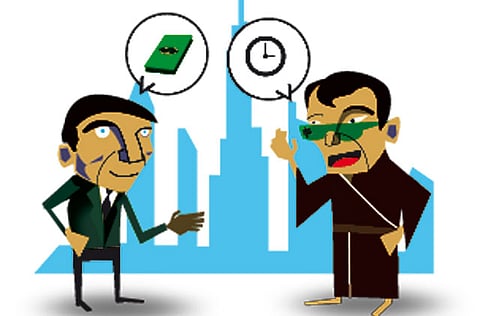
Sometimes, when we run out of money, something comes up that needs to be paid for. The bathroom sink is clogged, there's a dent in the wall or the PC just stops running and it scares the life out of you that you may have lost all your precious files.
You know nothing about any of these things, so you cry for help. After several phone calls, someone from your circle of friends comes over to your place and helps you solve your problem. To show your gratitude, you make him a nice meal or, after a week, you offer to baby sit his two little girls when the nanny fails to show up.
The spirit of giving and reciprocity is innate in people. At one time or another, every one of us has received help from someone without cost and, as we feel indebted to those who have been generous, we do something for them in return.
During these hard times when everyone feels disenchanted with the market economics and cash flow is getting scarce, a growing number of civic-minded consumers in the UAE, and in other countries, are taking the idea of giving to a higher level.
These individuals, joined together for a common good, don't necessarily know each other, nor are they all related. Within the community that they've built, everyone is treated equal. Things like social classes or discrimination against income, race, skills and qualifications don't exist.
Helping hand
Everyone does something for someone and, unlike traditional volunteering or any barter-based scheme, the services are not necessarily traded directly between two parties. And most importantly, traditional money doesn't exist. Time is the only medium of exchange. Welcome to time banking, a concept that has long been implemented by various organisations in more than 20 countries around the world. Through this system, people earn man-hours, not cash, in exchange for their labour, service or expertise.
If one spends an hour doing something for a member, he will get an hour's service from another person. In other words, teaching Salsa lessons for one hour can be compensated with an hour of house cleaning, baby sitting, gardening, etc.
A couple of months ago, a group of young professionals introduced the idea to UAE residents through the launch of an online-based community called Time Dirham. As of May 27, the organisation's website, www.timedirham.ae, has attracted 116 members. By autumn, organisers hope to sign up 300 individuals.
The special currency being used is called "time dirham" which is equivalent to the amount of time spent in service to members of the community. The Time Dirham's bank, operated through its online portal, serves as a broker or coordinator, by helping members connect and interact.
"The concept is very simple. You do something for someone and that other person does something for someone else and it continues. The thing about this system is that it creates perpetual giving. You give your time to someone and that person has to give to someone else. So, it's perpetual giving," says Shymaa Bin Braik, co-founder of Time Dirham.
Bin Braik says time banking should not be confused with barter, which is merely a direct exchange between two people, where the value of the things traded is based on a common agreement on the inherent value of the goods or service.
"With time banking, the medium of exchange is in essence time, which allows an hour of anyone's time to equal to one time dirham, always. It allows you to earn and then trade that time for something else, which is not a direct transaction," Bin Braik explains.
"The basic premise of time banking is to promote community, reciprocity and equality through the voluntary time. It is not focused on the goods or services being traded," she adds.
She says Time Dirham can also be viewed as a service-based system where its currency is not interchangeable with goods or money.
"Time dirhams refer purely to the time it takes for us to do things for others and have things done for ourselves.
"They are not intended to provide goods. As such, when goods are involved, pricing relates to the amount of time it takes to produce those goods, such as is the case with a woman offering baking services," she points out.
While the idea is to promote social exchange and encourage individuals to do something for the greater good, time banking can also be a way for cash-strapped residents to save money. Doing housekeeping for someone can earn a member some legal advice, which in the present monetary system, can be very expensive. "It's absolutely helpful for people who need funds because anyone can get involved, young and old, people with disability, people who speak different languages. There's always a place for anyone in the time bank because everyone has something to give. It doesn't matter what language you speak, how old you are or what degree you have," she tells Gulf News.
"It doesn't matter if you spend your time giving someone legal advice or you spend one hour pet sitting. We already have this sort of inequalities existent in the traditional system, where you say one hour of a lawyer's time is much more valuable than one hour of a waitress' time. This is where we say everyone's time is actually the same. It doesn't matter what you do."
Time banking was first put into practice in the United States by Edgar Cahn, a civil rights lawyer and activist, in the 1980s. Later, several time dollar projects spread across the US and to other countries.
Do you depend on beauty products? Do you do your research about a product before you buy it? Or do you trust the brand?


