Card loss: Owner pays bills
Cardmember liable for purchases made between time card lost and bank notified
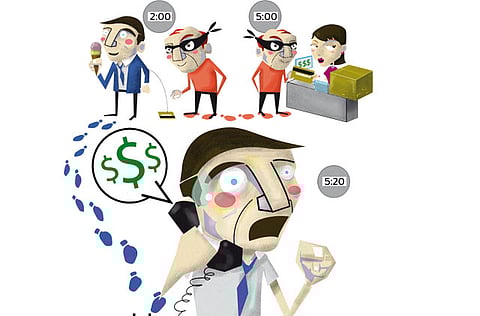
An informal survey of my colleagues from different parts of the world revealed a lack of awareness about vital credit card information in the UAE.
Few people seem to know that in case of a stolen or lost credit card here or when travelling abroad, a majority of the banks in the UAE would hold the cardmember liable for any unauthorised fraudulent transaction made between the time the card was lost and when the loss was reported to the bank.
The general refrain after hearing this often missed point mentioned by banks in fine print was "how dangerous" and "it's so scary."
One salutary outcome of the survey was that all those I spoke to vowed to be extra careful with their cards from now on.
Will this "scary" situation change any time soon? Perhaps unlikely until certain market structures come into existence, unless more awareness is created among various stakeholders, and regulations are passed and enforced to reflect a more consumer friendly environment, say bankers, independent experts and other relevant constituents involved in the process.
Banks such as Abu Dhabi Commercial Bank, Citibank, HSBC, National Bank of Abu Dhabi and and Royal Bank of Scotland (RBS) hold the customers liable for any unauthorised transactions before the card loss was reported.
Gulf News contacted other banks, including Emirates NBD, Mashreq, Noor Islamic Bank and Standard Chartered. They declined or did not respond within the deadline. There is no mention of who is liable on the websites of these four banks. RAK Bank does not have it either.
Case by case basis
Without answering the question of liability in case of a lost or stolen card before it is reported to the bank, Lloyds Bank Middle East responded in an email by saying that they look into each individual case and decide.
"In the unfortunate event that fraud is found to have occurred on a customer account our Relationship Managers will work with the impacted customer to identify the fraudulent transactions," said Richard Musty, managing director of Lloyds Middle East. "Each claim is dealt with on a case by case basis, but we make every effort to complete the investigation, and reimburse funds where applicable, as quickly and efficiently as possible."
The banks which responded to Gulf News'queries say cardmembers are not liable for any transaction made after they were notified of the loss. Usually after the banks are informed of the loss or theft, the card is immediately blocked and the card member is issued a new card within a stipulated time with a replacement charge.
All banks, including the multinational ones, justify this policy saying credit card terms and conditions are unique to each country and region, and are subject to factors such as local banking regulations, legislation and prevalent market practices.
All banks have one thing in common. In recent years, they have put the necessary software in place in association with Visa or MasterCard that tracks and minimises fraudulent transactions.
Though the system differs with banks in how they track fraudulent transactions and alert cardholders, a bank usually sends an alert text message or gives the customer a fraud monitoring call after a suspicious transaction. If the cardholder didn't make the transaction and at the same time realises that he has lost his card, he will be responsible for that fraudulent transaction. The onus is on the customer because he had failed to notify the bank of the loss before the bank alert went out.
Insurance
Some banks offer a form of insurance, going by names such as Citibank's Secure Wallet or NBAD's Wallet Guard which provides coverage on fraudulent transactions done on their bank's or other banks' credit cards when a wallet or handbag is stolen. There is a monthly fee for this optional offer.
Asked about their responsibility about being more upfront in communicating to customers, bankers said all the terms and conditions are laid down in the welcome kit or on their website. But that is not enough, says an expert.
"Here, because of the lack of regulation, the banks do their legal minimum of what information they need to give, such as in very small print or when communicating on the phone," said Andrew Rochford, business solutions consultant at ACI Worldwide (EMEA).
The backlash of consumers in the UK against the banks, for example, led them to be more transparent, both for legal and publicity reasons, he added.
"It used to be this way in the UK, but more competition and openness have brought a change in culture. Lack of consumer protection here in the region [doesn't help] either."
One of the common complaints revealed during the interviews was that many retailers and merchants in the UAE hardly care to compare the signatures on the back of the card and on the payment slip.
"If a merchant in the UAE hasn't checked the signature and hasn't compared it, and it turns out that the signature was different, he is not legally liable," said Rochford. "What they should do here is make the merchants legally liable."
Earlier this month XPRESS reported that Citibank had asked a cardholder Kaimarz Panjehar to pay the entire Dh40,000 involved in fradulent transactions conducted after he lost his card and before he reported it to his bank. Panjehar blames not just the bank but also the merchant.
The investigation revealed, Panjehar said, that the fraudster, an Indian, showed his passport when he was asked to show identification for the first transaction involving Dh29,700. Panjehar is an Iranian.
The merchant never bothered to compare the two—name on the card and on the passport, he said. This occurred in 2008 when Citibank did not have alerts in place, according to Citibank head of cards, UAE and Bahrain, Faraaz Ali. So Panjehar did not receive an alert text message or a call after the first transaction. There was a subsequent purchase of Dh9,900. Finally, a meagre sum of Dh55.
All three transactions were conducted in four and a half hours. Panjehar reported his lost card an hour after the last transaction. After investigation, as reported by XPRESS, Citibank asked Panjehar to pay the full amount on a relaxed payment plan, which he refused.
Panjehar now banks with Rak Bank. He hasn't closed his Citibank account, maintaining a zero balance in it.
Panjehar told Gulf News about Citibank calling him a few times to start paying the due, but they have stopped now.
"They know they are at fault. They know that the merchant was at fault. And the CID has told me to direct the bank to them if they keep making incessant calls."
The Indian who stole the card remains at large.
According to Visa's Middle East general manager Kamran Siddiqi, Visa works with merchants to ensure that appropriate measures are in place so that cardholders are protected from unauthorised transactions. Network International also conducts awareness programmes.
But there should be more merchant awareness programmes, Rochford said, for all merchants, big or small.
The level of fraud in the UAE is relatively low by global standards, Siddiqi said.
However, according to Citibank's Ali, it has almost doubled in the past two years in the UAE.
Technology such as "chip and pin" cards is in place at some banks. But not all merchants are chip and pin enabled, said Navneet Dave, head of cards, National Bank of Abu Dhabi, making it harder to fight fraud at all levels.
Liability limit
In countries like the UK, US, Malaysia and Singapore, there is a liability limit. It is a nominal amount the cardholder pays and the card issuer takes care of the fraudulent amount.
Singapore's cardholders were in the same boat as those in the UAE are in now until last November when the Association of Banks in Singapore set a S$100 (Dh269.311) liability cap for lost credit cards. India and South Africa do not have such a cap and the cardholder is liable to pay for any transaction made before the loss was reported.
Under the UK's Consumer Credit Act, the liability cap is £50 (Dh286.78). US federal law has set the cap at $50 (Dh183.613), which applies if the card was reported within two days of the theft, otherwise it goes up to $500 for the next 60 days, and unlimited thereafter (see box).
A liability cap will come to this market too, but it will take time, said experts.
In terms of credit maturity, when compared to the US, where there is a credit bureau, FICO score, and the depth at which reporting happens, the UAE is at a very nascent stage right now, said Citibank's Ali.
"Everything is a function of market evolution," added Dave of NBAD. Acknowledging that there is a need to limit the liability exposure of the customer, he said: "It's a question of time, it's a question of the market maturing and of the consumer maturing."
He pointed out that the lack of insurance companies offering cardholder loss to UAE banks is a detriment towards developing a liability limit.
All the stakeholders involved, including banks, merchants, customers, regulatory authorities — in this case the UAE Central Bank, consumer rights bodies, national bankers association and law enforcement authorities need to work together, some bankers said.
"There are multiple stakeholders who have to work in tandem," said the business head of cards of a national bank, on condition of anonymity. "In the absence of a regulatory enforcement, if I may call it that, it becomes all the more difficult for these multiple stakeholders with different interests to come together and reach some kind of an agreement in terms of a way forward."
The consumer rights body of the government of Dubai referred Gulf News to the Central Bank for views on the issue. But no official from Central Bank was available to comment on the issue.
The Central Bank regulations, as of now, do not specifically address the liability burden in cases of stolen or lost cards. Also, unlike the Association of Banks in Singapore (ABS), the Emirates Bankers Association does not have a Code of Consumer Banking Practice. ABS was in fact instrumental behind passing the new measures that limited the cardholder's liability.
Regarding protection, perhaps a banking ombudsman is required here, similar to the one in the United Kingdom, Rochford said. He added that the whole issue of regulation, protection and control needs to be looked at within the UAE. "However, more fundamental issues need to be clarified first, such as responsibility and debt liability," he said.
Liability caps in other countries
- Singapore: S$100, according to laws passed by Association of Banks in Singapore's Code of Consumer Banking Practice
- Malaysia: 200 ringgit under the Bank of Negara's law.
- UK: £50 according to Consumer Credit Act
- USA: The cap of $50 applies if the card was reported within two days of the theft, otherwise it goes up to $500 for the next 60 days, and unlimited thereafter.
- Australia: Cardholders have no liability at all, under the Electronic Funds Transfer Code of Conduct
Have your say
Do you think card holders should pay for the transactions on a lost or stolen card? Have you ever lost your credit card? What happened? Tell us.


