Red-hot food prices become cause of major concern
Rising cost of sourcing likely to have disastrous consequences for companies in the sector
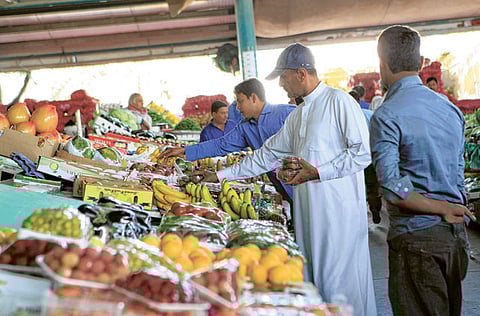
Dubai: We are living in unpalatable times. Seemingly with every passing week, whether you are dining in or eating out, what's being put on the table is weighing rather heavily on your wallet. Certainly enough to cause a bout of indigestion.
By the looks of it, food price inflation is here for an unwelcome — and extended — stay. And it's developing into a full-blown crisis.
What could further distort an already tense situation is the crisis that is bloodying Libya and its subsequent impact in driving up global oil prices. Early last week, oil climbed to its highest in more than two years.
All of this leaves local food wholesalers and retailers in a very difficult position. "In recent weeks, our procurement costs are up by more than 15 per cent and our suppliers have warned us to brace ourselves for more," said the owner of a leading wholesale business based in Dubai's Fruit and Vegetable Market.
"So far we have managed to keep supplies coming through without much disruption. But a sharp drop in demand locally would have huge consequences for us given these are perishables we deal in."
Already, cashflow problems are being keenly felt among the smaller and mid-sized businesses that make up the majority of this trade here. The sentiment among them is that any further deterioration in the cost of sourcing would lead to disastrous consequences for them.
Local traders in food commodities talk about working on alternate sourcing arrangements from cheaper supplier markets. But the prospect that by doing so would create immediate breakthroughs remains remote.
"As experts predict the market will remain volatile for the foreseeable future, we are adapting a sustainable policy that will have social and economical benefits such as sourcing from local producers and direct imports where the middleman can be totally eliminated," said Mousa Haji, chairman of Fathima Group, which operates supermarkets under the same name. "We are also in the process of introducing more private labels to our category where we can offer customers better prices."
But such wholesale transitions will take their time to translate into pricing that consumers can again be comfortable with. In the near term, the current projections are for inflationary pressures on food and related items to be a live wire issue for the local trade.
"Prices keep on increasing for almost all the products and the indication is it will be like this for some more time," said Zakeer Hussain, Manager at Food and Life Trading Co..
Regional supply
Until the recent political unrest swelled over in Egypt and Libya, there was a keenly felt expectation within the local food commodities trade that they should look to tap more supplies from within the region. That way they would have access to goods less costly to buy and ship in.
Again it might turn out to be a case of misplaced expectations. "As the gap between the real cultivation and demand is huge, even regional producers have to depend on imports," said Hussain. "Hence they are unable to sell goods at reasonable prices.
"And now there's the impact from regional disturbances. We are trying, but cheaper options are remote unless we compromise on quality… and that's just not possible."
The options on the table are limited. If oil prices continue the northward trek, even those available will get circumscribed further. The easy option — some in the industry would say even the only one — available for traders would be to pass on the higher costs to the consumer. But with the Ministry of Economy keeping close tab on retail prices of as many as 30 basic commodities, traders and retailers maneuver space is quite restricted now. From a wider economic perspective, the authorities' close oversight of the situation is required as the local - and the other Gulf markets for that matter - rely predominantly on imports for their food requirements.
Industry sources hope that the authorities would step in to alter the present pricing structure given how the global and regional supply situation has changed in recent weeks. If they don't, the immediate future does not look all that cheerful for traders.
"Importers and distributors are struggling for survival as the Ministry of Economy is not permitting them to make corresponding price increases in the local market," said Hussain.
The first two or three weeks of March could be crucial in that respect. If oil prices spike further during this period, the impact on commodity imports would be felt immediately. And in such a situation, retail prices would have to come in for adjustments.
Any which way one looks at it, the Ides of March await local residents when it comes to their food bills. The food crisis is not going to leave their dining tables.
Measures: Coming to grips
Governments the world over are doing more than their bit to come to grips with the food crisis, brought on by supply and price volatility. But so far, these efforts, concerted or otherwise, have not had much of an impact.
"I really do not believe they are coming to grips at all, nor do I think they will get a handle on the situation shortly," said Jean-Pierre Lehmann, professor of international political economy at IMD.
"Global governance is completely adrift, as the outcome of the recent G20 finance ministers meeting in Paris bears out. The French presidency of the G20 has promised to make food price volatility a priority, but one must not raise hopes too much. More likely the G20 will get bogged down in global imbalances and currency issues.
"The problem with food is not production, but distribution and governance."
While the world's population has grown by 5 per cent over the last five years or so, production of basic food commodities — rice, wheat, corn, soya, oilseeds, etc. — did so by 10 per cent. But the food crisis, according to Lehmann, emerges mainly from its poor distribution and governance.
"Poor governance means, among many things, that prices are distorted by interventions, subsidies [for ethanol at the expense of corn in the US] and export quotas," he said. "Yes, we will have more shocks."
For those in the industry, the food crisis is not even of recent origin. During a trip to Dubai late last year, Frits Van Djik, executive vice-president at Nestle, the world's largest food company, said: "Since the so-called food crisis started in 2007, all commodities have been impacted at some point or the other.
"I am not too optimistic that things will change. But it's the nature of the beast — if you are dealing with agricultural products that's how it goes."
Lehmann vouches for that: "It is going to get worse before it gets better - even if there is a brief lull, as there was after 2008. Costs of basic commodities have surpassed the peaks they reached at the height of the food crisis in 2008."
The food crisis goes well beyond the immediate future. Population growth in the coming years will be markedly high in regions such as the Middle East and North Africa, sub-Saharan Africa, central Asia and south Asia. These are broad swathes of the world where food distribution is notoriously inefficient.
Against that context, bear in mind that the wave of protests that rocked Tunisia and Egypt and now in Libya had to do with perceived inequities in the quality of life felt by large sections of their populace.
"Along with the increase in population, there will be an enormous wave of urbaniSation," said Lehmann. "Food inflation in urban settings with a very high proportion of unemployed youth will cause instability… at best."
According to the UN's Food and Agricultural Organisation, the numbers suffering from hunger has risen by 44 million in the last 12 months. "Though the problem of poverty will persist, especially among the so-called "bottom billion", there is also the phenomenon of the rise of the aspiring classes among the dynamic emerging nations," said Lehmann.
"The Economist has calculated that the number of persons this decade who will rise from mere subsistence to middle income consumption levels is about 1.5 billion. So demand will become stronger not only for more food, but also for better food.
"It is estimated that as much as 40 per cent of food production is never translated into consumption, because of bad infrastructure, communication and governance," said Lehmann. "If the huge amounts of waste could be mitigated, that could make a huge difference."
Do you research various options before buying groceries? Have you changed your food purchasing habits as a result of rising prices?


