Euro crisis jolts US luxury dealers
Tiffany's cut in sales forecast may be hint of things to come
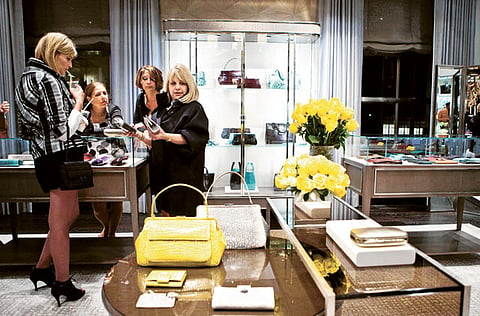
Washington: The US luxury sector, a bright spot in US retailing for the past two years, is struggling to maintain momentum as Europe's sovereign debt crisis sends shockwaves across the Atlantic.
US luxury sales, excluding jewellery, climbed 1.8 per cent in April from a year earlier, after gaining 6.7 per cent in the first quarter and 13 per cent in the fourth quarter, according to MasterCard Advisors SpendingPulse, which tracks retail sales in all payment forms.
The pullback by well-heeled consumers has already slammed Tiffany & Co, the world's second-largest luxury jewellery retailer, which yesterday cut its profit and sales forecasts. The question is whether the pain will deepen in other parts of the luxury sector, putting pressure on the bag and shoe sellers such as Saks, Neiman Marcus Group and Coach.
"For the luxury industry '08 and '09 were the years of the crash '10 and '11 were the years of the recovery, and '12 is the year that may give luxury consumers pause," said David Schick, an analyst with Stifel Nicolaus & Co in Baltimore. "Luxury doesn't outperform the broader economy forever. It never has."
Wealth effect
Since 2010, wealthy shoppers have continued to buy luxury merchandise even as the US economy limped along. Rising stock markets made such consumers feel comfortable splurging — the so-called wealth effect — and many were eager to treat themselves after a period of frugality. In the past two years, sales at Coach grew at a 12 to 15 per cent clip; Saks at a 6 to 8 per cent pace.
Ground zero for Tiffany's woes: the 175-year-old jeweller's New York flagship on Fifth Avenue, where Wall Streeters and wealthy European tourists have been known to drop as much as $32,100 (Dh117,807) on yellow diamond rings. The store accounts for 8 per cent of Tiffany's worldwide sales and about 40 per cent of that comes from visiting foreigners, Mark Aaron, a Tiffany spokesman, said at an investors conference last month.
When Tiffany announced its first-quarter earnings, it became clear that all was not well at the flagship, where sales fell 4 per cent from a year earlier. Two factors were largely to blame. Wall Street firms cut bonuses and delayed payments after investment banking and trading revenue dropped in 2011. And European tourists, burdened by economic woes at home and a stronger dollar, became less willing to spend.
US jewellery sales fell 3.7 per cent in April, according to SpendingPulse, which is based in Purchase, New York.
"Is demand slowing considering everything that is happening in the US and Europe?" said Hana Ben- Shabat, a New York-based partner in the retail practice at A.T. Kearney, a management consulting firm. "I think yes there is some slowing in demand in those regions."
Stock market gains simply aren't sufficiently robust to offset the "economic headwinds," according to Michael McNamara, a SpendingPulse vice-president. "The environment is getting more difficult," he said.
For the moment, affluent shoppers are still inclined to open their wallets for shoes and handbags, said Matt Arnold, an analyst for Edward Jones & Co. "It comes down to where the consumer sees the best bang for the buck," Arnold, who is based in Des Peres, Missouri, said in an interview.
Spending shift
Leather goods may dodge the bullet as the rich shift spending from jewellery priced in the tens of thousands to other luxury goods costing thousands, according to Ben-Shabat. New York-based Coach said April 24 that its North American sales at stores open at least a year will be at least as high as 6.7 per cent. They climbed 10 per cent in the year-ago fourth quarter. Saks, also based in New York, is forecasting a mid-single digit range comparable sales gain in percentage terms versus a 16 per cent jump a year earlier.
All eyes will be on the seesawing news in Europe and the US presidential election, Stifel's Schick said. "How will the luxury consumer feel after politicians start talking about taxes?" he asked.
