Gold demand in Middle East stalls as prices fall on global concerns
Regional somewhat "muted" from investors looking to benefit on the price change
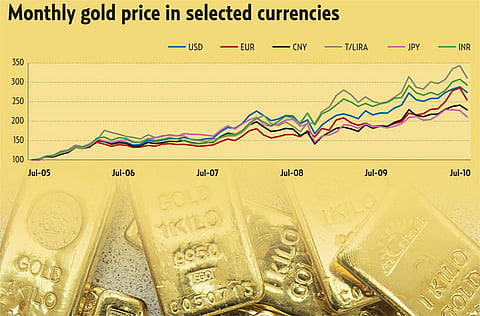
Dubai: Gold demand in the Middle East faltered in the second quarter with a fall of 7 per cent on the back of high prices
Statistics by World Gold Council showed that UAE's year-on-year demand fell by 15 per cent, Saudi Arabia bucked the regional trend and rose by 5 per cent and Egypt dropped 15 per cent.
Pradeep Unni, Senior Relationship Manager, Richcomm Global Services, a brokerage firm that trades gold, said that aside from rising prices, the UAE gold demand is low due to global economic concerns and a shortfall in inbound European tourists.
"Sixty per cent of the gold-buying in the UAE is by tourists.
"That number was lower because of Europe's conditions and prices that were quite high last quarter," he said.
During the second quarter of 2010, the average gold price moved into higher trading ranges in most currencies. The gold price surged to a new high of $1,261.00/oz (Dh4,627.87) on June 28 above May's record of $1,237.50/oz.
Negative impact
The rise in local prices prompted a sell off in certain countries and also negatively impacted jewellery demand, especially in countries where gold demand is sensitive to increasing or volatile prices, WGC said.
Regional demand was somewhat "muted" from investors looking to benefit on the price change of gold, trading through instruments such as exchange-traded funds. Middle East saw demand for a total of 3.9 tonnes, at a growth of 3 per cent.
Year-on-year declines in Egypt of 40 per cent to 0.2 tonnes, and other Gulf countries with net sell off of 0.4 tonnes, was more than offset by an increase in the other markets.
In the UAE, investment demand growing at 26 per cent and Saudi Arabia, growing at 3 per cent, price expectations had a similar impact as in the jewellery sector, encouraging purchases of gold investment products in anticipation that higher prices would be realised on those investments, the report said.
"The Akshaya Trithiya festival met with good interest, but demand tailed off in response to high and rising prices during the second half of the quarter. Across much of the Middle East region, it seems to have been the expat Indian population that reacted most strongly to the higher price level, while in Saudi Arabia the local population were less price-sensitive," the report said.
Unni said that seasonal buying — that begins before summer holidays as home-bound travellers prefer to take gold as gifts — offsets the general dip in demand. "Per capita take up was very low, but is still better than last year," he said.
Expected to be firm
In the coming quarter, prices are expected to be firm as various occasions spur retail buying. Gold price is going to be range bound at $1,175, and $1,260, given the global uncertainty in US, or debt issues in Europe, global uncertainly will continue to be there. That will keep gold as a safe haven and within that range," he said.
Gold purchase will be on a high in the coming few months as Indian festival of harvest will set off with Navratri, nine days of celebration, when farmers come into increased amounts of cash, and well as Diwali, the festival of lights near the end of this year.
However, before those, Muslims will celebrate Eid, marking the end of Ramadan, also a gold-buying occasion for many.


