Public-private energy ventures mooted
Global Energy Forum discusses opportunities and risks associated with such partnerships
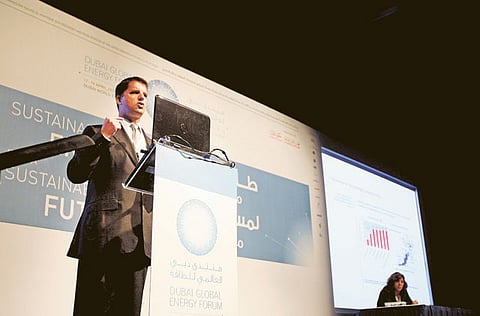
Dubai: In line with Dubai's 2015 strategy to establish strong partnerships with the private sector, the government is looking to promote public and private partnerships (PPP) in the energy sector.
"According to the World Bank, electricity access in 2009 was nearly 100 per cent. But if we look at the emerging markets in some areas it's as low as 30 per cent. Even in the Middle East it's somewhat below the 100 per cent mark," said Jonathan Robinson, head of project finance at HSBC Middle East, UAE.
"As emerging markets position themselves for growth, there will be increased demand for energy infrastructure. The increased demand will thus pressure governments to find new ways to fund it.
"Public/private partnerships have been widely adopted in the western markets for many years, but not so widely adopted in the emerging markets and thus represents an opportunity," he said.
‘Driving innovation'
In his speech at the opening of the Dubai Global Energy Forum, Saeed Al Tayer, vice-chairman of the Dubai Supreme Council of Energy, said that one of the aims of the forum was to discuss the opportunities and risks involved in public and private partnerships.
"PPPs have become highly effective means of achieving results and further driving innovation and diversity in the provision of public services. By making the most of public assets while generating jobs among the private sector, PPPs offer a win-win proposition for everyone," said Al Tayer
"Foremost among the advantages of PPPs are the rapid and effective delivery of infrastructure projects that add value as they combine the best that the public and private sectors offer.
"DGEF is the ideal platform to nurture and effectively deliver such partnerships that will change the criteria of building energy infrastructures on the local, regional and possibly international levels as well."
According to Moncef Cheikh Rouhou, a professor of management econ-omics and finance at HEC Paris, PPP investment fell in the early years of 2000 and rebounded after 2003.
During this time, the Mena region has remained one of the most modest areas of PPPs in the world "which means there's a lot of potential in the region," said Rouhou.
PPP investment in Mena is mostly in telecom, water and sewerage with 12 out of 23 countries involved in such partnerships.
According to Rouhou, projects reaching financial closure total 130 in the region, with telecoms making up the vast majority. PPPs in the energy sector came just below telecoms with a total of 33 projects; 27 in electricity and six in natural gas.
"In the last ten years I've seen many of the GCC governments embark on this transitional policy of change. Many of the economies have already embarked on programmes, particularly in the power sector. Abu Dhabi, Bahrain, Oman, Saudi Arabia, Kuwait and soon Dubai will be embarking on build-operate-own (BOO) and build-operate-transfer (BOT) programmes for their powering needs," said Robinson.
Dubai's first example of a PPP is Dewa's Hassyan power plant, the first to produce electricity and water by an independent producer in Dubai.
Global interest
"While we've seen this adopted widely in Abu Dhabi, this marks a first step in Dubai and will set the precedence for future PPP's in the emirate. We've recently received some 30 expressions of interested from power developers around the world," said Robinson.
The Dubai government, which has just opened up to the possibility of PPP's, formed the Dubai Supreme Council of Energy whose purpose is to develop this form of partnership.

