Presiding over the expansion of a health-care network
Adams oversaw firm's growth from a diagnostic laboratory chain
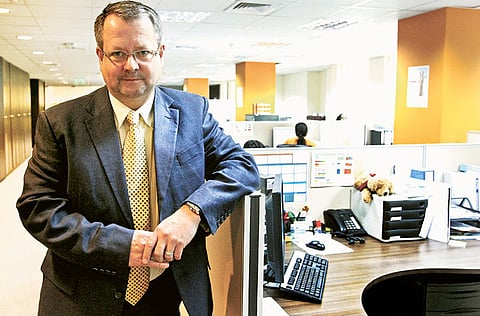
Dubai: In matters of health, it always helps to get a second opinion. The same rule could just as easily apply to the business of health care.
Just over two years ago, Gulf Healthcare International was operating a business model based on lab diagnostic centres. While this was providing a stable revenue stream, it paled in comparison to the kind of growth potential inherent in the GCC's health-care industry. Mark Adams, who has a background in insurance, was brought in as CEO two years ago. "When I joined we were very much a lab diagnostics group and I was saying to the board that the thinking had to change," said Adams, who is now a shareholder in the enterprise.
"Whilst diagnostics was an important part of health care, you are reliant on independent doctors referring their tests to you. But if you are actually looking after the patients through your own primary care setting, you get the vertical integration with the labs as well."
The process set in motion an expansion programme featuring a mix of acquisitions of third-party owned clinics as well as those created organically. "In the two years, we have developed a number of clinics with more under construction, but at a totally different level to what they were before," Adams said.
Sharp differentiation
And he has brought in sharp differentiation into what the network of clinics offers. This led to creating separate identities with ‘Amber' being the entry-level care provider and Adara serving a clientele further up the value chain. Then there will be the Atria line-up of sub-specialty clinics. "Unfortunately, you can't have a one-size fits all kind of offering in the health-care business," said Adams. "You have to segment the brands to give people what they want and at rates they can afford."
The on-going network expansion will concentrate on creating saturation coverage in the UAE and in Kuwait. Qatar is rated as a strong possibility for an entry in the near term, but additional markets would get a look in only after a three- to five-year time-frame. During this period, GHI's intention is to secure itself firmly into the two markets that it knows best.
It certainly has the funds to make that happen. Early this year two private equity funds managed by J.P. Morgan Asset Management made a strategic investment in the company. In the near term, GHI is lining up a Dh100 million outlay programme to expand the number of clinics within the network.
"It's not just the funds from J.P. Morgan; we are putting in the profits from the business into the network expansion," said Adams. "The clinics we are establishing are not one-man bands or have doctors operating in a converted villa.
"We are creating polyclinics where we do most things a hospital will do such as minor surgery and endoscopic procedures.
"We also have the ability for someone to see a family doctor, an internal medicine doctor or a GP. If they then want to see a cardiologist they can do that under the same roof.
Gatekeeper system
"Patients don't tend to have relationships with hospitals, but they do with doctors. In the Middle East, there isn't a strong primary-care gatekeeper that you have in other parts of the world.
"In every other system, the Department of Health wants to have a primary-care gatekeeper system because that way you build relationships with the patient and the patient's family. There you have the GP as the first line of contact to assess a patient and manage the hypochondriacs so that they don't go further into the system."
However, none of this means GHI's focus will be confined to the primary-care space. The first steps have been taken to seek a prominent role in the region's thriving secondary-care category.
"We are in talks with potential partners to get there and that's obviously the most logical step for us," said Adams. "Building a hospital takes three years and we are looking at one project in Dubai and one in Sharjah."
My Tips: Employees first
* If you focus your attention on the staff as your Number One priority, they will better serve your customers and your shareholders will do well as a result.
* When dealing with multi-cultural teams, don't assume that they understand what is expected of them until you have asked them to explain the vision of the business and their role in it.
* Never punish an honest mistake, encourage bravery and empower decision-making. But ask your team to learn from successes and failures.
* Demand team loyalty. Cabinet solidarity is key to building confidence in an organization, challenge hard around the board room table but speak with one voice thereafter.
* Embrace the differences of people and know that harnessing left- and right-brained people balances decision-making and increases the likelihood of success.

