Event records Dh232b orders with Emirates leading way
Gulf airlines are looking to hedge their fuel purchases to help offset ballooning fuel costs
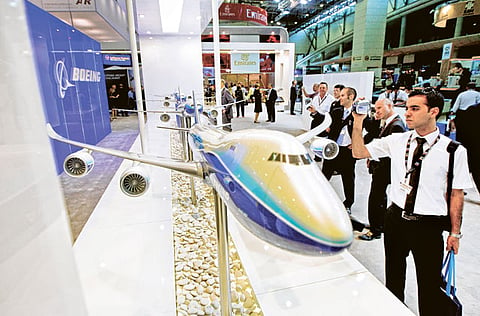
Dubai: The Dubai Airshow closed its doors yesterday with $63.3 billion (Dh232.31 billion) worth of orders for aircraft, maintenance services and flight training programmes.
"Visitor numbers broke the record with 56,548 people, making the 12th edition of the Dubai Airshow the biggest as well as the most colourful yet, as the halls, pavilions and chalets displayed the colours of the UAE national flag in celebration of the nation's 40th anniversary," organisers said in a statement.
The event, which started with a Dh66 billion order by Emirates, continued with a series of announcements that reached its climax on the third day, when Qatar Airways CEO Akbar Al Baker accused Airbus, saying they were still ‘learning how to make planes' and then a few hours later placed an order for 80 Airbus A320 neos and five A380s.
The theme of flight training which permeated this year's show continued on the final day with Fujairah Aviation Academy signing a deal with Iata to develop the Fujairah facility as an Iata-approved training centre for graduates.
The UAE's 40th anniversary celebrations at the show came to a climax as the country's new aerobatic display team — Al Fursan — opened the aerial display with a fly-past with an Emirates Boeing 777 aircraft, proudly trailing the colours of UAE national flag to the delight of the crowd below.
Alison Weller, Managing Director of airshow organiser F&E Aerospace, said: "We promised a Dubai Airshow that would be bigger and better than ever and we did not disappoint. The past week has been notable for its buoyant crowds, spectacular aerial displays and astonishing order announcements. As the show comes to an end, it will be time to take stock of the successes and the challenges, in preparation for Dubai Airshow 2013 at Dubai World Central!"
The event is organised under the patronage of His Highness Shaikh Mohammad Bin Rashid Al Maktoum, Vice-President and Prime Minister of the UAE and Ruler of Dubai, and in co-operation with Dubai Civil Aviation Authority, Dubai Airports and the UAE Armed Forces. Meanwhile, the Gulf airlines placing multi-billion dollar jet orders are looking to hedge their fuel purchases to help offset ballooning fuel costs which threaten to crimp expansion. Gulf airlines unveiled impressive growth plans at the show, betting that the region will continue to expand as a hub for air traffic.
Enjoying a petrodollar spending spree while the Eurozone is struggling with a debt crisis, Gulf carriers are intensifying competition for their European rivals.
But when it comes to rising fuel costs, an Achilles heel for airlines worldwide and typically accounting for about 40 per cent of a carrier's operating costs, they are not immune either.
"Fuel is our largest expense, equivalent to approximately 35 per cent of our cost base," Etihad Airways told Reuters. The carrier's chief financial officer said on Wednesday that the airline has already hedged 81 per cent of its fuel needs in 2011, saving around $300 million in costs.
For next year, it was hedging 70 per cent of its fuel requirements, at prices below the market, James Rigney said. "We have been hedging our exposure to jet fuel prices since 2007 with the objective of reducing the volatile impact that fuel costs can have on our financial performance and to achieve a degree of certainty and stability in our biggest cost item," the company said.


