Air Arabia to keep lease option open if urgent need arises
Company defies the nay-sayers, grows from $15m to $1.2b capital
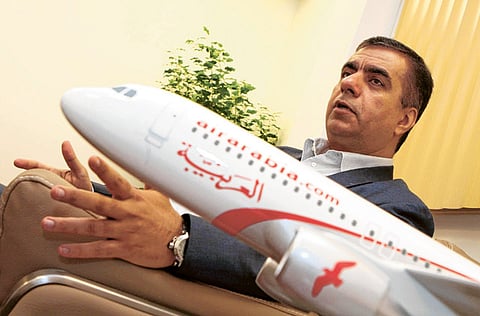
Dubai: Thursday marks seven years of service by Air Arabia, the region's first low cost carrier. From an initial capital of $15 million (Dh55 million) to $1.2 billion, it will have a fleet of about 70 aircraft when it receives the 44 A320 aircraft that will enter service in the next few years. Adel Ali, chief executive, speaks to Gulf News about the past and the future of the airline.
Gulf News: How would you sum up the success of Air Arabia over the past seven years?
Adel Ali: Going from a company that most people in the industry thought would not work, and a business model that is not for the region ... To see that you have progressed from $15 million to $1.2 billion capital ... to more than 70 aeroplanes, and to make sure that we have three hubs to operate from, and more importantly, there is a revolution that has taken place in the aviation industry as a result of our initiative.
If you go back to 2003, when we started this business, air travel was very limited, people used to pay a lot of money, those with lower incomes had never been on an aeroplane. All those things have changed today. Everybody flies. Everybody believes that our business model is right. Almost every airline wants to have low cost [travel] in the Arab world.
One should be proud of the achievement of Air Arabia in terms of how we changed the whole air travel philosophy in seven years.
We created intra-regional travel in this region, it was very small to non-existent and now, I think, everybody travels to every country. Travel from the UAE to Doha or Muscat has become a normal thing. That for us is the achievement.
We've also successfully proven that not every airline has to be dependent on the government [for] support. We've demonstrated that air travel can be a private business in this part of the world and not only a private but also a successful private business. Since we've gone IOPO, we have been giving dividends and investors have been benefiting.
What is your current view of operating out of Sharjah International Airport?
We are very happy that the airline's main base is Sharjah Airport. Sharjah is the true airport for a low-cost business model. It's the size of the airport, size of airdrome taxi-out and taxi-in that saves us and saves the customer time, and makes the overall journey much shorter. As a result of that, it makes the operations cheaper. That of course is good for our business.
At the same time, Sharjah Airport... has tripled its capability of capacity. It has renovated and built a very modern terminal for today where the technology and facilities that a customer needs are in place. And they've also increased the number of aircraft stands. Along with that, we've also managed to bring in a new catering supplier.
The new runway that the government is building is a vision of the future. They know there will be a runway needed maybe in two or three years' time.
They are really thinking ahead and putting those things into place. That is one thing that is really appreciated and would make ... air travel much better.
So the airport infrastructure is just growing in line with the airline. And they are probably a step ahead of us. Every aspect of Sharjah Airport you touch, you will find an improvement.
The last thing we needed to complete this picture was a hotel, which will hopefully open in January. From that point of view, the whole progress of the operation is good.
How can capacity limitations in new hubs affect the airline's growth plan?
In the airline business, you always want to grow and you always want to make sure you fly to more airports.
It's an industry that always brings challenges because there are the capacity issues, destinations, political issues, competition and climate issues. What you have to do is work around those things and progress it.
But the fact is, you've got to develop your business by growing ... So long as that is happening in your business, you keep growing.
We will get limitations on everything, but there are always solutions. When you're limited on aircraft, you order some more. When you're limited on routes, you go and find some more.
And when there is competition, you try and fight it. And that's what we're here for.
You've just begun to take delivery of the 44 A320s. Are you looking beyond that?
We are, but we've not made decisions.
As an airline, we don't rush in to order aeroplanes. We want to make sure that what we have, we utilise. There is always the option of leasing an aircraft if you want to make an airline bigger, if you have an immediate need.
And therefore, we don't believe that our business will suffer or slow down as a result of not ordering aeroplanes. We just make sure we order what we need.
We take risks but extremely calculated risks. We have to look after ourselves.
We don't have any deep pockets from any government to give us.


![People on boat aver Danube river taking picture during summer night ride [Stock image of Danube river used for illustrative purposes only]](http://media.assettype.com/gulfnews%2Fimport%2F2019%2F02%2F22%2Ftab-Budapest-iStock-802029848-(Read-Only)_resources1_16a4a166f2c_large.jpg?w=320&auto=format%2Ccompress&fit=max)