North Korea, the most bizarre country on Earth
Visitors to this secluded state get to see proud symbols of the nation
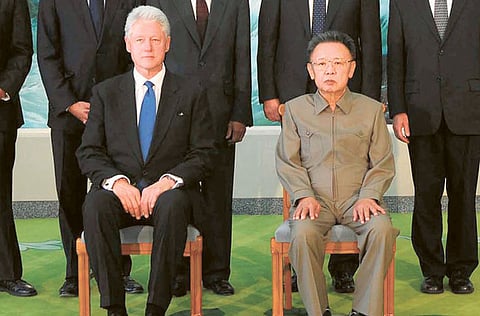
Bangkok: The last Stalinist-style dictatorship on Earth has lost its "Dear Leader" Kim Jong-il, and now the world is wondering what is going to happen with the secluded country that only a few people from outside were able to visit for tour purposes so far.
While the nation is in dire need for political, economic and almost all other conceivable reforms, it has yet to be seen what changes the North Korean leadership around the designated successor Kim Jong-un and the powerful military is planning to implement — if anything.
I made two trips to North Korea, in 2002 and in 2006, which resulted in a well-received travel guide book, indicating that the outside world is highly interested in first-hand reports on the country.
Interestingly, it is not difficult at least for Europeans to get a tourist visa for North Korea, and the trip is fully organised by a state-run travel agency and is not really expensive.
Tight schedule
The only drawback is that visitors need to stick to a tight schedule set by the North Korean agency and cannot travel on their own.
However, what the North Korean tour guides present to foreigners, is nevertheless interesting:
It is like a tour across a Stalinist open-air park, to put it ironically. Visitors are shown what the guides call "achievements and proud symbols of the nation", be it the huge arch of triumph in the capital Pyongyang, which is of course a few metres taller than its counterpart in Paris, the giant mausoleum of the country's founder, and the late Kim Jong-il's father, Kim Il-sung, where residents as well as visitors have to parade in an almost religious manner by a glass-covered sarcophagus where the embalmed body of Kim Il-sung lies, and where his son most likely will be laid to his final rest, too.
Visitors are further shown the monumental statue of the country's founder, on top of Pyongyang's Mansu hill, a 60-metre bronze artwork of Kim Il-sung with his right arm stretched skywards. Interestingly, no such statues of Kim Jong-il exist.
One must-see is Kim Jong-il's alleged birthplace at an attentively restored former anti-Japanese guerrilla camp at the Baekdu mountain in the north, close to a romantic volcano crater lake considered as a "sacred place".
A cross-country tour also leads to the bizarre International Friendship Exhibition, a large window-less museum complex hewn in the rocks of the Myohang-san mountains in the north.
In 150 rooms, it contains an estimated 150,000 gifts presented to Kim Il-sung and Kim Jong-il by foreign dignitaries over the last decades.
Visitors are stunned by items such as Joseph Stalin's bullet proof limousine, a bear's head handed over by former Romanian dictator Nicolae Ceauscesu, a crocodile suitcase formerly owned by Cuban leader Fidel Castro, a metal horseman by Libya's Muammar Gaddafi, and countless other minor curios such as a massive ashtray presented by the Austrian-North Korean Friendship Association. During the visit, The Internationale, the anthem of socialism, blares from hidden loudspeakers.


