No deal on controversial Lebanon salary scale bill
No deal on controversial Lebanon salary scale bill
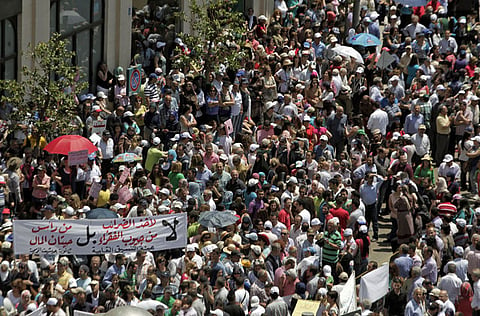
Beirut: Although lawmakers were allegedly poised to reach a compromise on the controversial salary scale bill, parliament failed to pass the proposal developed by a committee that finally settled on a $1.4 billion maximum — up from an earlier ceiling of $1.2 billion — that nevertheless fell far below the original $1.9 billion that was approved by the Najib Mikati Government.
As teachers and civil servants held what they termed a “day of rage,” various political blocs engaged in classic bargaining, to put something on the table even if the will to act was clearly absent. What prevented an accord were the tax measures proposed to finance various salary increases, although attempts to press the Cabinet to cut waste in leading departments, most notably in the state-owned Electricité du Liban — a deficit ridden institution that wasted nearly $2 billion a year — though few were optimistic.
Instead, deputies entertained the unpopular idea of raising VAT from 10 per cent to 11 per cent, increasing customs by 1 per cent, enlarging taxes on bank profits from 15 to 17 per cent, augmenting revenues on deposit interests from 5 to 7 per cent, and expanding duties on real estate profits.
Of all of these proposals, the VAT hike was the least popular, as it would add the burden on the working classes. Indeed, while most deputies sympathised with the demands of the Syndicate Coordination Committee (SCC), a coalition of private and public school teachers and public sector employees, many were concerned about the negative economic repercussions of dramatic increases in wages, arguing that such increases ought not be accompanied by VAT hikes that would nullify concrete gains.
The demonstrators at Beirut’s Riad Al Solh square held placards with slogans urging deputies to stop procrastinating, with one placard reading: “Resolve it (the scale) or Go Away,” while the head of the private school teachers association, Nehme Mahfoud, lashed out at corruption in state institutions. For his part, the head of Public Secondary School Education Teachers Association, Hanna Gharib, requested that deputies remain honest towards the SCC and approve the wage hikes.
Verbal attacks continued unabated throughout the day, as Speaker Nabih Berri sent word that parliament did not legislate under pressure — although it seldom legislated — urging Hanna Gharib to apologise to deputies for calling them thieves. Earlier, Gharib booted at parliamentarians for postponing their deliberations indefinitely, as he demanded the government to enforce a qualification-based employment policy and refrain from increasing taxes on the poor, adding that that the SCC “faced thieves, not capitalists.”
Berri tasked the Education Minister Elias Bou Saab to inform Gharib that “charges would be brought against him if he did not apologise for his statements,” which prompted a harsh rebuke from Gharib who pointed out that he had never specifically accused Lebanon’s deputies of being bandits. “I did not say thieves,” he clarified during a demonstration outside parliament, but referred to them as “money whales,” adding: “I haven’t harmed the dignity of any deputy and in case I did, I apologise.”
Theatrics aside, sharp differences remained on the substance of the bill, as Hezbollah rejected all of the decisions taken by the ministerial-parliamentary committee, and presumably wished to give employees their full rights without increasing the burden on low-income families. According to deputy Ali Fayyad, the Loyalty to the Resistance bloc expressed solidarity with the strikers because, he clarified, “the salary scale that the subcommittee put forth was unfair and did not address the weaknesses in the original bill.”
For his part, deputy Alaeddine Terro, from the Walid Junblatt National Struggle Front, insisted that “clear” funding sources be identified to finance the salary scale, before any decisions were reached to avoid an economic chaos.”
The Speaker said that he would call for a fresh session on May 25 if no decisions were reached on Wednesday, since he “preferred to avoid a dispute in the last 10 days before the expiry of President Michel Sulaiman’s six-year term.”


