Who is Zeeshan Ali, the Pakistani pilot set to make space history?
The 40-year-old air force pilot will spend about a week on China’s Tiangong space station
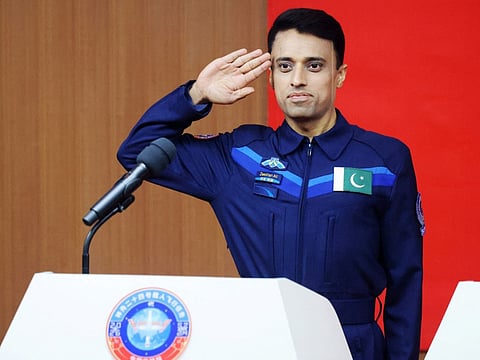
Dubai: Muhammad Zeeshan Ali had spent his career as a Pakistan Air Force pilot. To earn a place aboard a Chinese spacecraft, the 40-year-old wing commander had to learn how to work in weightlessness, respond to emergencies in orbit and communicate with his crewmates in Mandarin.
On Wednesday, November 25, Ali is due to become the first Pakistani to orbit Earth and the first foreign astronaut to visit China’s Tiangong space station. His assignment is to carry out scientific experiments, including research from Pakistani universities, during a stay of about a week.
The mission
The Shenzhou-24 spacecraft is scheduled to lift off aboard a Long March-2F rocket from the Jiuquan Satellite Launch Centre in north-western China at 8.18am Beijing time, 5.18am in Pakistan and 4.18am in the UAE. Ali will fly as a payload specialist alongside mission commander Tang Hongbo and flight engineer Wu Yi. A military pilot
Ali and fellow Pakistani pilot Khurram Daud emerged from three rounds of screening that assessed candidates’ medical fitness, psychological resilience and ability to withstand the forces experienced during launch. The two were selected in April to train in China. Ali secured the seat on Shenzhou-24, with Daud designated as his backup.
At the Astronaut Centre of China in Beijing, Ali trained in spacecraft systems, emergency procedures and the work he would carry out aboard Tiangong. Centrifuge exercises familiarised him with the forces he would feel during launch. Joint drills with the Chinese crew gave him practice handling technical problems and coordinating tasks aboard the spacecraft.
Learning Mandarin
Learning Mandarin was part of that preparation. Ali had to understand the commands and technical terms his crewmates would use during flight. At a pre-launch briefing, he spoke in Mandarin and thanked the Chinese government for helping him realise his ambition of going into space.
Answering a question from CGTN ahead of the launch, Ali described Shenzhou-24 as “not a finish line” but “a launchpad” for China-Pakistan space cooperation. He said he hoped the partnership would grow from one astronaut and one flight to multiple joint missions, eventually reaching the Moon, Mars and beyond.
Ali also spoke about what he would look for when he first saw Earth from orbit. He told his family he would search for the light of home. For children watching from Pakistan, he had a message of his own.
“To every child who is watching while I am in orbit, just look up at the sky and remember that I am up there with your dreams,” he added.
What will Zeeshan Ali do?
Ali will set up equipment and samples, carry out scheduled experiments and take part in routine crew activities. Pakistani universities submitted more than 300 proposals to the Space and Upper Atmosphere Research Commission, or Suparco. Four Pakistani biotechnology experiments were selected, with research relevant to food security and climate change. The mission’s scientific work also includes an experiment involving photosynthetic microorganisms.
His stay will be shorter than the usual six-month rotation for Chinese crews. After about a week, Ali is expected to return aboard Shenzhou-23 with astronauts Lai Ka-ying and Zhang Zhiyuan, who are already on Tiangong. Their crewmate Zhu Yangzhu will remain aboard to complete a year in orbit.
Pakistan’s Namira Salim was the first to reach space in October 2023 on a Virgin Galactic suborbital flight. Ali’s mission will mark the country’s first orbital flight and give Pakistani researchers a chance to see experiments developed in their own laboratories carried out aboard a space station.
New era for space research
Pakistan’s Prime Minister Shehbaz Sharif met Ali and Daud in Islamabad on April 23 after their selection for training. He called the mission a “matter of pride for the entire nation” and said he hoped it would “usher in a new era of space research in Pakistan”. Chinese Ambassador Jiang Zaidong attended the meeting, where Sharif also welcomed the prospect of closer cooperation between the two countries.
That cooperation took shape in February 2025, when Suparco and the China Manned Space Agency signed an agreement to train two Pakistani candidates and send one to Tiangong. The flight takes a partnership that has included work on satellites and space technology into crewed missions. For China, it will be the first time its human spaceflight programme has flown a foreign astronaut.
With inputs from agencies