From mules to machines: How India built the record-breaking Chenab bridge
At 359m high, the bridge is marvel born from grit, cliffs and bold engineering
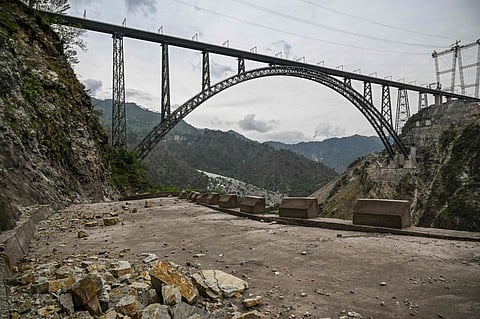
Dubai: In the early days, there were no roads — only cliffs, foot trails, and mules.
Survey teams camped on Himalayan ledges under freezing skies, hauling equipment by hand and hoof, inching toward a dream once thought impossible: Laying railway tracks through one of India’s most unforgiving terrains.
Two decades later, that dream stands realised in steel and stone. The Chenab Bridge, soaring 359 metres above the river it is named after, is now the highest railway bridge in the world — towering 35 metres above the Eiffel Tower in Paris.
It forms the crowning achievement of the Udhampur-Srinagar-Baramulla Rail Link (USBRL), a landmark project that has redefined Indian engineering capabilities.
The bridge was officially inaugurated by Prime Minister Narendra Modi on Friday in Jammu and Kashmir, marking a monumental milestone in Indian infrastructure and engineering.
What makes the Chenab Bridge special?
The 1.31-km-long Chenab bridge project was approved in 2003, and its construction took two decades to complete.
Built at a cost of Rs14.86 billion ($178 million), it is the world’s highest railway bridge.
It is made with 28,660 mega tonnes of steel that can withstand sub-zero temperatures as well as up to 40 degrees.
At 359 metres, it is taller than the Eiffel Tower in Paris by 35 times and is at least five times the height of Qutub Minar.
The government had described it as the “biggest civil-engineering challenge faced by any railway project in India in recent history”.
The bridge can withstand wind speeds up to 266km/hr and strong earthquakes.
Decades of research and consultation were needed to ensure that it was strong enough for train movement and to withstand bad weather.
The bridge has been designed in a way that allows trains to pass through at a low speed even if a pier supporting the structure gets damaged.
The trains can run even in sub-zero temperatures. Its special features allow smooth operations in the extremely cold areas of Jammu and Kashmir. They are equipped with silicon heating pads to prevent water from freezing and bio-toilet tanks.
The trains also come with an auto-draining mechanism and an anti-spall layer that will help loco pilots operate the train safely during bad weather.
Behind this colossal feat is a story of audacity and perseverance — engineers from across the country, many unfamiliar with the Himalayan landscape, battling nature’s fiercest challenges.
Roads did not exist; horses and mules were the lifelines carrying materials through the jagged slopes. Slowly, temporary paths were carved, and eventually permanent access roads stretching 11 km on the north side and 12 km on the south side were constructed to support the massive endeavour, according to The Indian Express.
L Prakash, Chief Engineer of the USBRL project and now Executive Director, recalls those early days: "I knew the Sahyadris well, but here I was, a boy from Mysore, navigating the terrifyingly high and alien Himalayas. We had no roads — only mules and sheer determination to reach the site."
The project’s builder, Afcons Infrastructure Limited, shared insights with The Economic Times about the engineering hurdles overcome. The use of the world’s tallest crossbar cable cranes and specialized heavy machinery was vital. To stabilise the ancient, steep Himalayan slopes, massive consolidation grouting was employed to create sturdy foundations for the massive arch.
Landmark moment
The construction of the arch itself was a landmark moment. Using cantilever techniques, the two halves of the arch were built simultaneously from either side of the river, meeting triumphantly at the crown on April 5, 2021 — a day remembered as a defining success.
Another challenge was the viaduct construction, which involved navigating multiple transition areas with intricate launching sequences carefully planned and executed in four stages. For the first time in Indian Railways, incremental launching was performed on a transition curve combined with a longitudinal gradient — a technical milestone credited to the innovative project team, according to The Economic Times.
Afcons’ Deputy Managing Director Giridhar Rajagopalan emphasized the scale of innovation, while Managing Director S Paramasivan hailed the bridge as a testament to Indian engineering excellence and teamwork:
"This bridge will inspire generations of engineers and stands as a tribute to our commitment to nation-building."
Ensuring quality was paramount. For the first time in Indian Railways history, a National Accreditation Board for Testing and Calibration (NABL) accredited laboratory was established onsite to monitor standards at every stage.
Situated at 359 metres above the Chenab River, the bridge eclipses iconic global landmarks, reshaping India’s connectivity by bridging Kashmir with the rest of the country. This monumental infrastructure is part of the 272-km Udhampur-Srinagar-Baramulla Railway Link, bringing the dream of seamless rail travel from Kashmir to Kanyakumari closer to reality.
This feat is more than an engineering victory — it symbolizes India’s determination to conquer formidable natural challenges with ingenuity, courage, and unmatched skill.

