A taste of diplomacy
Malaysia is the latest Asian nation to follow the win-hearts-with-food policy
The way to a person's heart is truly through his or her stomach. This wise adage holds true even in today's world in which computers and iPads are as ubiquitous as the craving for good food.
Asian diplomats in the United States are discovering that the easiest way to win friends and influence people is through food. American audiences have been treated to culinary delights at parties, cultural events and specialised country-specific food shows. The Malaysian External Trade Development Corporation (Matrade), the trade-promotion arm of Malaysia, has been popularising Malaysian food through its much-publicised Malaysian Kitchen Programme, now in its second year in the US.
Matrade's initiative was started primarily to increase food exports by generating demand for Malaysian foods, ingredients and spices.
However, this initiative has also become a potent weapon in Malaysia's diplomatic arsenal.
Amy Hamidon, the wife of Malaysia's former permanent representative to the United Nations, Hamidon Ali — he recently returned to Malaysia after a six-year stint in New York — tried to popularise Malaysian food at various fora, including the United Nations, where she held a number of food-related events and where, as one American observer told me, "the whole world came to eat". Indeed, Yoo Soon-taek, the wife of UN Secretary-General Ban Ki-moon, was a patron at one event organised by Hamidon's wife at the huge UN dining room.
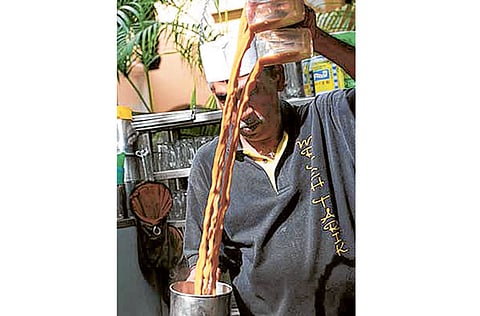
Though it has made a "Johnny-come-lately" entry into the world of food diplomacy, involving the use of food as a vehicle to promote national interests in a foreign land, Malaysia also discovered that serving food could be done in an entertaining way. For example, it recently introduced the teh-tarik to New Yorkers, who watched in sheer delight and curiosity how hot tea can be mixed with sweet condensed milk and poured from a pot into the glass.
Teh-tarik has its origins in the ubiquitous Indian chai and is said to have been brought to Malaysia and other South East Asian countries by Indian immigrants. Teh-tarik literally means "pull tea", as the beverage is prepared by using outstretched hands to pour the piping hot tea from a pot or mug into a glass held in the other hand by the person preparing the tea. Though the tea itself may not always have a huge fan following because of the sweetened condensed milk, the acrobatic manner in which the tea is prepared can be amusing for someone who has never witnessed the teh-tarik spectacle.
"It's not the tea but the acrobatics involved in making it that the tea drinker will always remember," Shalini Manoharan, a Malaysian Tamil housewife who lives outside New York, told Weekend Review.
New York is, of course, the ultimate melting pot not only of races but also of their national cuisines — from Ethiopia and Mauritius through India, China and Japan to France and Italy.
Indeed, the whiff of curry and tandoori chicken floating through the air is as common in New York as the sight of the roasted ducks displayed in the windows of Chinese restaurants.
Most foreign diplomats in New York would almost certainly have had some exposure to food diplomacy because their own country would have, probably, also resorted to it. India, for example, started its food diplomacy many decades ago with sampling of food at Indian events in the US. The Indian samosa (a stuffed pastry, triangular in shape with a savoury filling that may include potatoes, onions, peas, coriander and, alternatively, ground meat or lentils) has, meanwhile, unlocked doors for Indian diplomats and businessmen who have recognised the samosa's attribute as an excellent companion to beverages such as tea and coffee.
Frozen, ready-to-eat samosas along with dosas (a paper-thin crepe-like wrap filled with potatoes and vegetables), naan (bread) and other food products can often be spotted in American supermarkets.
American experts familiar with food used as a diplomatic tool say that diplomacy also operates to convey cultural ideals and values of a country to foreign audiences. Food diplomacy, as an extension, relies on culinary delights to arouse and stimulate the world's appetite, and can bolster a nation's image and create what modern marketers describe as "brand awareness". India, China, Japan, Thailand, etc have reaped the rewards of their food diplomacy.
Malaysia, like other Asian countries, recently also participated in the LuckyRice Festival's night market in Brooklyn, New York. India is starting outreach campaigns such as the India Calling event in Los Angeles or the Maximum India Festival held in Washington DC to introduce global audiences to the cultural reality of Asia's third strongest economy.
"Food is a universal language. Even the most disciplined person can succumb to the sights and smells of good food. You can make lasting friends with good food," says a Filipino diplomat who prefers to remain anonymous.
Thailand has effectively used food diplomacy as part of its foreign policy. Thai food diplomacy takes a front-stage position at all kinds of events, including industry trade shows where food becomes, invariably, part of anything that Thailand has to offer — ranging from tourism holidays through automotive parts and components to textiles, jewellery and precious stones.
"Food has a unique gift to convey cultural sentiments and even change public opinion and perceptions, provided the food is of good quality and is presented elegantly," says Kate Andrews, an English food aficionado, on a visit to a food show in New York.
Manik Mehta is a commentator on Asian affairs.


