A rare 'thank you' to the media from the Trump administration
News teams who knew about Saturday's strike credited for not putting mission in jeopardy
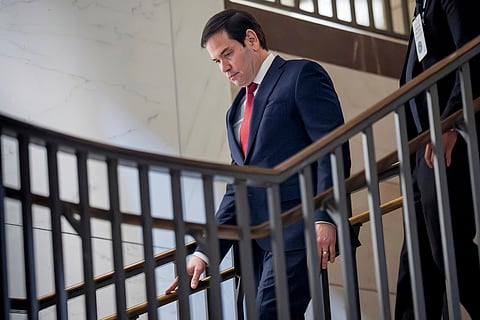
In the wake of last weekend's U.S. military action in Venezuela, the news media got something it has seldom heard from the Trump administration: a “thank you.”
Secretary of State Marco Rubio credited news organisations that had learned in advance about last Saturday's strike that led to the capture of Venezuelan President Nicolás Maduro with not putting the mission in jeopardy by publicly reporting on it before it happened.
Rubio's acknowledgment was particularly noteworthy because Defense Secretary Pete Hegseth has cited a mistrust of journalists' ability to responsibly handle sensitive information as one of the chief reasons for imposing restrictive new press rules on Pentagon reporters.
Most mainstream news organisations have left posts in the Pentagon rather than agree to Hegseth's policy.
Speaking on ABC's “This Week” on Sunday, Rubio said the administration withheld information about the mission from Congress ahead of time because “it will leak. It's as simple as that.” But the primary reason was operational security, he said.
“Frankly, a number of media outlets had gotten leaks that this was coming and held it for that very reason,” Rubio said. “And we thank them for doing that or lives could have been lost. American lives.”
Advance word got out
Semafor, citing “people familiar with communications between the administration and news organizations,” reported that The New York Times and The Washington Post had both learned of the raid in advance but held off reporting on it to avoid endangering U.S. military personnel.
Representatives for both outlets declined comment to The Associated Press on Monday.
Withholding information on a planned mission for that reason is routine for news organisations, said Dana Priest, a longtime national security reporter at the Post who now teaches at the University of Maryland.
Even after the fact, the Post has asked government authorities about whether revealing certain details could endanger people, she said.
Pre-dawn attack
When The Atlantic magazine editor Jeffrey Goldberg was inadvertently included in a text chain last spring where Hegseth revealed information about a military attack in Yemen, the journalist did not report on the events until well after US personnel was out of danger and the information had been thoroughly checked out.
Most Americans learned of the Venezuela attack in the predawn hours of Saturday when President Donald Trump announced it on his Truth Social platform upon completion.
While The Associated Press did not have advance word that the operation would happen, its journalists in Venezuela heard and observed explosions taking place there, and that was reported on the news wire more than two hours before Trump's announcement.
The US involvement was not made clear until Trump's post, however.
Decisions on publication have many dimensions
Hegseth, in defending rules that restrict reporters' movements and reporting in the Pentagon, told Fox News last year that “we have expectations that you're not soliciting classified or sensitive information.” The Times last month filed a lawsuit seeking to overturn the rules.
Decisions on whether to report information that could put lives or a mission in danger often involve high-level discussions between editors and government officials.
But Priest stressed that in a country with freedom of the press, the ultimate decision on whether to report the information lies with the news organisation.
The reporters are not going to be deterred by a ridiculously broad censorship edict by the Trump administration.Dana Priest, University of Maryland
Generations ago, President John F. Kennedy persuaded editors at the Times not to report when it learned in advance of a US-backed attack by Cuban exiles on Fidel Castro’s forces at the Bay of Pigs in Cuba.
The mission proved a monumental failure and a Times editor, Bill Keller, later said that Kennedy expressed regret that the newspaper had not reported on what it had known because it could have prevented a fiasco.
Many mainstream journalists covering the military and national security have extensive experience dealing with sensitive issues, Priest said.
But there's a difference, she said, between reporting information that could put someone in danger and that which could prove embarrassing to an administration.
“The reporters are not going to be deterred by a ridiculously broad censorship edict by the Trump administration,” Priest said. “They're going to dig in and work even harder. Their mission is not to curry favour with the Trump administration. It's to report information to the public.”


