Meet the Emirati inventor honoured by Sheikh Mohammed at 15, now building AI in the UAE
From early recognition to AI innovation, her journey reflects UAE ambition
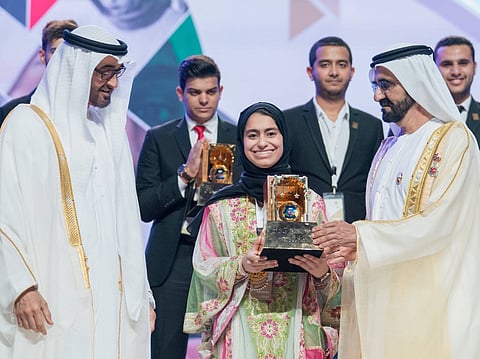
Dubai: At 15, Fatima Alkaabi was recognised by Sheikh Mohammed bin Rashid Al Maktoum as the UAE’s youngest Emirati inventor. Within a few years, she was invited to a majlis with Sheikh Mohamed bin Zayed Al Nahyan, where they spoke about her projects and what she planned to do next.
At 24, Alkaabi is now co-founder of AiEmirati, a platform working on how artificial intelligence understands Emirati culture. The problem she is focused on is specific. If a system is trained on incomplete or inaccurate data about a culture, the output reflects that gap.
Get updated faster and for FREE: Download the Gulf News app now - simply click here.
Where it all began
Her interest in technology started at home in Al Ain. She spent her childhood fixing toys, opening up devices and trying to understand how they worked.
She repaired the television for her grandmother. She fixed broken items for her sisters. That hands-on approach came before any formal training.
In 2010, she joined a summer programme for gifted students. A robotics workshop there introduced her to building something from scratch.
“I built my first project there, a photographer robot that could take photos of my friends and me,” she said. “Only later did I realise that what I had built was actually an invention.”
Over the next few years, she developed 12 inventions. Each one came from observing a problem and trying to fix it.
Moving beyond experiments
Her early work included projects like a robotic cheerleader built for the UAE national football team. Later projects moved towards solving real-world challenges.
She developed a Braille printer that uses voice commands, aimed at helping visually impaired users access written material more easily. Another project focused on road safety, with a smart steering system designed to reduce distracted driving by preventing texting at the wheel.
She also built what she describes as a telepresence robot, allowing children who are unwell to attend school remotely and remain socially connected to their classmates.
“Each invention started from observing a real problem and asking how I could fix it,” she said.
Recognition, then direction
Being recognised early brought visibility, but it also changed expectations.
“That recognition was a turning point because it validated that young people can contribute meaningfully to society,” she said.
A more defining moment came in 2018, when she was invited to Sheikh Mohamed bin Zayed Al Nahyan’s majlis.
“What struck me most was that His Highness dedicated more than an hour to sit with me and discuss my projects, my aspirations, and my future plans. He asked specific technical questions. We debated ideas. It did not feel ceremonial. It felt real,” she said.
The discussion revolved around specifics, including what she should study and where her work could go.
“In 2018, before artificial intelligence became the major global focus it is today, His Highness encouraged me to specialise in my technical field, to study abroad, and to explore AI,” she said.
That advice influenced her academic decisions.
Studying abroad
She went on to study computer engineering at Virginia Tech in the United States.
The experience was not limited to academics. Living alone and adjusting to a different environment forced her to become independent quickly.
“Living alone in a different country expanded my perspective. It allowed me to understand technology on a global level while deepening my appreciation for my roots and identity as an Emirati,” she said.
Exposure to different systems and approaches to engineering helped her understand how technology is built at scale.
Identifying a gap in AI
The idea behind AiEmirati came from testing existing AI tools.
During her time at CNN Academy, where she met her co-founder Elizaveta Vartanian, she began asking simple questions to widely used AI systems about UAE heritage.
“We tested popular AI models and asked them about UAE heritage. The results were inconsistent and sometimes inaccurate,” she said.
That pointed to a larger issue. AI systems are trained on available data. If a culture is not properly represented in that data, the system will not represent it correctly.
She and her co-founder began sharing their findings publicly through social media, using deepfake videos and AI-generated content to demonstrate how easily perception can be shaped.
“That reaction confirmed something important. We must proactively shape how AI understands our culture,” she said.
From experiments to a working platform
AiEmirati was formally set up in late 2025. It now operates as a studio and lab focused on building projects that connect Emirati heritage with modern technology.
Its work includes interactive installations, research and content development.
One of its first public projects, presented at the Sharjah Entrepreneurship Festival 2026, was based on an Emirati proverb. Visitors knocked on a physical door and received a response in the form of Emirati wisdom.
“It demonstrated that culture should not remain static in archives. It should be interactive, living, and evolving,” she said.
What she is working towards
Her current focus is on building AiEmirati into a long-term platform while continuing to develop her expertise in artificial intelligence.
She is also working with local entities and private companies on projects that combine technology and heritage in practical ways.
Alongside that, she spends time speaking to students and younger audiences.
“If I started at 10 years old, there are thousands of children today who can start even earlier, especially with the tools available now,” she said.
Her advice for young innovators is to always “stay curious.”