From old Dubai icons to the newest openings
Inside the season when old favourites and debutantes share Dubai’s table
Dubai doesn't sit still with its restaurants any more than it does with its skyline. This season, the story is less about new versus old and more about how comfortably the two now share a table: a trattoria reopening exactly as it left off, a rooftop newcomer borrowing its mood from 1960s Hong Kong, and a fleet of old-guard names rewriting their weekly rituals so regulars have a reason to keep coming back. Here is where the city is eating.
Get updated faster and for FREE: Download the Gulf News app now - simply click here.
The Establishment
Scalini Dubai
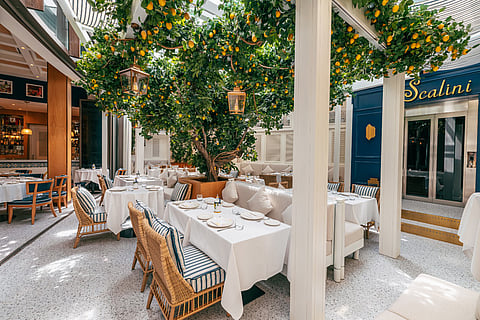
Scalini Dubai hardly needs introducing to anyone who has spent a decade eating their way along Sheikh Zayed Road, but as of this September, it earnt a second look. The beloved trattoria has reopened after a full renovation, and to its credit, nothing of its old warmth has been sacrificed for the refresh. What's changed is the register: a more Mediterranean design language, all blue-and-yellow tonework, striped fabrics and a veranda that borrows its shade and citrus trees from the Amalfi Coast. Executive Chef Francesco Cortorillo's menu keeps faith with the ingredient-forward Sicilian tradition - a red prawn crudo bright with white grape vinegar, a tableside beef tartare, a Nerano-style linguine finished with fried zucchini and Provolone del Monaco. Same soul, sharper edit, and we can’t get enough of it.
Zuma Dubai
Zuma Dubai is less a restaurant at this point than a weekly appointment system for the city's professional class. The Ebisu Business Lunch handles the weekday negotiation-over-miso-soup crowd; Saturday's Baikingu Brunch turns the volume up considerably, with the full robata and sushi repertoire plus a dedicated dessert room; and Yashoku carries things into the evening, when dinner tips gracefully into something closer to a night out. Eighteen years in, its contemporary Japanese cooking still holds its nerve, and doesn’t seem to be slipping off a must-visit list anytime soon.
Coya Dubai
COYA Dubai, on the beach at Four Seasons Resort Jumeirah Beach, has a menu that has barely dated (thankfully): smashed guacamole, citrus-sharp ceviches, a Chilean sea bass rice that remains the table's unofficial centre of gravity. The Pisco Bar does the heavier cultural lifting, this year via The Spirits of Peru: Madre Tierra, a cocktail programme that traces the country's geography from Amazon rainforest to Andean peak. Saturday brunch and the Wednesday-and-Sunday Azúcar Nights still anchor its social calendar.
Jamavar Dubai
Jamavar Dubai, tucked into Address Residences Downtown, has built its reputation on regal, formal Indian cooking - but its most affecting moment each year is Leelamma's Onam Sadhya, a banana-leaf feast named for the late matriarch of the restaurant's founding family. This year's run has closed for the season, but it's worth flagging ahead of 2027: a nearly twenty-dish Keralan spread, curated by Culinary Director Chef Surender Mohan, that is less like a promotional menu and more like an act of family memory.
Mimi Kakushi
Mimi Kakushi treats its Weekend Brunch (Saturday and Sunday, midday to four) as one of the more transportive options in the city - sushi and maki, wagyu tataki, miso black cod, all set to a live DJ inside a room built around 1920s Osaka jazz-bar theatrics. The kitchen has spent this year testing the format's edges too, with a rosé collaboration with Roseblood and a preview brunch built around a Japanese close-up magician - evidence of a team with no intention of letting the format calcify.
The Debutantes
Gymkhana Dubai
Gymkhana is, by most measures, the single biggest name to land in Dubai this season. The two-Michelin-starred London institution - a fixture on Mayfair's Albemarle Street since 2013, and a two-star kitchen since 2024 - opened its first UAE outpost in the first week of September at Gate Village, DIFC, following earlier expansions to Riyadh and Las Vegas. The Dubai room spans two levels plus a terrace, seating 137 across lantern-lit dining areas upstairs and a mirrored, chandeliered lower level anchored by a peacock bar, all drawing on the aesthetic of colonial-era Indian social clubs. The menu carries over London signatures - aloo chaat, tandoori masala lamb chops, kid goat methi keema, chicken butter masala - across chaat-style sharing plates, tandoori specialities, curries and biryanis, alongside dishes created specifically for Dubai. If you love Indian food, this restaurant does it like no other.
Yù & Mì
Yù & Mì, which opened in January inside Mandarin Oriental Downtown Dubai's Wasl Tower on Sheikh Zayed Road, is arguably the most ambitious concept the city has seen open this year. Perched on the 36th floor, it splits neatly in two: a moody, tea-and-baijiu-driven cocktail bar modelled on 1960s Hong Kong speakeasy culture, giving way to a Cantonese-and-Sichuan dining room built around tableside Peking duck, king crab xiao long bao and dim sum trolleys. Executive Chinese Chef Yang Guojian leads the kitchen, with Dim Sum Head Chef Jade Lee - formerly of Mandarin Oriental Kuala Lumpur and Jakarta - overseeing a dumpling programme with genuine pedigree behind it.
Rocambolesco
Rocambolesco is due to open this September 25 in Uptown Dubai, and it's shaping up to be one of the season's more playful Italian arrivals. Spread across two floors - a ground-level dining room, terrace and bar, with a more intimate first-floor dinner space to follow later in the year - the concept is built around la convivialità, the Italian idea of shared plates and long, unhurried meals. The kitchen is led by Executive Chef Luigi Stinga, a MICHELIN Guide Abu Dhabi Young Chef Award recipient who spent five years at Talea by Antonio Guida, reworking Italian classics with a contemporary edge.
MiMi Mei Fair Dubai
MiMi Mei Fair Dubai brought its Mayfair original to the Opera District late last year, recast as the fictional private residence of "Empress MiMi." The design does most of the talking: a marble mosaic foyer nodding to Beijing's Forbidden Palace, an intimate twelve-seat Peacock Room lined in hand-painted silk chinoiserie, a Film Noir-styled Moon Bar drawn from Chinese folklore. This is less a restaurant launch than a fully art-directed set - worth the visit for the room alone, whatever lands on the plate.
Old Favourites, New Rituals
Not every worthwhile addition to the city's dining calendar is a new restaurant. Sometimes it's simply a new way in.
ROKA Dubai
ROKA Dubai has introduced an all-day Teishoku Set Menu at its Business Bay address, giving guests a curated route through the robatayaki repertoire without the usual à la carte negotiation. The Classic, at AED 125, moves through gyoza and tempura starters into a choice of mains - salmon teriyaki, cedar-roasted baby chicken; the Premium, at AED 180, steps up to sashimi moriawase and a choice between lamb cutlets and yuzu miso black cod. A sensible, value-minded entry point into a menu that can otherwise feel like a lot to navigate alone.
The MAINE JBR
The MAINE, JBR has gone considerably bigger with OVERBOARD, its new all-you-can-eat, all-you-can-drink brunch, running Saturday and Sunday across two sittings. There's a raw bar stacked with tartare, ceviche and poached crab claws; a stone-fired pizza station; pasta tossed to order over a Parmesan wheel; a carvery turning out côte de boeuf and truffle spatchcock chicken, the whole production backed by a four-hour open bar. Beyond the brunch itself, the restaurant's daily Shuck Fest (AED 10 oysters, four to eight) and Golden Hour two-for-one deserve a weekday visit of their own.
Sexy Fish Dubai
Sexy Fish Dubai has extended its signature More Than Brunch into a Thursday night edition -
part share-style dinner, part nightlife hybrid, running from seven until close, with three tiered drinks packages and a late-night Candy Room opening at eleven. A format built explicitly to bridge dinner and the club, for guests uninterested in changing venues mid-evening.
Akira Back
Akira Back, the Michelin-recognised Japanese restaurant at W Dubai - The Palm, has introduced Back at Six, a three-course early-evening menu running Tuesday to Friday. It's a considered way to catch Chef Akira Back's signatures - miso black cod, the 48-hour short rib - at a gentler hour and a gentler price than the full à la carte experience commands.
On Our Radar
Commodore Club
Commodore Club at Jumeirah Marsa Al Arab leans further into its marina setting with a limited-edition Summer Menu that evolves monthly alongside the core à la carte - currently running a watermelon ceviche and a sharing chicken paella.
Sakhalin Dubai
Sakhalin Dubai, the J1 beachfront seafood destination from Boris Zarkov and Michelin-starred chef Vladimir Mukhin, is one of the city's more genuinely distinctive concepts: a MediterrAsian menu with Russian undertones, built around an ice market, raw bar and open-kitchen theatre.
Barrafina Dubai
Barrafina, the cult London tapas counter, made its first-ever international move to DIFC's Gate Village back in January - an intimate 55-seat room built around an open-theatre kitchen, serving the brand's signature tortilla and gambas rojas alongside Dubai-exclusive dishes like Galician dry-aged beef. Long enough open now to have settled into its rhythm, but the counter-dining format still makes it one of the district's more theatrical bookings.


