Fatima AlBanawi on grief, legacy and the power of storytelling
Fatima AlBanawi’s craft and her observations on life have a way of sticking in the mind
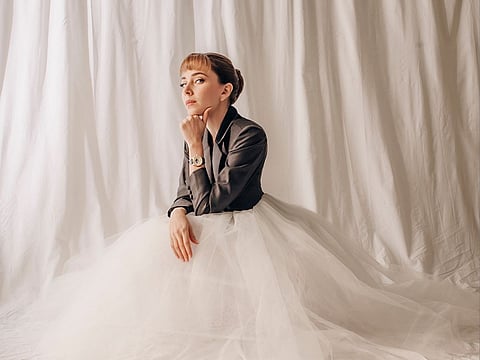
Even in life’s most difficult moments, Fatima AlBanawi never loses her passion for storytelling. On screen, she appears effortlessly elegant, dressed in a sharp power suit, her hair swept back in a sleek knot. And even through a subtle veil of sadness, one can catch that familiar glimmer in her eyes.
“Thank you for being here” I say softly, offering my condolences for the recent loss of her grandmother. The Saudi filmmaker and actress behaves as she always does. She is poised, present, and ready to share the kind of stories that will linger in the hearts and souls of her listeners. Sustained by memories of the woman who helped shape her into who she is—her beloved sitoo (meaning grandma in Arabic)—Fatima carries her grief with her usual grace and has lots to say.
She sighs as she reflects on her recent experience. “Subhan Allah, she says (meaning God’s wisdom) is incredible. When you lose someone, you suddenly start looking at their life in terms of legacy, and you realise just how rich it really was.” Having experienced loss myself, I can instantly relate to this sentiment. It is a humbling, eye-opening moment when life brings you down to earth in its own way, closer to the essence of things. “You start seeing how multi-layered human beings are,” she adds. “The ebb and flow of joy and difficulty, of beautiful memories and of painful ones. It really opens your eyes to how profound individuals are across a lifetime.”
And only in the quiet that follows the loss of a dear one, do we truly understand the depth of their influence—an experience Fatima personally lived through, as she spent the days after her grandmother’s passing immersed in photo albums spanning decades. “Arranging those albums became a way of healing,” she says.
Each photo carried a memory, a scene, a moment frozen in time. But what captivated her most, she tells me with her characteristic warm enthusiasm, was realising that these albums had unconsciously inspired the mood board of the cover shoot that we had done earlier.
“Now that I think about it, the hairstyle, the elegance, the quiet strength—it looks exactly like my grandmother in her youth,” she smiles. “The whole shoot feels like her. A replica of her old photos.”
It’s true, that shoot felt exceptional in many ways. One thing that made it special was that she brought her nephew, Eissa Hafiz, on board—another young Saudi talent destined to leave his mark on the Kingdom’s filmmaking scene. The actor and producer, who began performing on stage at the age of seven, was clearly on the path to success alongside his aunt in the world of cinema.
“During my first international film festival in Berlin—when I attended the world premiere of my feature film, Barakah Meets Barakah—he kept calling me to ensure I took a photo with Meryl Streep. When I didn’t, he jokingly told me I needed to appoint him as my manager.”
When life unfolds like cinematic memories, there are moments that feel suspended in time, scenes we return to again and again. For Fatima, these are the moments that linger, marking a transition.
“I return to those moments of transition a lot: moving cities, graduating, returning home, opening my company, my first day on a film set, meeting someone special, or even simple conversations that stay with me for years.”
In many ways, her life and work have mirrored each other. They share the same lens of curiosity about people, places, and the sensory textures of the world around us—a perspective that resonates deeply with the theme of the issue: Life As Cinematography.
“I observe life the way I observe a scene on the screen,” she says. “Not just in a romanticised way, but also in a human way. I pay attention to people’s gestures, their silences, their contradictions, and the stories that lie behind everyday moments.”
Fatima’s background in psychology undoubtedly trained her to look closely and to observe deeply, though she recalls that this attentiveness was innate, present even in her childhood. Perhaps that’s why she chose the path of cinema, both academically and professionally.
“Cinema gave me the language to express what I see,” she fondly reflects. “What I love about cinematography is that it is capable of reshaping life in many ways: sharp and edgy at times, at others cosy and harmonious.”
Fatima’s passion for storytelling—whether through writing, filmmaking or acting—didn’t result from a sudden flash of inspiration. It developed gradually. Growing up, she was immersed in the stories her parents told, which drew upon her roots in Jeddah and sparked her love of storytelling.
“Their travels, their education, their hopes, even their journeys taught me a lot. Perhaps that was what inspired my desire to get to know humans more closely. Studying psychology, during my research at Harvard, I kept noticing that everything I cared about came back to people’s stories, how they tell them, how they hide them, and how they carry them.”
“You can’t create resonance if you don’t start from a place of truth,” she affirms. “For me, that means being willing to ask uncomfortable questions, look at one’s own blind spots, and understand the emotional reality of characters, instead of projecting onto them. Also, drama, drama, drama.”
Perhaps what gives her work that emotional and psychological depth is her honesty. When she started The Other Story project, it soon became clear that storytelling wasn’t something she wanted to do ‘on the side’. It was the core of who she was and the tool through which she could make a meaningful contribution.
“When I saw how people responded to The Other Story, I felt a sense of mission. What started as a creative experiment became a space where people trusted me with their truth. That responsibility shifted something in me. It gave me the courage to make a film like Basma as my directorial debut.”
Since then, that sense of mission has continued to guide the choices Fatima makes. Creatively, it pushes her toward stories that open conversations and reflect people’s real experiences. “Personally, it keeps me grounded in my intentions, in why I choose certain roles, why I write about specific themes, and why I approach my work with empathy and curiosity,” she says.
That moment made Fatima realise that she could turn storytelling into a career, freeing herself from the repeated question: What do you enjoy most, acting or writing or directing?
“I want to tell a good story, and I will do whatever I can to tell that story at any given time, regardless of the role I play.”
Despite wearing many hats—actress, filmmaker, writer and artist—those who follow Fatima on social media might recall that she described herself as a “Contemporary Storyteller” in her bio a decade ago. That was long before she became so multifaceted. At the time, she was focused solely on acting. “I believe I was speaking about my purpose more than my role, and this is why I feel at ease switching hats and shifting gears.”
This sense of purpose has also guided her collaborations with luxury brands. She approaches them in the same way she approaches her craft—intentionally, thoughtfully, and always through the lens of narrative.
“I make it a priority to explore the story behind a brand and the narrative they want to share with the world,” she says. “It’s essential for any partnership that there’s an alignment in values, vision, and the type of narrative each aims to convey.”
This is evident in her recent collaboration with Montblanc: “We share a similar outlook on life. I believe purpose breathes life into everything I do, whether I’m writing, directing, or growing personally. Montblanc’s commitment to writing, legacy, and personal journeys reflects that same ethos.”
For Fatima, these collaborations aren’t about glamour; they are rooted in creativity, discipline, and the undeniable power of stories, making them a natural extension of her values.
Halfway through our conversation, when I pause to admire the wallpaper behind her, Fatima decides to give me a spontaneous 360° tour. She tilts her screen with a smile to reveal her “little office”, displaying that amiable playfulness the young woman never loses, even in moments touched with sadness. I catch a virtual glimpse of her beautiful paintings hanging on the walls. “I do paint sometimes,” she says, casually, before showing me the antique desk that belonged to her great-grandfather, worn smooth by the generations. “This is what I call vintage!” she laughs. Then she points to a wall adorned with the whimsical tote-bags she has collected over the years.
This small glimpse into Fatima’s world —playful, curious, and rooted in memory— reveals the instinctive pull towards storytelling. And it makes me wonder: does this young woman, who grew up in a country (and a region) that is still emerging in terms of female creative expression, have her own story?
“Engaging with other people’s lives and reflecting on my own have given me clarity, empathy, and a space where I can feel grounded and present.”
Fatima reveals that storytelling has also been a healing process. “It’s amazing to carve out a path that no one has been on before, but your role as a pioneer only works if you can continue on the path you’ve carved out, and that takes resilience, patience, and creativity.”
Recognised as a Next Generation Leader, Fatima is a true trailblazer in her field, someone who broke the glass ceiling at a time when women who were brimming with talent and creativity faced great challenges and were hindered by obstacles. Today, the increased visibility of women in the creative sector has opened doors and expanded the freedom available to Fatima and many others on their storytelling journeys.
“The growing visibility of women in the creative sector has empowered me to pursue stories that resonate with me and provided a supportive network during moments of doubt or frustration. I feel less alone today, “ Fatima affirms. “When I began, the opportunities were so scarce. Now, I can explore new themes, take creative risks, and share authentic stories with confidence, knowing that there is an audience that will value them.”
The Saudi film industry has made significant strides, yet Fatima believes countless stories and perspectives remain unexplored. She tells me that one of her proudest moments was being on the set of her directorial debut film, Basma, where the majority of the crew were women working across all departments.
“I can now reflect on what once was a challenge with humour instead of a sense of tragedy. It’s so liberating to grow in experience, or maybe it’s just liberating to grow older. Everything seems light and fun.”
Perhaps for Fatima, Barakah Meets Barakah was the breakthrough. Premiering at the Berlin International Film Festival, it was one of the first Saudi films to gain international recognition. “That was a groundbreaking film for its time, unlike anything that had been done before in Saudi Arabia or the region,” she says.
Those who saw the film will recall how it introduced a fresh, contemporary perspective on Saudi society, its culture and its young people, at a time when more than 70% of the population was below the age of thirty.
“It opened doors for Saudi stories to resonate locally and globally and helped establish a space for new voices and narratives in Saudi Arabia, as well as other regional cinema. Much stronger ones are in the offing.”
If there was nothing more to do, then it would feel like the end for Fatima, but her passion races far beyond the horizons of ambition and her creativity seems inexhaustible.
“The Saudi film industry has grown a lot in recent years, but there are still stories that need to be told, and perspectives that haven’t been explored,” she says.
For the moment, we can only guess what else will appear on her horizon.


